Copper Roofing Nails for Slate and Copper Roofs
A Boston slate roofer on copper roofing nails: how slating nails differ from flashing nails, the right gauge for slate and why galvanized falls short.
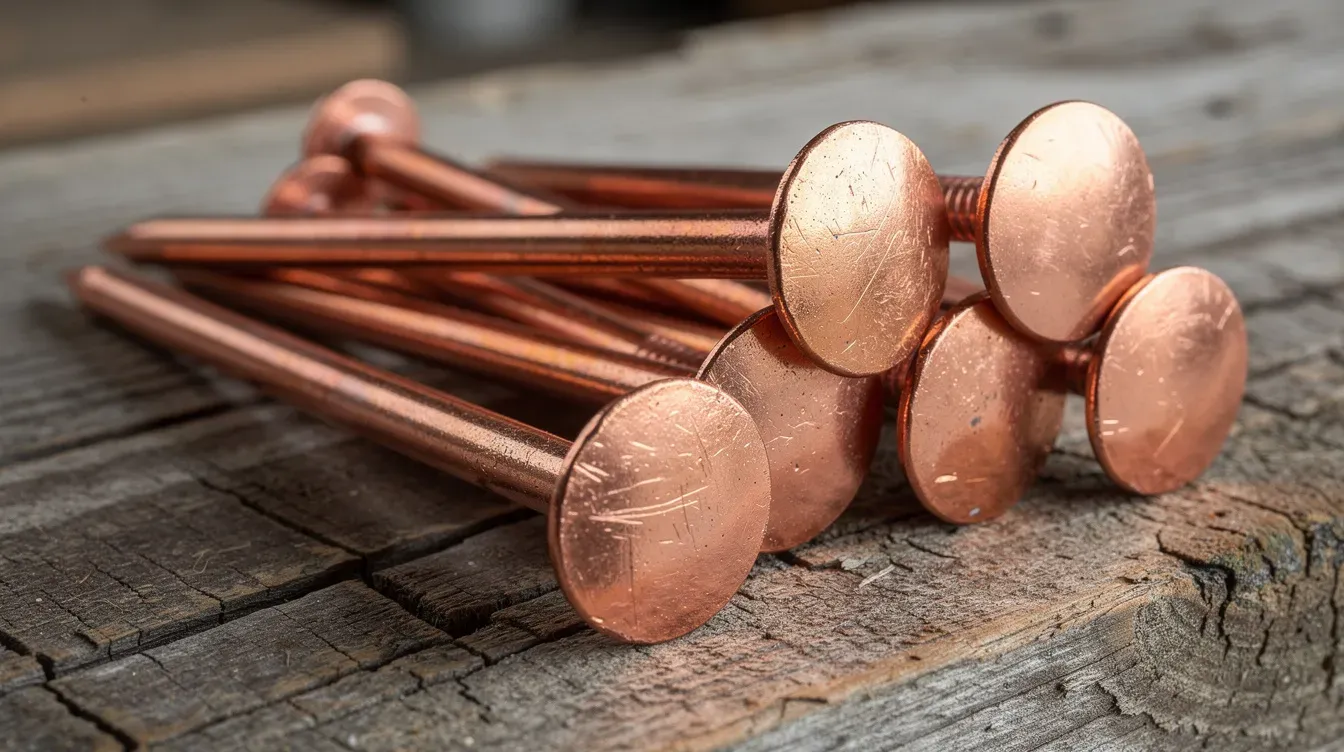
TL;DR: Copper roofing nails are the standard for slate. They don't rust and they last about as long as the slate. Use solid copper with a smooth shank and a wide flat head. 11 gauge is standard, and 10 gauge suits hard decks or long nails. Nail length is twice the slate thickness plus 1 inch, with at least 3/4 inch into the deck. Galvanized nails rust in time. Copper flashing needs copper nails to avoid galvanic corrosion. Copper panels go on with cleats, not face nails.
Copper · 9 min read
Nails are the cheapest thing on a slate roof. They’re also the part that decides when the roof comes apart. A slate can sit on a roof for well over a century, and if the nail under it rusts through in thirty years, the slate slides out anyway.
So copper roofing nails are the standard on good slate work. Below I’ll go through the kinds you’ll see, how long they need to be, how they compare to galvanized nails, and what to look for if you ever buy a box yourself. We don’t sell nails. But I get asked about them a lot, so I figured I’d share what I know. Also, a quote that lists the wrong ones tells you something about the roofer.
What Copper Roofing Nails Are For
A slate roof is hung, not glued. Each slate gets two nails through pre-punched holes near the top. The course above covers those nails, so you never see them once the roof is done.
It doesn’t rust. A copper nail is nearly pure metal, soft enough to bend a little as the roof moves. Its corrosion resistance against salt air and freeze-thaw is the reason for its durability. Copper nails commonly last 75 to 100 years or more. That’s close to the slate itself, since a good slate roof runs 75 to 150 years.
The soft metal also makes repairs easy. When a slate breaks, a slater slides a ripper under it and cuts the copper nails. That frees the broken slate without disturbing the ones around it. A steel nail fights you on that.
Copper Slate Roofing Nails and Flashing Nails
Copper slate roofing nails, or slating nails, have a fat flat head, usually 3/8 inch across. That head diameter’s the whole point. It spreads the load so the nail grips the slate and doesn’t crack it. Same nails work on clay tile.
Flashing nails are skinnier, with a little head you can hide. You’d use those on copper flashing and the light copper bits where a fat head looks dumb or won’t fit. Some companies sell one nail for both jobs. Read the label.
Either kind comes smooth or ringed. You buy them loose, by weight.
Solid Copper Means the Whole Nail
Solid copper means copper all the way through. There are plated steel nails too, and in the box you can’t tell. Drive one and the plating scrapes off. Then it rusts, sometimes in a couple of years.
So check the package for the words solid copper. No words, no copper. Quality products say it plainly.
Smooth Shank Beats Ring Shank on Slate
Slaters have used smooth nails forever. The slate association spec starts from smooth copper and says ring shank usually isn’t needed. Sure, ring shank grips harder. Sounds great until you’ve got to pull one.
Here is the catch, and anyone who has done slate repair on an old house in Somerville or Brookline in the middle of winter has run into it more than once: a ring shank nail is a pain to cut out during a repair, and you’re more likely to crack the slates next to it.
Most have a diamond point. Starts clean in the wood, so they drive with ease.
Which Gauge to Get
You’ll run into two gauges. The SRCA standard says 11 gauge minimum, about 0.120 inch. On hard decks thin nails bend, so guys go to 10 gauge, and the SRCA wants 10 gauge on any copper nail 2-1/2” or longer.
Both are common, and I don’t lose sleep over which one shows up as long as it’s solid copper and the right length for the slate. One big brand’s 1-1/2” smooth shank copper nail, the kind sold in a 1 lb pack at home centers, is 11 gauge. Others make the same length in 10 gauge. Neither is wrong for standard slate.
How Long Roofing Nails Need to Be
The rule is twice the slate thickness plus 1 inch. The nail needs adequate penetration into sound timber, at least 3/4 inch into the sheathing, and it shouldn’t poke more than about 1/4 inch out the underside. The SRCA lists these lengths for a deck 1 inch or thicker:
- 3/16 to 1/4 inch slate: 1-1/2” nails
- 3/8 inch slate: 1-3/4” nails
- 1/2 inch slate: 2” nails
- 3/4 inch slate: 2-1/2” nails
- 1 inch slate: 3” nails
Go short and they pull out. Go long and the points stick through under the eaves where everyone can see them. Lots of old Boston houses have board decks under an inch thick, so we check first and choose the length after.
Nailing matters just as much. The head should sit snug, not driven hard into the slate. Too much hammer force cracks the slate or deforms the soft copper. Hang it a hair loose and it hangs right.
Copper Nails Next to Galvanized Nails and Other Materials
Galvanized nails cost less, and the zinc coating does slow rust. But it doesn’t stop it. How long they last varies a lot with the coating and the exposure, and figures of 15 to 30 years are often quoted. The National Slate Association’s spec says galvanized nails aren’t recommended except for short-term repair. That’s much less than a slate roof’s life.
When a galvanized nail rusts through, the slate drops. And rust can stain whatever is below it.
Aluminum is a bad pick near treated lumber. Copper-based wood preservatives can corrode aluminum fasteners quickly. Stainless steel in Type 304 or Type 316 is an accepted alternative, especially on hard decks. It’s harder to cut during repairs, though.
There’s one more small benefit. Copper ions in runoff discourage moss and algae, so you may see a bit less growth near copper. A nail head is small. Don’t count on it to keep a whole roof clean.

Nails and Copper Flashing on the Same Roof
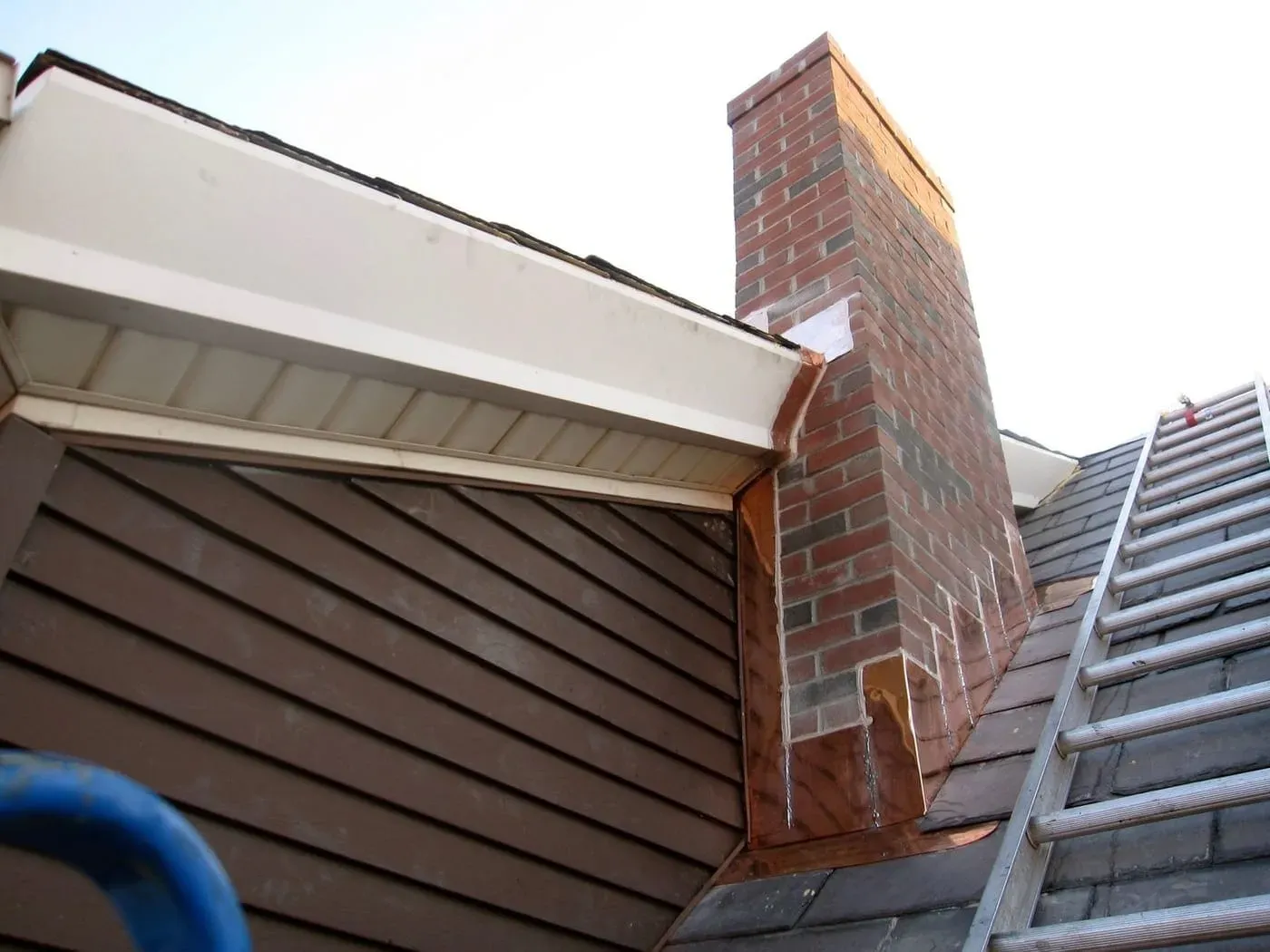
Copper flashing goes in the valleys and around every chimney and dormer wall. It prevents rust stains and leaks at those joints and helps the roof last longer. And it needs copper fasteners.
Mixing metals causes galvanic corrosion. Put a steel nail in copper flashing and the steel corrodes fast where the two touch, especially when they’re wet. Copper on copper avoids that. So material compatibility matters everywhere on the roof. Gutters and hangers count too. Our copper snow guards go on with copper for the same reason.
On chimneys we fasten step flashing to the roof deck and never to the brick. A chimney moves on its own schedule. The chimney flashing repair post walks through that.
Copper Roofing Panels Get Fastened Differently
On copper roofing panels, like standing seam, you avoid face-nailing. Copper expands and shrinks a lot between a summer afternoon and a January night. Nail straight through a panel and it can’t move. It buckles, or it tears at the nail.
Instead the panels are held with copper cleats hidden in the seams, and the cleats are nailed down. That leaves room for thermal movement. A copper roof done this way lasts 80 to 100 years or more. Our copper metal roof post goes into the details.
Also, copper sheet isn’t sold by gauge. You’ll see 16 oz or 20 oz copper, which is weight per square foot. A spec that says “24 gauge copper” is mixing it up with steel. Nail gauge is a separate number again.
Buying Copper Nails by the 1 lb Box
Copper nails are sold by the pound, usually in a 1 lb box for small repairs. For bigger work there are 5 lb and 25 lb boxes. The count per pound drops as length goes up. Catalogs show about 155 per pound for 11 gauge at 1-1/2”, and roughly 130 for 10 gauge at the same length.
At a store or online, the product page should list solid copper, the gauge, the length in inches, and the shank type. If one is missing, don’t add it to your cart. Shipping and delivery times vary, so if you’re doing a repair, order before the roof’s open. Plenty of good ones are made in the USA. Check the ship date before you purchase, too.
A lot of customers read the most recent reviews before checkout. That helps. But a five-star review saying “great product” won’t tell you the gauge. That information is needed before you buy, not after.
Is a Lower Price Nail Worth It
A lower price nail saves a little on a small part of the job. Copper costs more per pound than galvanized, and it’s still a tiny part of what a slate roof costs. Labor is the big number.
Think about what gets replaced later, because that’s where the real money goes when a fastener gives out twenty or thirty years too early on a roof that was supposed to outlive everyone who paid for it. If the nails fail early, the slates come off and the roof is redone. That’s a lot of risk for a small saving. I’d rather spend it once.
Copper Nails on Historic Slate Roofs
For historic restoration, copper nails are the usual choice. They’re period-correct, and they weather to a green patina that matches the copper around them. They also avoid the rust streaks that steel leaves, and a rust streak is the first sign a preservation reviewer will notice. That’s protection for the look of the house, not just the roof.
Proper installation is what makes all of it last, and that’s one thing I’d change your mind about if you think the nail alone does the job. The right nail at the wrong length, or driven too hard, still fails. Our historic roof restoration page covers that kind of work, and how long a slate roof lasts explains why the nails matter so much.
Talk to the Owner
If you’ve got slates slipping, or you’re not sure what nails are on your roof, call me. I’m Arturo Nieto, and the number is 617-913-1130, or reach us through the contact page. For broken or loose slates, see our slate roof repair post.
We’re Art Slate Roofing, LLC, at 22 Clarendon St #2, Malden, MA 02148. Licensed and insured, MHIC #176393, rated 4.8 across 24 Google reviews.
Frequently Asked Questions
Are Copper Nails Better Than Galvanized for Slate?
Yes. Galvanized rusts eventually, and when it goes the slate slides off. Copper lasts about as long as the stone.
What Size Copper Nail Do I Need for Slate?
Take the slate thickness, double it, add an inch. 3/8 inch slate gets a 1-3/4 inch nail, and you want it into the deck at least 3/4 inch.
Should Slating Nails Be Smooth Shank or Ring Shank?
Smooth.
Can I Use Steel Nails With Copper Flashing?
Don’t. Wet steel touching copper corrodes, sometimes in just a few years, and then you’ve got a loose flashing and a rust streak running down the brick that won’t scrub off no matter what you try.
How Many Copper Nails Are in a Pound?
Around 155 if it’s 11 gauge at 1-1/2 inch. Longer ones run fewer.
Do Copper Nails Turn Green?
The ones you can see do, slowly. Most sit under the next course of slate though. Nobody ever sees them.