Standing Seam Copper Roof in Boston: Details and Real Cost
Standing seam copper roof cost and details for Boston homes: panel seams, copper weight, patina, flashing, and when copper belongs with slate.
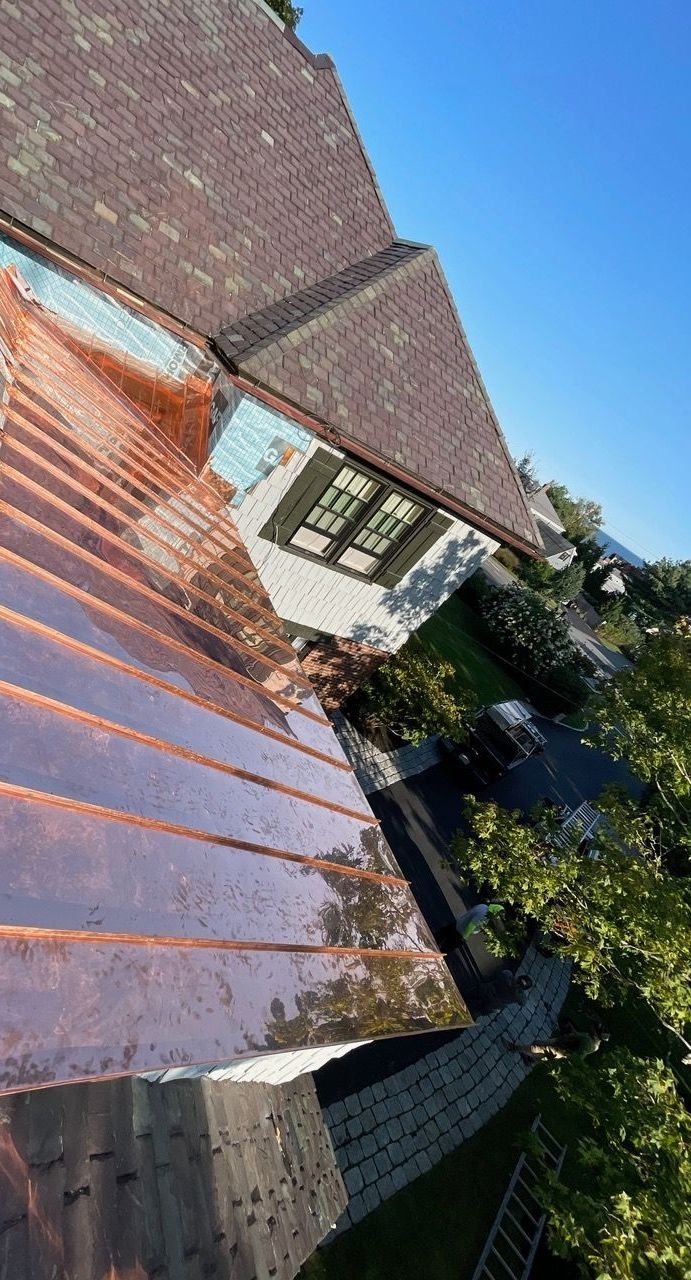
TL;DR: A standing seam copper roof is a run of copper roof panels joined by raised vertical seams, held down by hidden clips so the metal can move. On a Boston home it usually lands around $28 to $35 per square foot installed once the flashing and details are done right. It lasts a century or more, and it turns from salmon to brown to green on its own. The seam type, the copper weight, and how the roof meets slate and chimneys decide whether it stays dry.
Copper · 12 min read
A standing seam copper roof is the kind of roof people stop and photograph. Long clean lines running up the slope. Raised ribs between each panel. A color that starts like a new penny and ends up the green of an old church. On the right Boston house it looks like it grew there.
Get up on it, though, and the romance drops away. What you are really looking at is a stack of decisions. What weight of copper. Snap-lock or a folded mechanical seam. How far apart the hidden clips sit so the metal can grow and shrink without oil-canning or tearing a fastener loose. How the copper meets the chimney, the slate, and the gutter. Nail those and the roof laughs off a hundred New England winters. Miss them and you own a beautiful roof that leaks at a seam by March.
That gap, between the pretty photo and the actual detailing, is what this page is about. The national cost calculators all give you the same thing: a per-square-foot band and a paragraph on green patina. What none of them tell you is which seam belongs on a Beacon Hill bay window, why the clip spacing outranks the metal thickness, or what the job really costs in Greater Boston once the flashing is done in copper instead of caulk.
What a standing seam copper roof actually is
Start with the panel. A copper roof panel is a flat pan of copper bent up at both long edges. Set two of them side by side and those upturned edges meet. Join them and you get a raised vertical rib. That rib is the seam. It stands proud of the flat, which is where the name comes from, and it keeps the joint up out of the water instead of down in it.
Now the part most people miss. The copper roof panels do not get face-nailed. Under each seam runs a row of concealed clips, screwed to the deck. Each clip grips the panel but lets it slide.
Why does that matter? Because copper moves. A lot. A 20 foot run can grow close to a quarter inch between a January night and a July afternoon on a south-facing slope. Screw it down tight and it fights that swing every day until something gives. Let it ride on clips and it stays flat and quiet for decades.
So the shiny copper metal roof panels are only half the roof. The clips, the seams, and the flashing are the other half, and that half is the half that decides whether you stay dry.
Snap-lock vs mechanical seam
There are two ways to close the seam. The choice is not about looks.
Snap-lock. The panel edges get pre-formed at the shop. On the roof they push together and click, no seaming machine required. Faster to run, cheaper to install. Snap-lock wants a slope of 3:12 or steeper, which is most pitched roofs in Cambridge, Somerville, and Newton. The trade-off is that it seals a shade less tight than a folded seam, so it stays off the flat stuff.
Mechanical seam. Here the panels go down with the seam open, then a powered seamer crawls the run and folds the copper over. One fold for a single lock, two for a double. That folded seam beats back wind-driven rain and carries the higher wind numbers. Standing seam copper gets tested to UL-90, the top wind class Underwriters Laboratories rates, and a mechanical double-lock is how you reach it on an exposed roof. It costs more because of the labor and the machine time.
On a real Boston house you usually see both on the same building. Snap-lock takes the steep main slopes. Mechanical seam handles the porch roof, the shallow dormer, the flat-ish bay cap where water crawls instead of runs. Watch out for the crew that only owns one method. They will talk you into running it everywhere, because that is what their tools do. The roof shape should pick the seam. Not the truck.
How thick is the copper, and why it is sold in ounces
People ask what gauge the copper is. Copper does not use gauge. It is sold by weight per square foot, in ounces, and that number is standing in for thickness.
Here is the translation, because the ounce figure means nothing until you see it in inches:
- 16 ounce copper is about 0.0216 inches thick and weighs a pound per square foot. This is the everyday roof panel weight. On Boston houses it is what goes on most of the time.
- 20 ounce copper is heavier, roughly 0.027 inches and 1.25 pounds per square foot. It earns its keep on long panel runs, low slopes, and rough exposures near the water in places like Milton or the harbor side of town.
- Flashing at valleys, chimneys, and sidewalls runs 16 or 20 ounce too, so the weak points are never built out of thinner metal than the field.
The Insurance Institute for Business and Home Safety notes that copper roof coverings run in this 16 to 20 ounce range for the sheet itself. Look at those numbers again. A copper standing seam roof is thin. Two hundredths of an inch of metal. The strength does not live in the sheet. It lives in the folded seam and the clip layout that lets the whole thing breathe with the weather.
Thicker copper does buy you one visible thing: it resists oil-canning, that faint waviness you catch in the flat of a metal panel under low sun. Narrower pans help too. On a bright roof facing the street, spending up to 20 ounce and tighter pan widths is money you can see.
Patina: what the color does over time
Copper never gets painted, and it never needs a coating. It protects itself. The Copper Development Association explains in its Copper in Architecture Design Handbook that the metal grows its own oxide layer, which clings to the surface and shields the copper underneath from further weathering. That layer is the patina. It is the reason a copper roof can outlast the house’s wiring, its windows, and two or three furnaces.
The color moves on a schedule you cannot rush much:
- Fresh copper is bright salmon-pink, close to a new penny.
- Inside a few weeks to a few months it dulls to russet and then chocolate brown.
- Over roughly 10 to 30 years the brown weathers to the blue-green everyone pictures on an old steeple.
Salt air speeds the clock. A roof a few blocks from the ocean can hit green in under 10 years. An inland roof in Lexington may sit brown for two decades before it turns. Want green now? Factory pre-patinated copper starts there. Love the penny look and want to hold it? Clear-coated copper keeps the shine for a while, though the coating wears eventually and the metal starts its normal march anyway.
Two things I tell every homeowner. First, copper runoff during the brown years can stain lighter masonry below it, so we plan the downspouts and splash paths before the roof goes on. Second, patina is not rust, and it is not a defect. The owner who calls me that first fall, worried the roof is “changing color,” is watching it do exactly what it is supposed to do.
Standing seam copper roof cost in Boston
Here is the number you came for. A standing seam copper roof cost in Greater Boston usually lands around $28 to $35 per square foot installed. National guides put bare copper standing seam near $28 to $31 per square foot before local conditions, and some Boston jobs run past that once you count the labor. Copper as a raw material sits three to four times the price of steel, so the range tracks.
That per-square-foot figure is a starting point, not a quote. What actually moves it on a real house:
- Seam type. A mechanical double-lock costs more to run than snap-lock.
- Copper weight. 20 ounce costs more than 16.
- Roof shape. Valleys, dormers, hips, and a chimney or two mean more flashing and a slower crew.
- Panel length. Long clean slopes fly. Chopped-up roofs crawl.
- Staging and access. A three-story South End rowhouse with no driveway is a different animal than a ranch in Belmont.
- Tear-off and deck repair. Whatever the old roof was hiding shows up the day it comes off.
Because copper is priced by the square foot, the total swings hard with the size of the job. A copper porch roof or a bay cap can be a few thousand dollars. A dormer plus a small entry might run five figures. A full copper roof on a larger house climbs into the tens of thousands, and a complicated historic roof goes higher still. For a 2,500 square foot roof, a full copper job commonly falls somewhere in the $50,000 to $80,000 range once the details are counted.
Weighing copper against the sticker price of asphalt? The honest frame is time, not today. Asphalt wins the first morning and loses over the next 80 years. A copper roof you buy once can outlast three or four asphalt tear-offs. Our copper roof cost guide for Boston breaks the material and labor split down further, and if gutters are in the project, the copper versus aluminum gutter math runs the same long-horizon logic on the drainage.
Can a standing seam metal roof be copper?
Short answer: yes. Copper is one of the three metals a standing seam roof gets built from, next to steel and aluminum. It behaves the same way mechanically, flat pans and raised seams, but it is the one that ages to a patina and the one that reads as a lifetime roof.
Here is where people get crossed up. A painted steel copper metal roof exists, and from the street on year one it can pass for the real thing. It costs a fraction of the price. What it does not do is last a century or turn that living green, because the color is paint and the base is steel. When someone tells me they want “the copper look” on a budget, a copper-colored steel standing seam is a fair call on a plain house. When they want the roof their grandkids inherit, that is real copper, and there is no substitute for it.
Most Boston copper does not cover the whole house anyway. It lands on the porch, the bay, the turret, the low addition off the kitchen. That is copper and metal roofing working together on one building, where the copper carries the parts that show and the parts that have to last.
How a copper roof actually goes down
People search for how to install a standing seam copper roof expecting a weekend how-to. It is not that, and this is not a DIY guide. But knowing the sequence tells you what a good crew is doing up there, and where a cheap one cuts.
It runs roughly like this. Strip the old roof to the deck. Fix any soft or rotted sheathing, because copper telegraphs a bad deck straight through the finished panels. Lay a high-temperature underlayment, and at the eaves an ice-and-water membrane that reaches well past the interior wall line, which matters more here than almost anywhere given New England ice dams. Set the eave and gable edge metal in copper. Snap the panel layout so the pan widths land even and the seams run true, then form or field-cut the panels to length. Set them one at a time, clip each seam to the deck at the right spacing for the panel length and the exposure, and either snap or machine-fold the seam closed as you go. Build the flashing at every chimney, valley, and wall in copper, woven into the panels rather than smeared over them.
The two places a crew saves money and you pay for it later: clip spacing and flashing. Space the clips too far apart or pin a panel through the field and the copper cannot move, so it buckles or splits. Flash with sealant instead of formed copper and the joint dries out and opens in a few winters. Neither shows on install day. Both show in year 15.
How I detail a copper roof
I am Arturo, and I have been installing and repairing copper around Greater Boston for years. A few rules I hold to, because they are exactly where copper jobs go right or wrong.
I let the metal move. Clips get spaced so the panels float, and the fasteners stay off the field of the pan. A copper roof screwed down tight looks perfect in October and buckles by August.
I match the seam to the slope. Steep, snap-lock. Low porch or shallow bay, mechanical double-lock. I do not run one method across a whole odd roof just because it is quicker for me.
I build the flashing first, and out of copper. Copper against a brick chimney gets copper counterflashing let into the mortar joints, not a bead of roof cement that cracks out in three winters. The chimney flashing method is spelled out here, and it holds whether the roof above it is slate or standing seam.
I respect the cold. Copper stays workable through a New England winter, but the deck, the underlayment, and the ice protection at the eaves have to be right before a single panel goes down. I wrote up copper roofing in cold Boston weather for the specifics.
None of that shows in a photo. All of it shows in year 30.
How copper standing seam pairs with slate
A lot of Boston houses are not picking slate or copper. They already own both, and they want the two to keep working as one roof.
Slate takes the big steep slopes. Copper takes the parts slate cannot do well: the valleys where two slopes collide, the flashing at chimneys and sidewalls, the porch roof, the bay cap, the low rear addition. On a Victorian in Jamaica Plain or a brick rowhouse on Beacon Hill, the copper is usually already in the valleys and the flashing, so adding a copper standing seam porch roof reads as part of the same house instead of a patch tacked on.
The two metals also age into each other. Copper flashing set into a slate roof goes brown and then green on the same clock as a new copper porch beside it. That is one reason we run both under one roof at Art Slate’s slate and copper service. Already have copper and one seam or flashing is leaking? The copper roofing repair service handles the fix without tearing off sound metal.
Where copper roofs actually fail
Copper does not really wear out. When a copper roof gives trouble, it is almost always the detailing, not the metal. A few failure modes I keep seeing on older Boston roofs, and how to keep them off yours.
Galvanic corrosion. Copper does not get along with aluminum or plain steel. Put them in contact with water running between them and the softer metal eats itself fast. So copper never touches aluminum gutters, aluminum flashing, or steel fasteners. Everything that meets the copper is copper or stainless. That is one more reason a copper roof and copper gutters belong together, which the copper versus aluminum gutter math gets into.
Oil-canning. The faint waviness in the flat of a panel, worst in low raking sun. It is cosmetic, not a leak, but it looks cheap on a street-facing roof. Narrower pans, heavier copper, and a dead-flat deck all cut it down. A crew that rushes the layout makes it worse.
Pinned panels. The most common real leak is a panel that cannot move, because someone fastened through the field or packed a seam too tight. The copper fights the temperature swing, works a fastener loose or splits at a fold, and water finds the gap. The fix is designing for movement from the first panel.
Tired flashing. After 40 or 50 years the field panels are still fine and a chimney or valley flashing has finally flexed enough times to open a joint. That is a repair, not a re-roof. The sound copper stays. The failed detail gets rebuilt.
When copper is the wrong call
Copper is not the answer for every roof, and pretending it is helps no one.
Newer house, plainly built, owner moving in five years? The payback on copper never lands. Asphalt or a painted steel standing seam does the job for a fraction of the price. Budget fixed and tight? A partial copper approach, copper only on the front porch or the street-facing bay, puts the look where it counts without roofing the whole house in metal.
Copper shines on houses worth keeping for the long haul. Historic homes. Well-built Colonials and Victorians. Anything where the roof is part of the architecture and the owner is thinking in decades, not in resale. Those are the roofs where a standing seam copper roof stops being an expense and starts being the last roof the house ever needs.
Frequently asked questions
How much does a standing seam copper roof cost in Boston?
Most standing seam copper work in Greater Boston runs around $28 to $35 per square foot installed. A small porch or bay roof can be a few thousand dollars. A full copper roof on a larger house can reach the tens of thousands. Seam type, copper weight, roof shape, and staging all move the number.
How thick is a copper standing seam roof?
Copper is sold by weight, not gauge. Most Boston roofs use 16 ounce copper, which is about 0.0216 inches thick and weighs a pound per square foot. Heavier 20 ounce copper, roughly 0.027 inches and 1.25 pounds per square foot, goes on long runs, harsh exposures, and low slopes. The panel is thin. The strength comes from the folded seams and the clip layout, not the raw thickness.
Can a standing seam metal roof be copper?
Yes. Copper is one of the metals a standing seam roof gets made from, alongside steel and aluminum. On Boston houses copper often shows up on porches, bays, and additions rather than the whole roof, because it costs more per square foot than a painted steel copper metal roof that only looks the part. Real copper is the one that ages to a patina and lasts a century.
How long does a copper roof last?
A copper roof installed correctly commonly lasts 100 years or more. The copper itself outlives the fasteners and the wood deck under it. On most Boston homes the flashing details fail before the panels do, which is why the seams and clips matter as much as the metal.
Does a standing seam copper roof turn green?
Yes, but slowly. New copper is bright salmon-pink. Over months it darkens to russet and chocolate brown, and over roughly 10 to 30 years it weathers to the blue-green patina people picture. Homes near the coast turn faster. If you want green sooner or want it locked bright, pre-patinated and clear-coated copper exist.
Snap-lock or mechanical seam for a Boston roof?
Snap-lock panels click together and suit slopes of 3:12 or steeper, which covers most Boston pitched roofs. Mechanical seam gets folded closed by a machine, handles low slopes down to near flat, and sheds wind-driven rain better. Porches, dormers, and shallow additions are where the mechanical seam earns its higher cost.
Can a standing seam copper roof cover part of a slate house?
Yes, and that is common in Boston. Many homes keep slate on the main slopes and use copper standing seam on porches, bays, dormers, and low additions where slate does not sit well. The copper flashing already ties the two together, so the look stays consistent.
Talk to the owner
If you are thinking about a standing seam copper roof, the useful first step is not a square-foot number off the internet. It is someone standing on your roof, deciding which seam the slope wants, what copper weight the exposure needs, and how the metal has to meet your slate and your chimney.
Picking a copper roofing company comes down to that. Every copper job Art Slate quotes gets walked by Arturo before a price goes on paper. See our slate and copper roofing service, read the copper roof cost guide, or schedule a free assessment. Arturo can tell you whether copper is the right roof for your house, and where a partial copper approach gets you the look without roofing the whole thing in metal.