Chimney Flashing Repair in Boston: Why Slate and Copper Roofs Leak Here First
Chimney flashing repair in Boston: why slate and copper roofs leak here first, how proper copper flashing works, and when to rebuild.
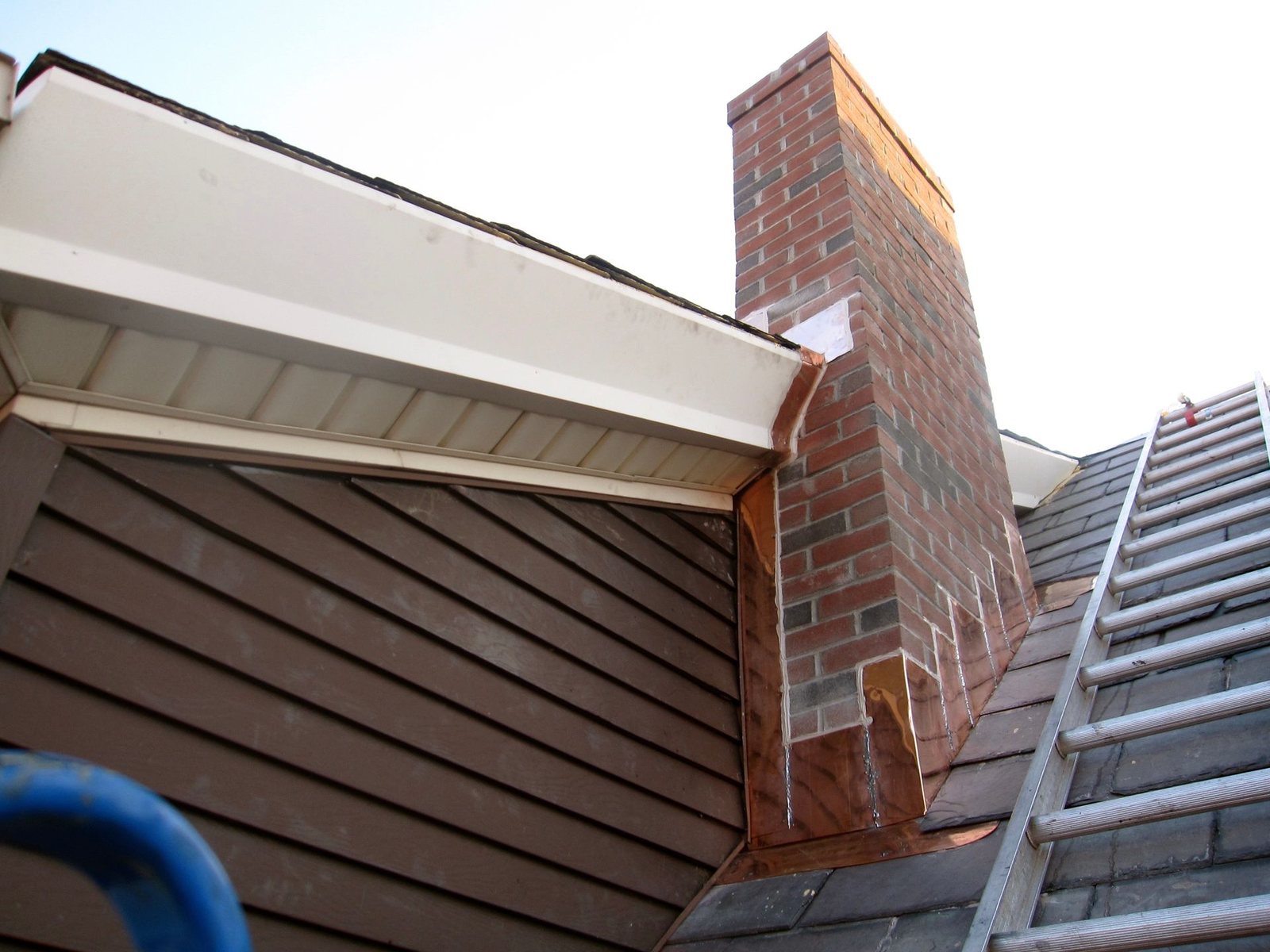
TL;DR: On Boston's slate and copper roofs the leak almost never starts in the field. It starts at the chimney. Step flashing woven into the courses and counter flashing set into the mortar are what fail first, usually because someone caulked a joint that should have been cut into brick. Most chimney flashing repair here is a few hundred to a few thousand dollars, not a tear-off.
Copper · 9 min read
A ceiling stain near the chimney sends most Boston homeowners looking for a roofer, or worse, a mason, to rebuild the stack. Usually neither is the real problem. The water is getting in at the flashing, the metal that seals the joint where the chimney passes through the roof. On the slate and copper roofs we work on, that joint is the single most common place a roof leaks, and it is the one part of the roof a national cost guide cannot see.
This piece is about chimney flashing on the roofs Boston actually has: slate and copper fields, brick chimneys, and the freeze-thaw winters that work every joint loose. What the flashing is, why it fails here first, the difference between the two layers that make it work, and how we decide between a reseal, a re-flash, and calling in the mason.
Where a slate or copper roof actually starts leaking
Homeowners assume a leak means a bad slate or a worn copper seam. On a sound roof it rarely does. Slate lasts a century or more, and a properly soldered copper field outlives the people who argued about its price. Both are far more durable than the metal flashing tucked around the chimney. So the flashing goes first.
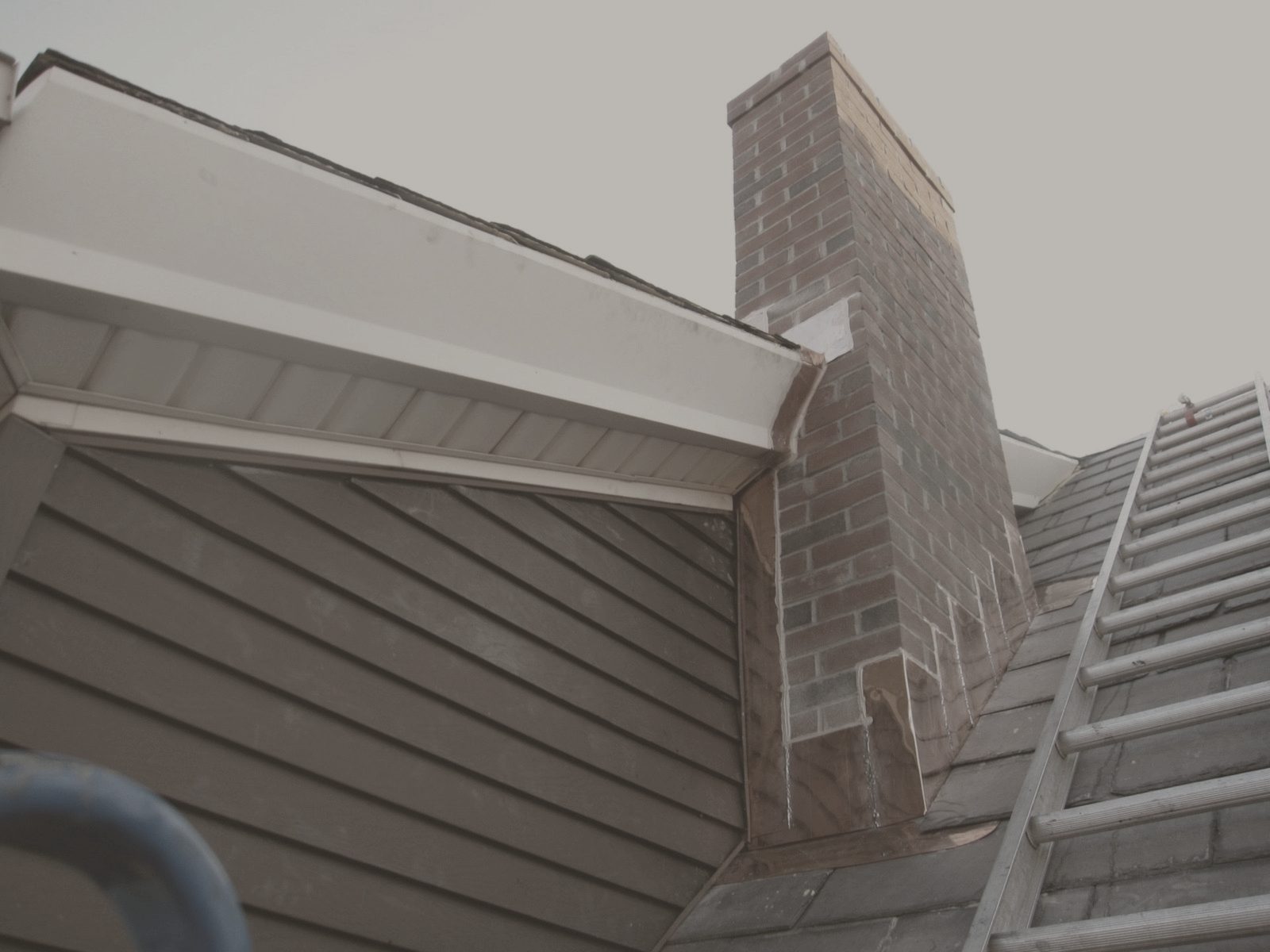
There is a reason for that beyond age. The chimney is a hole cut through the roof, and every hole needs a watertight collar built by hand. That collar takes more thermal movement than any other part of the roof, because masonry and metal expand and contract at different rates and the chimney heats up when the flue runs. Work a joint through enough Boston winters and the seal that was fine on install day opens up. The field slate around it can be flawless and the roof still leaks.
That is the gap most chimney content skips. It treats the chimney as a masonry object. On a premium roof, the chimney is a flashing detail, and the flashing is what you repair. If you are weighing repair against replacement on the roof itself, we lay out that whole framework in our guide to slate roof repair versus replacement.
Step flashing and counter flashing: the two-part system leaks come from
Good chimney flashing is two layers, not one, and understanding the difference tells you why so many repairs fail.
- Step flashing. These are L-shaped pieces of metal, one per course of slate or shingle, woven into the roof as it is laid and turned up against the side of the chimney. Each piece laps over the one below it, so water stepping down the roof always lands on top of metal, never behind it.
- Counter flashing. This is a second layer set into the chimney’s mortar joints and bent down over the top edge of the step flashing. It covers the raw upturned edge so water sheds off it, onto the step flashing, and back onto the roof.
This Old House describes the same two-part arrangement in its flashing guide: step flashing woven into the courses, counter flashing embedded in the mortar and folded down over it. Both layers have to be present and intact. Miss the counter flashing and the top edge of the step flashing sits open to the weather.
Here is where most bad repairs come from. A crew in a hurry skips cutting the counter flashing into the brick and just runs a bead of caulk along the top of the step flashing instead. It looks finished. It sheds water for a few years. Then the caulk hardens, cracks, and pulls away from the brick, and water runs straight down behind the flashing and into the house. If your chimney was last “flashed” with a caulk gun, that is not a repair that lasts. It is a clock.
Apron, head, and the chimney cricket: the flashing pieces most repairs forget
Step and counter flashing get all the attention, but a chimney needs metal on all four sides, and the pieces a rushed crew skips are the ones on the uphill and downhill faces.
- Apron flashing. The single piece that runs across the downhill face of the chimney, the side pointing down the slope. It laps over the roof below the stack and carries off the water running down the brick. A short or cracked apron is a classic slow drip right below the chimney.
- Head flashing. The mirror piece on the uphill face, tucked up under the slate or shingle above the chimney so water coming down the roof is turned around the stack instead of driven against it.
- The chimney cricket, or saddle. On a wide chimney the uphill face works like a small dam: snow and water pile against the back wall, sit, and freeze. A cricket is a low peaked ridge of framing and metal built behind the chimney that splits that water and sends it down both sides. On a wide stack it is not optional. The International Residential Code requires a cricket on any chimney more than 30 inches wide across the slope.
Boston winters are where the cricket earns its place. The back of a wide chimney is exactly where an ice dam forms and meltwater sits for weeks, and a flat-backed chimney with no cricket is the one we most often find rotting the deck behind it. If your chimney is wide and the stain shows up every February, a missing or failed cricket is the first thing we look for.
Why Boston’s brick chimneys change the repair
Most chimneys here are brick, many of them on homes built between roughly 1890 and 1920, and that changes how counter flashing has to be done. On a masonry chimney, counter flashing belongs in the mortar joint, not on the face of the brick. The metal is set into a cut called a reglet, folded in, and the joint is repointed to lock it. Done right, that joint is meant to last, and it protects the flashing edge for decades.
The catch on an older Boston chimney is the mortar itself. Historic brickwork was laid in soft lime mortar, and it does not take a modern high-cement repointing mix without trouble. The National Park Service is blunt about this in Preservation Brief 2 on repointing mortar joints: a repointing mortar that is too hard or too vapor-tight for the surrounding masonry damages the brick. So cutting a reglet and repointing a counter flashing on a 120-year-old chimney is masonry work with real rules, not a groove and a squirt of mortar. This is the point where a flashing repair and a chimney repair overlap, and where the roofer and the mason have to agree on the boundary. When the brick and joints themselves are spent, it moves from our side of the job to the masonry side, which we cover on our chimney repair page.
Winter makes all of this worse. Meltwater from ice dams backs up under the flashing and freezes, and the freeze-thaw cycle levers open exactly the joints the chimney flashing depends on. If your chimney leak shows up in January and dries out in April, ice is part of the story, and it is worth reading how we handle ice dams in New England alongside the flashing itself.
Copper versus aluminum flashing: what lasts on a Boston roof
The metal you flash a chimney with should match the roof it lives in, and on a slate or copper roof that metal is copper.
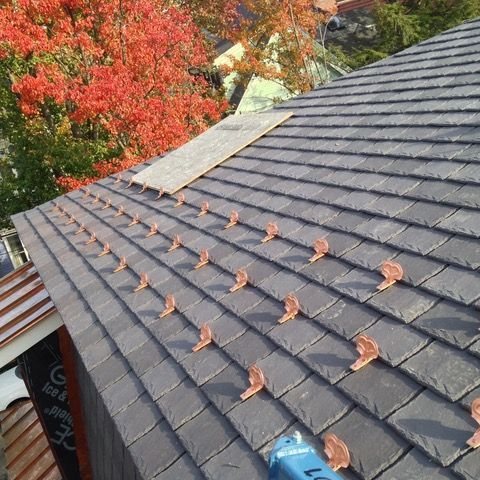
Copper flashing routinely lasts 50 years or more, often the full service life of the roof around it. It does not rust, it takes solder, and its seams can be made watertight by hand rather than relying on a sealant that ages out. Aluminum, by contrast, runs closer to 15 to 20 years and can corrode where it sits against masonry or touches a dissimilar metal. Galvanized steel lands in between and eventually rusts through at the folds. On a roof built to last a century, flashing it in aluminum is fitting a 20-year part to a 100-year roof, and planning to be back for it.
There is a second reason copper belongs on these roofs. Put aluminum or steel flashing in direct contact with a copper gutter, a copper valley, or copper roofing, and you set up galvanic corrosion, where the two metals in the presence of water quietly eat the weaker one. Matching copper to copper avoids that entirely. The same long-horizon logic that makes copper worth its price at the chimney is the logic we run for gutters in the copper versus aluminum fifty-year math, and it is why our copper roofing and flashing service solders copper details rather than caulking substitutes.
Chimney flashing repair or full replacement: how we decide
Repair is the default. Most chimney flashing problems are a repair, not a rebuild. The decision comes down to why the flashing is leaking, and it sorts into three cases.
- Reseal or re-set. The flashing is sound but a sealant joint or a lifted counter flashing edge has let go. We clean the joint, re-set the counter flashing into the reglet, and repoint it. This is the common one, and it is a few hundred dollars of work on a roof worth far more.
- Re-flash. The metal itself has failed. It has split at the bends, corroded through, or was never counter-flashed into the brick to begin with. Here we strip the old flashing and install new, ideally soldered copper. Patching metal that is already going just moves the leak.
- Rebuild territory. The leak is not really the flashing. The brick is spalling, the crown is cracked, or the mortar joints are gone, and no flashing will seal against failing masonry. At that point the chimney needs masonry work first, and on a historic home that often runs into a wider historic roof restoration conversation.
The signal that pushes a job from repair toward replacement is repetition. If the same chimney has been resealed two or three times and the stain keeps coming back, the flashing is telling you the metal or the masonry underneath it is done, and another bead of sealant is money spent to be back next spring.
What chimney flashing repair costs in Boston
National cost guides put chimney flashing repair at roughly 300 to 1,800 dollars, with a full re-flash around 500 to 1,500 dollars and counter-flashing into the mortar adding several hundred more. Those are national averages on ordinary roofs, and for Boston they read as a floor, not a target.
Two things push a real number up here. The first is copper. Soldered copper flashing costs more than aluminum in both metal and labor, and on a slate or copper roof it is the correct material, not an upgrade. The second is the masonry. Cutting a reglet and repointing counter flashing into soft historic brick is skilled mason’s time, and it is the part a per-foot estimate always underprices. A brownstone chimney with cut-in copper counter flashing is a different job from a caulked aluminum L on a ranch, even though a cost calculator files them under the same words.
What does not change is the math against the alternative. A chimney flashing repair in the hundreds to low thousands sits in front of water damage that runs into the tens of thousands once it reaches the framing, the plaster, and the deck. Of every dollar you can spend on a roof, the flashing at the chimney is among the best-defended.
Frequently asked questions
What causes most chimney leaks on a Boston roof?
Almost always the flashing, not the chimney or the field. The metal that seals the joint between the chimney and the roof fails long before the slate, copper, or brick does. On the roofs we assess, a stain near the chimney points to the flashing first and the masonry second. That is why a real flashing inspection should come before anyone quotes you masonry work.
What is the difference between step flashing and counter flashing?
They are two halves of one system. Step flashing is a set of L-shaped metal pieces woven into each course of slate or shingle and turned up against the chimney. Counter flashing is a second layer set into the chimney’s mortar joints and folded down over the top of the step flashing. Water sheds off the counter flashing, onto the step flashing, and back onto the roof. Miss either layer and the joint leaks.
How long does copper chimney flashing last compared to aluminum?
Copper flashing routinely lasts 50 years or more, often the full life of a slate or copper roof. Aluminum runs closer to 15 to 20 years and can corrode where it touches masonry or dissimilar metals. Galvanized steel sits in between and eventually rusts through. On a roof meant to last a century, copper is the flashing that matches it.
Can chimney flashing be repaired, or does it need full replacement?
It depends on why it is leaking. A sound flashing with a failed sealant joint is a repair, often a reseal or a re-set counter flashing. Flashing that has split at the bends, corroded through, or was never counter-flashed into the brick needs replacing. Patching metal that is already failing just moves the leak a few feet and buys a year or two.
How much does chimney flashing repair cost in Boston?
National cost guides put chimney flashing repair at roughly 300 to 1,800 dollars, with a full re-flash around 500 to 1,500 dollars and counter-flashing work into the mortar adding several hundred more. Read those as a floor here. Soldered copper flashing on a historic brick chimney runs to the upper end and past it, because the metal and the mason’s time both cost more. It is still a fraction of what the water damage behind a neglected chimney costs to fix.
Does my chimney need a cricket?
If the chimney is more than 30 inches wide on its uphill side, yes, and building code says so. A cricket is a small peaked saddle behind the chimney that splits water and snow around it instead of letting it pond against the back wall. On Boston roofs the back of a wide, cricket-less chimney is the spot we most often find a hidden leak and a rotting deck, because that is where ice sits longest. A narrower chimney can be fine on good head flashing alone.
Talk to the owner
Every chimney we flash gets walked by Arturo before a number goes on paper, because the repair-or-rebuild call depends on what the metal and the mortar are actually doing up there, not on what the stain looks like from the floor. If you have a mark on the ceiling near the chimney and cannot tell whether you need a reseal, a re-flash, or a mason, that walk is free. See how we handle copper flashing on our copper roofing and flashing page, or schedule an assessment and we will tell you straight where the water is getting in.