Boston Copper Roofing and Copper Roof Repair
Boston copper roof repair, standing-seam installation, flat-lock copper, gutters, and chimney flashing. Hand-soldered by an insured crew since 2005.
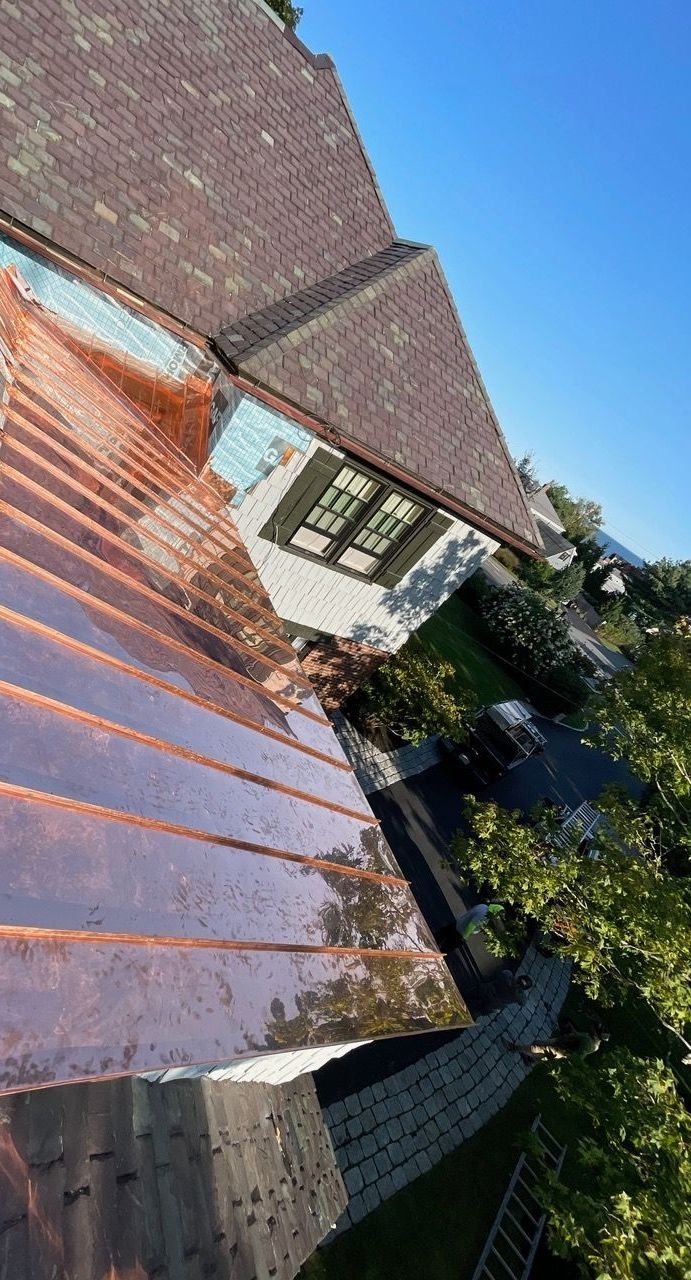
Copper Roofing · Boston
We build and repair copper roofs across Boston: standing-seam and flat-lock fields, copper gutters, finials, flashing, and bay-window cladding. We solder our seams, we don’t screw them, and we cleat the metal so it can move with the weather. The patina is yours to keep.
What we install
Copper is the only flashing we trust.
Copper is the most forgiving material in roofing. It moves with temperature, it self-heals tiny pinholes, it doesn’t rust, and properly soldered seams hold for a century. The catch: it has to be installed correctly. Steel fasteners corrode copper through galvanic action. Screws don’t move with the metal. Improper sweat-soldering fails in the first New England winter.
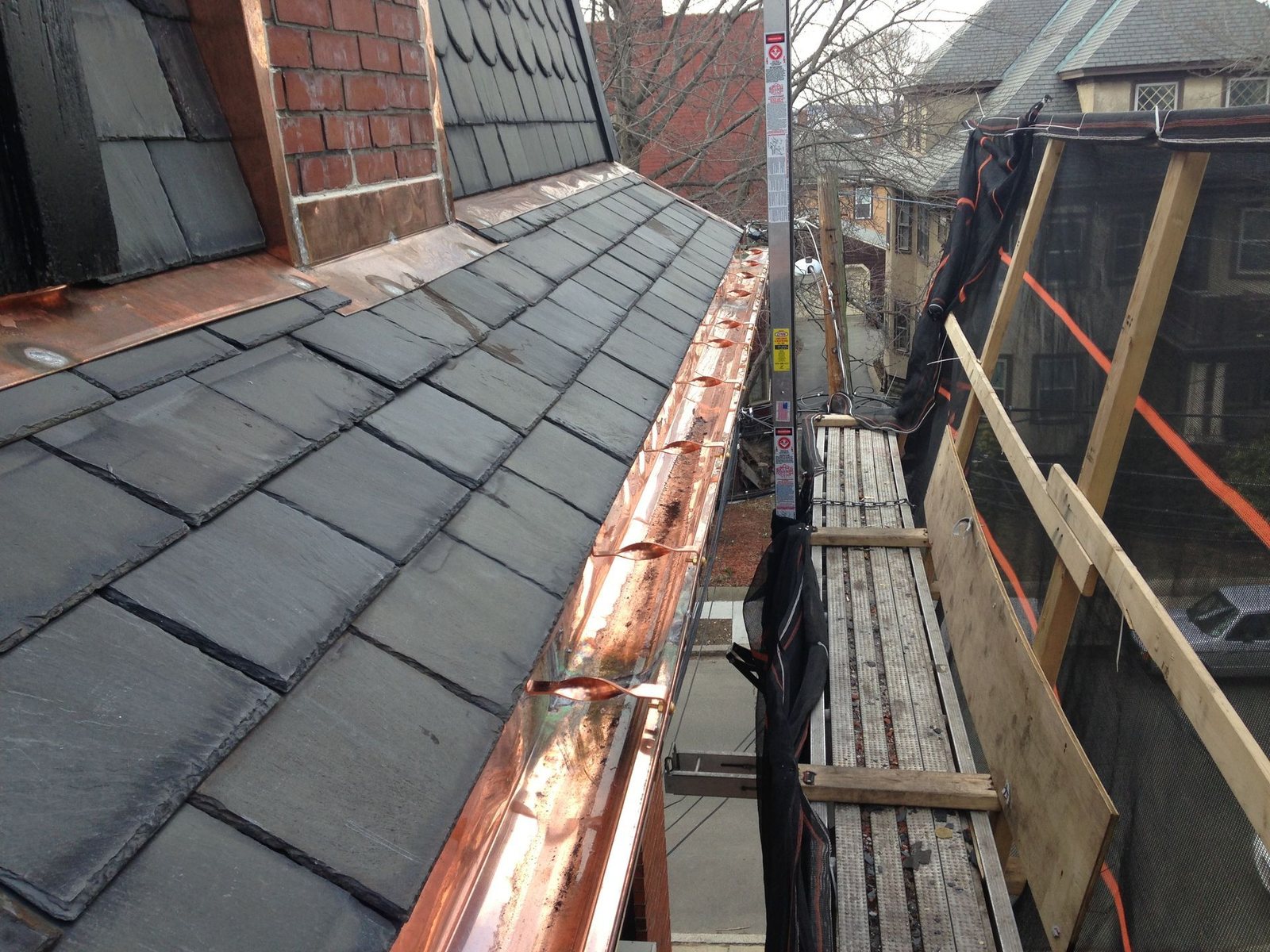
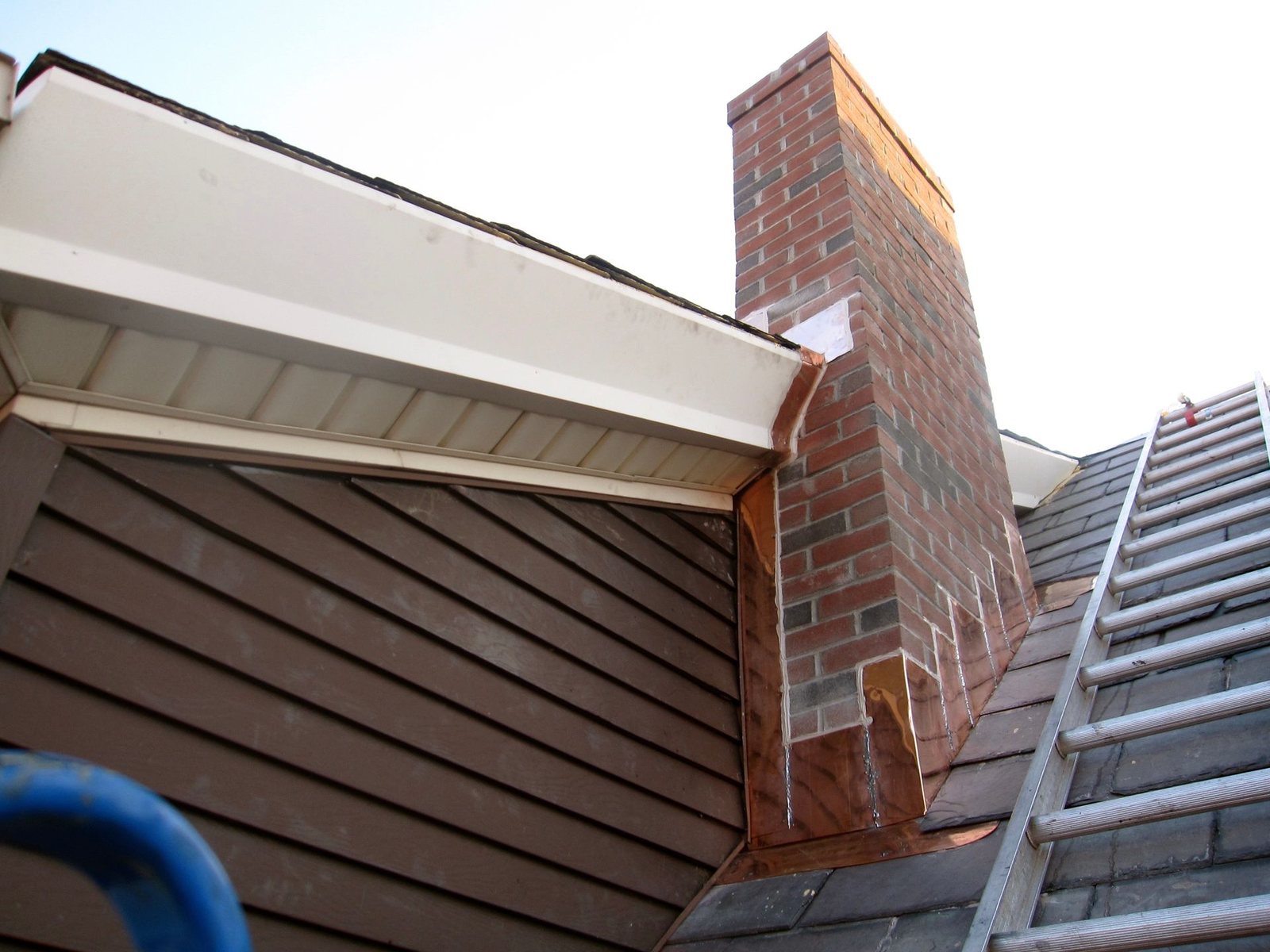
We install copper as flashing on every slate roof we do, at the valleys, chimneys, and dormers where water actually decides whether your roof leaks. We also install full copper roofs: standing-seam, batten-seam, and turret/bay-window copper. Half-round and K-style copper gutters, hidden-hanger systems, and copper downspouts that age into the same green as your neighbor’s 1898 conductor head.
We do not install pre-painted copper, copper-toned aluminum, or copper alloys that look right and age wrong. The patina is the point.
Why people put copper on for good.
A copper roof outlives the people who install it. Past a hundred years is normal, which means it isn’t a repeating expense the way asphalt is. You do it once. That longevity reads on a sale too. A copper or slate roof tells a buyer the house was kept properly, and it carries a value premium that a fresh layer of shingles never does.
It asks almost nothing of you in return. Beyond the occasional look-over, copper handles itself. There’s no coating to redo, no annual upkeep. If a particular shade of patina matters to you, it can be cleaned, but that’s a choice about how it looks, not something the roof needs to keep working.
It’s also about as clean a material as roofing gets. Copper is natural and fully recyclable, and a roof measured in centuries simply makes far less waste than one torn off and landfilled every 18 to 25 years.
We do free assessments on copper work. We’ll walk the roof, look at the framing, and give you honest numbers before anything is decided.
Repair or replace
Copper roof repair, or a full replacement?
Most calls we get about copper aren’t for a whole new roof. They’re a leak, a green stain on a ceiling, or a seam that’s opened up after a hard winter. A copper roof almost never fails across the field. It fails at a joint: a soldered seam that cracked, flashing that pulled away from a chimney, or a section where someone before us used the wrong fastener and the metal tore around it.
When the field metal is sound and the patina is intact, repair is the honest answer. We re-solder the open seam, rebuild the flashing detail, and leave the rest of the roof alone. A repair like that can buy another few decades, because the copper around it still has most of its life left.
We push toward full replacement in a narrower set of cases: when the roof was installed wrong from the start and is tearing at fasteners in more than one spot, when earlier “repairs” were caulk and roof cement smeared over real problems, or when a copper roof at the end of a very long life has finally thinned at the water lines. We’ll tell you which situation you’re in after we’ve been on the roof, not before.
Cost
What a copper roof costs in Boston, and what moves the number
There’s no honest flat price for copper. What you pay comes down to the size of the roof, its geometry, and the copper profile. A long, clean run of standing seam covers ground fast. A roof full of dormers, valleys, and short offset panels eats labor and wastes more sheet at every cut, so two roofs of the same square footage can quote well apart on shape alone.
Two things sit under every copper number, and neither bends much. The first is the metal. Copper is a commodity priced far above steel or aluminum, and when it moves on the market, quotes move with it. The second is the soldering labor. Copper is cleated and hand-soldered, not nailed and forgotten, and the pool of roofers who do that correctly around Boston is small. That craft is most of what you’re paying for.
We break the real per-square numbers down by system, and by house type, in our Boston copper roof cost guide, including why a mansard costs more than a plain gable of the same size. If you’d rather see the long-run figure at the gutter line, the same argument runs through our 50-year math on copper versus aluminum gutters.
Systems
Standing-seam, flat-lock, and copper at the gutter line
Copper isn’t one system. The right one depends on the pitch and the architecture.
Standing-seam is the vertical-rib copper you picture on a steep roof or a turret. The raised seams shed water fast and lock over cleats that let each panel float. It’s the workhorse for pitched fields and bay-window caps.
Flat-lock is flat sheets locked and hand-soldered edge to edge into a continuous watertight skin. It belongs on the low-slope decks behind the parapets of Boston’s brownstones and rowhouses, where water sits and drains slowly instead of running off. It carries more linear feet of soldered seam per square, which is why it’s the labor-heavy end of copper.
Then there’s copper at the edges: half-round gutters, hidden-hanger systems, downspouts, and the flashing at chimneys, valleys, and sidewalls. On a lot of Boston homes this is where copper earns its keep first, long before anyone re-roofs the whole house. A copper gutter run drains more water than an aluminum one of the same nominal size and outlasts it by decades.
Boston
The Boston details we plan around
Copper on a Boston roof has to answer to three local realities, and we design for all three before a sheet gets cut.
Freeze-thaw. We cross the freezing line more than sixty times in an average winter, and each crossing makes the metal expand and contract. Copper stays ductile through that cycling and flexes instead of cracking, which is exactly why it’s cleated to float rather than screwed down tight. The full material science is in our piece on why copper survives Boston winters.
Coastal salt air. From the harbor out to the North Shore, salt-laden air chews through galvanized and painted steel. Copper is effectively immune to it. The same patina chemistry that protects against rain protects against salt, which is why copper is often the whole argument on a coastal home.
Historic-district approval. If your home sits in a Landmarks district like Beacon Hill, Back Bay, or the South End, exterior roof work visible from the street generally needs a certificate from the historic commission before it starts. Copper is usually welcomed in these districts, sometimes required. The approval is real, so we build it into the schedule rather than discover it after a crew is booked.
Why copper
Real copper, and never a steel fastener
The way a copper roof fails early is almost always the same: the wrong metal touched it. Steel or galvanized fasteners set against copper corrode through galvanic action and bleed rust into the seams. Screws driven tight stop the metal from moving, so the stress lands on the fastener and the copper tears around it. We use copper cleats and copper nails, and we let the metal float. That single discipline is the difference between a roof that lasts a century and one that leaks in five years.
We also install real copper, not the look of it. Pre-painted copper, copper-toned aluminum, and cut-rate alloys age wrong and never earn the patina that makes copper worth the money. A copper roof’s finish is the metal itself, changing from bright to bronze to the blue-green you see on an old church. There’s nothing to repaint and nothing to reseal. A documented service life of 80 to 100-plus years assumes only that the cleating and soldering were done right (Insurance Institute for Business & Home Safety).
Hiring
How to tell a good copper contractor from a cheap bid
Copper punishes shortcuts, and the shortcuts don’t show for a few winters. A few questions separate a real copper contractor from a crew that’s about to learn on your roof:
- Ask how they fasten it. The right answer is cleats and copper nails, with the metal left free to move. “We screw it down” is the wrong answer.
- Ask who solders the seams. Hand-soldered joints with 50/50 or lead-free solder are the standard. If they plan to caulk seams or run a bead of sealant, that’s a roof-cement repair wearing a copper coat.
- Ask what touches the copper. Every fastener, drip edge, and adjoining metal should be copper or copper-compatible. Mixed metals are a slow galvanic failure.
- Ask who’s actually on the roof. We walk and run every copper job with our own crew. No subcontractor learning copper on your dime.
If a bid comes in far below the others, it’s usually because one of those four is being skipped. On copper, the cheap version costs more, because you pay for it twice.
Our Process
How the work actually gets done.
Senior craftsmen, owner-walked, period-correct materials, sweat-soldered copper. No shortcuts on any of these.
01 / DESIGN
Profile & Pattern Design
Standing-seam, batten-seam, or panel. Profile and seam spacing matched to the architecture. Mock-ups for visible runs.
02 / FABRICATE
On-Site Fabrication
Cut, brake, and form on-site to match the actual roof geometry. No off-the-shelf panels stretched to fit.
03 / SOLDER
Hand-Soldered Seams
Every horizontal seam sweat-soldered with 50/50 solder. Every vertical seam locked and cleated. No exposed fasteners.
04 / FINISH
Penetration & Cap Detail
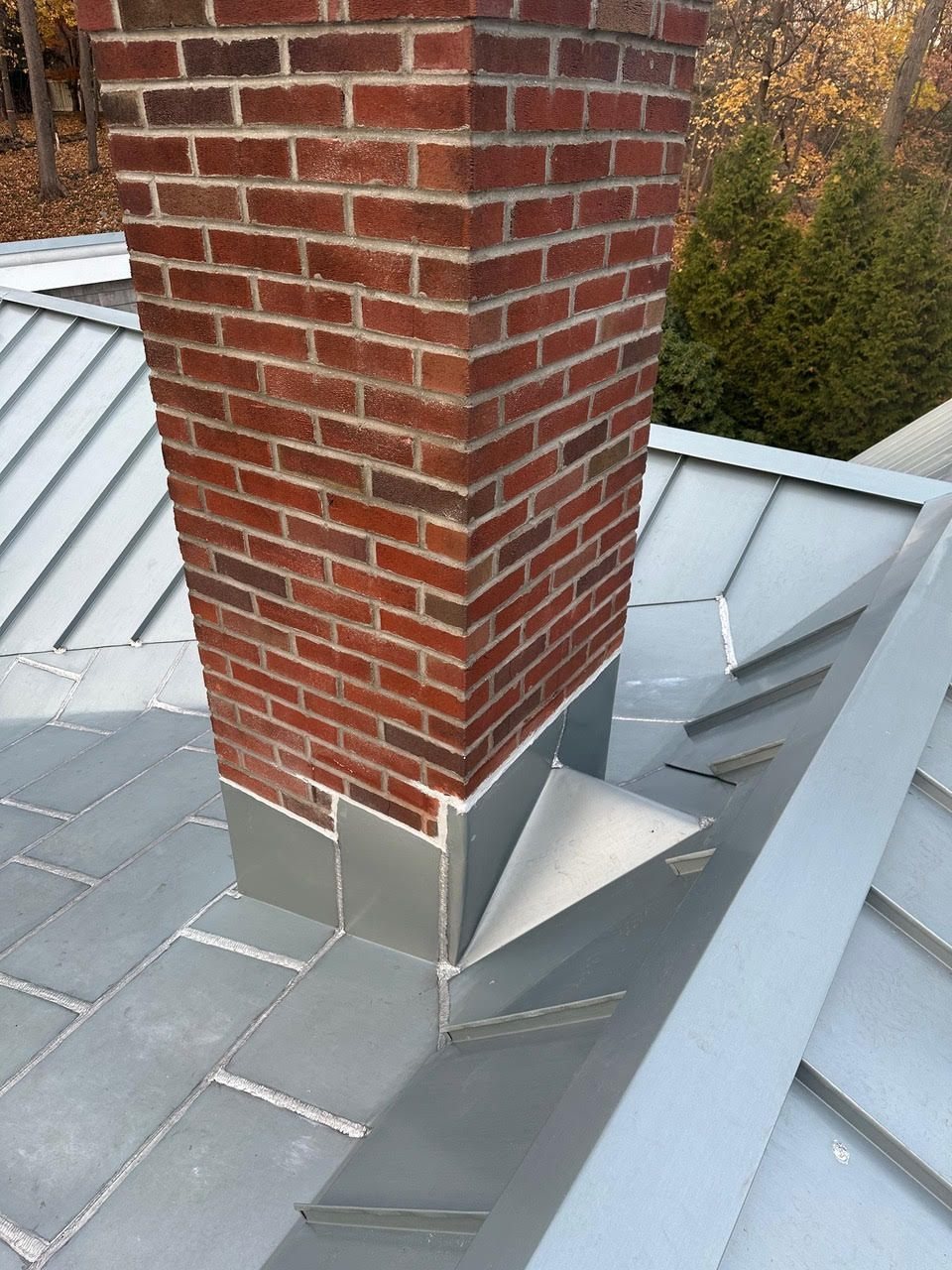
Chimney saddles, pipe collars, and dormer caps, all hand-formed. The details are where copper roofs fail, so we don’t skip them.
Recent Work
A glimpse of the portfolio.
Research Tool
What is a copper roof actually worth?
The Benefitra-built tool runs your specifics through the actual math. No signup. No email gate. No upsell.
- Storm Damage Triage Emergency
- Insurance Claim Likelihood Pre-claim review
What does slate actually cost you over a lifetime?
A slate roof costs more on day one and less by year sixty. This works out where the crossover falls on your house, using Greater Boston replacement cycles rather than national averages.
- Re-roofs avoided
- —
- Slate pulls ahead
- —
Totals are in future dollars, with replacement costs escalated 3.5% a year, so long horizons produce large-looking numbers. The useful figure is the gap between the two columns and the year slate pulls ahead, not the absolute total. Planning figures, not a quote: real numbers depend on pitch, access, the state of the deck, and how much copper the roof needs. Arturo walks the roof before anyone puts a price on it.
Want these numbers checked against your actual roof? Send it over and Arturo will take a look. The assessment is free, and if the answer is that you do not need us yet, that is what you get told.
“Is a copper roof actually worth the premium over 100 years?”
Copper is a lifetime material, and like slate it carries a property-value premium that asphalt doesn’t. The Slate Lifetime ROI calculator runs the 100-year math on premium materials including copper alternatives.
Schedule Your Assessment
Copper roof done right is the last one you’ll install.
We walk every copper job ourselves. No subcontractors on the roof, no shortcuts on the seams. Schedule an honest assessment.
or call 617-913-1130, available 24/7 for emergencies