Copper Flashing for Boston Homes: Weights, Uses, and What to Know Before You Buy
Copper flashing explained: where it goes, 16 oz vs 20 oz vs gauge, roll sizes, soldered and locked joints, galvanic corrosion, patina, lifespan, and what to check before you buy a roll.
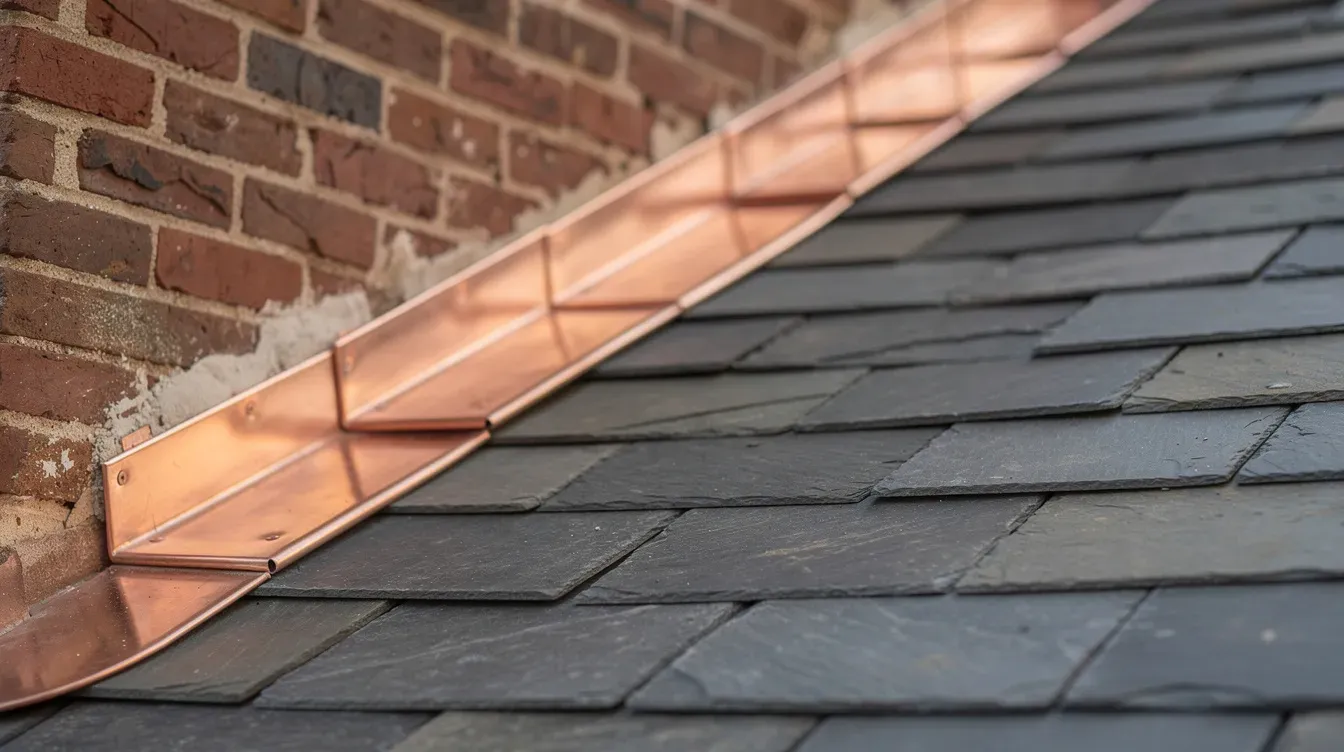
TL;DR: Copper flashing is sheet copper bent to keep water out wherever a roof runs into a wall, a chimney, a valley or an edge. For roofs you want 16 or 20 ounce copper. The thin 30 gauge rolls some stores sell are craft weight. Copper resists corrosion and grows a patina that protects it, and IBHS puts copper roofing at 80 to 100 plus years, though flashing on a slate roof usually gets rebuilt somewhere around years 50 to 75. Solder it or lock it together, and keep it away from aluminum and zinc.
Copper · 13 min read
Water runs down a roof just fine until it hits something. A chimney. A dormer wall. The inside corner where two slopes meet. Copper flashing is the bent sheet metal that catches the water at those spots and puts it back on top of the roofing, where it belongs.
On an old Boston house the roof is full of those spots, and that’s where leaks like to start. Most of the copper calls we get aren’t for a new roof at all. Somebody has a green stain on a ceiling, or a seam opened up after a hard winter, or the flashing pulled away from a chimney. The field of a copper roof almost never fails. The joints do.
So this is a guide to the joints. It starts with the pieces and why copper gets picked over cheaper metal. Then the confusing part, what 16 ounce and 30 gauge really mean. After that I get into how it’s joined, the metals it can’t touch, and what to check if you’re buying a roll yourself. The numbers come from sources named in the text, mostly the Copper Development Association (CDA) and the Insurance Institute for Business and Home Safety (IBHS), plus the published listings from flashing makers.
What copper flashing actually does on a roof
Think of it as a set of overlapping metal pieces that redirect water away from every gap in the roof. Each piece laps over the one below it, so water always lands on something that sheds it downhill. Done right, the whole thing works as one system from the ridge to the gutter.
These are the pieces you’ll find on most older houses around here:
- Step flashing, the short bent pieces woven in with each course of slate or shingle where the roof meets a sidewall or a chimney
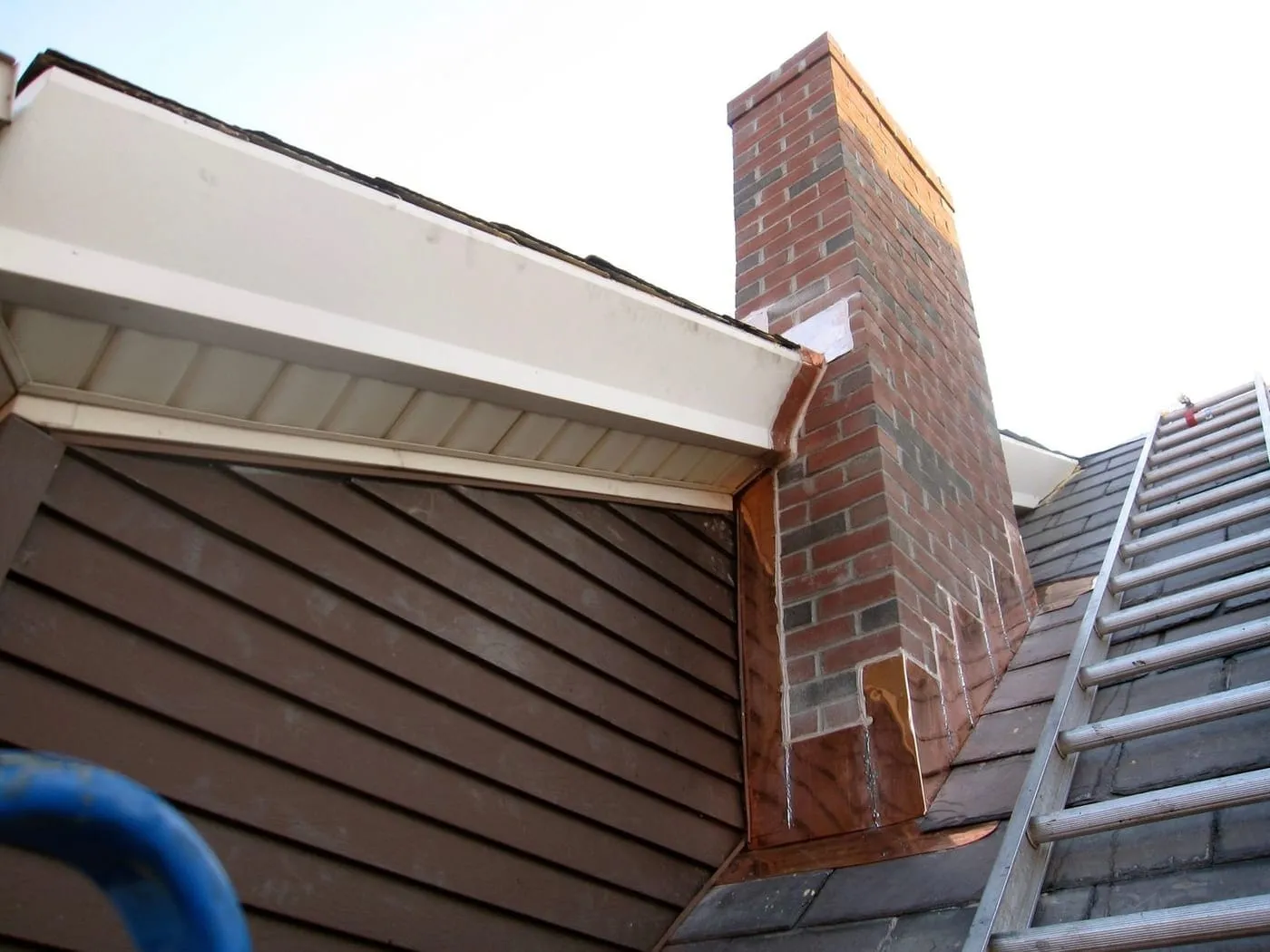
- Counterflashing, which caps the step flashing and is set into the brick, either in a mortar joint or a cut groove called a reglet
- Valley flashing, a long strip that lines the inside corner between two slopes
- A cricket or saddle, the little peaked roof behind a wide chimney that splits the water around it
- Aprons and edge pieces at the front of a chimney, under a dormer, and along the eaves
Miss one and the leak has a head start.
Why roofers keep choosing copper
It costs more than aluminum or galvanized steel. Nobody argues that. People choose copper for its durability, and because it’s easy for a good roofer to bend and solder into whatever shape an old chimney demands.
The green is the good part
Copper doesn’t rust.
New flashing goes in bright as a penny and turns brown within months. Then it takes its time. Over many years it weathers toward the blue-green you see on old church roofs and steeples.
The CDA’s Copper in Architecture Design Handbook explains what’s going on. Acidic moisture reacts with the surface, and the patina that forms “adheres tightly” and protects the copper from further weathering. That green layer is the metal sealing itself up, so please don’t let anyone scrub it off.
On lifespan, IBHS puts properly installed copper roof systems at 80 to 100 plus years. Flashing gets a rougher deal than the rest of the roof because it sits right where the water and the movement pile up. Our slate lifespan guide puts the first full flashing renewal on a slate roof at years 50 to 75. That’s when the copper valleys and aprons that have carried water for two generations get rebuilt, and the stone is usually still fine.
It moves more than you’d think
Cold doesn’t bother it. Copper stays ductile in deep cold, so it bends with the house where some plastic and rubber flashings get brittle and crack. Heat isn’t a worry either, since copper won’t melt until about 1,980°F.
Movement is the thing to respect. The CDA lists copper’s thermal expansion at 0.0000098 per degree Fahrenheit, which sounds like nothing. Now take a 10 foot piece through a 100 degree swing, from a January night to a July afternoon on a south-facing roof. It grows and shrinks by about 1/8 inch, every year it’s up there. Good designs allow for thermal movement. Cleats hold the metal without pinning it, and slip joints and expansion joints give it room to slide. Nail straight through a long piece and sooner or later it buckles or tears at the nails. It’s why our copper roofing page says we cleat the metal so it can move with the weather.
Easy to work, and it’s still worth money at the end
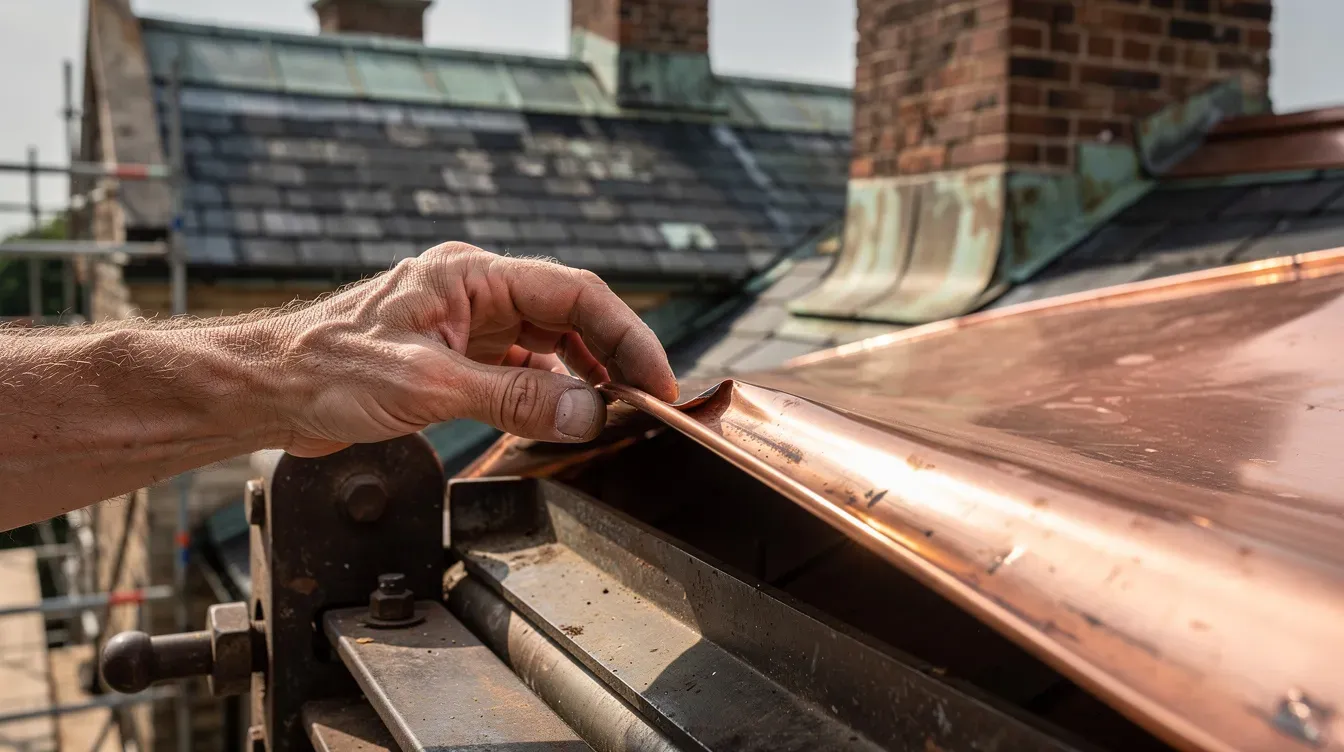
Copper is soft enough to fold into a tight hem on a brake and it takes solder well. That suits restoration work, where you’re matching a cap that was bent by hand a hundred years ago, and it suits new construction just as well. Same old techniques.
Old copper doesn’t go in the dumpster when it finally comes off. Scrap yards pay for it. The CDA says copper can be recycled again and again without any loss in performance, and its handbook notes that premium scrap normally holds at least 95 percent of the value of new metal.
Copper flashing weights, or why 16 ounce and 30 gauge aren’t the same thing
Roofers talk about copper in ounces. That’s weight per square foot, so a square foot of “16 ounce” copper weighs 16 ounces, which is a pound. In thickness, the CDA’s handbook lists 16 oz at about 0.0216 inch and 20 oz at about 0.027.
Sixteen is the CDA’s minimum for counterflashing and copings. We go heavier in valleys, because a valley drains two slopes at once, and on our copper ridge and valley project you can read why 20 ounce is our standard there.
You can buy rolls in either weight, and working out what one weighs per foot takes about ten seconds. A 16 inch roll of 16 oz copper covers 1.333 square feet per running foot, so it weighs about 1.333 pounds a foot. Sellers round it to 1.334. A 20 inch roll of 16 oz comes in around 1.67 pounds a foot.
That 30 gauge roll at the hardware store
You’ll see listings for “30 gauge dead soft copper” and figure it’s the same stuff. It isn’t close. Thirty gauge copper is about 0.010 inch thick, roughly 7 ounces per square foot, so it’s less than half as thick as 16 ounce. Dead soft means fully annealed. You can bend it by hand and cut it with snips, which makes it great for crafts and small patches.
The CDA doesn’t recommend soft copper for most building work anyway. Its handbook calls soft temper “extremely malleable,” good for ornamental pieces, and says cold rolled copper is much stronger and by far the most popular temper in construction.
One more trap. Gauge numbers don’t line up between sellers. The CDA’s table pairs 16 oz with 23 gauge on the B&S scale, while some sellers call the same 16 oz roll 24 gauge. Go by the ounces.
Solder or lock: how the pieces get joined
You join copper flashing by soldering or with mechanical locks.
A soldered joint fuses the pieces into one watertight unit. That’s what we want anywhere around a chimney. On our brick chimney copper flashing project, the chimney was showing white chalky bloom on an inside wall. Water was tracking down through the masonry because the crown had failed and the old step flashing had rusted out. The chimney came down to the roofline and went back up with sweat-soldered 20 ounce copper step flashing and a new copper cricket, where there had never been one.
Locked seams fold the edges of two pieces together. They’re used where the metal has to slide a little, and cleats hold the copper down without a nail going through it.
Some joints can take a sealant in place of solder, according to the CDA, but only one tested as safe with copper. The handbook warns that acrylic, neoprene and nitrile based sealants have been seen to actively corrode copper. If a contractor’s plan is to run a bead of caulk along the joints, that’s a roof cement repair wearing a copper coat.
On slate the flashing has to go in with the stone. Step flashing gets woven in course by course as the slate goes on, and the counterflashing laps down over it from the brick. Skip the weave and you’ve got a leak waiting for its first good storm.
Copper flashing doesn’t get along with other metals
Put copper against a different metal, add rain, and you get galvanic corrosion. One of the two metals wears away.
Most people assume the copper takes the damage. The CDA says the reverse. It ranks copper near the top of the scale and says it “will not be harmed” by contact with the more common metals but “will cause corrosion of the other metals.” Aluminum and zinc are the big worries, and galvanized steel is zinc coated. Plain iron and steel usually hold up next to copper unless the steel is small compared with the copper. A steel nail is exactly that case.
So the rules on a copper job are short. Fasten copper with copper, brass, bronze or stainless steel. Keep aluminum gutters and drip edges from touching it. The CDA also warns against letting water off copper drain onto aluminum, since the copper salts in that runoff can speed up corrosion of the aluminum. Where two metals have to meet, a compatible tape, gasket or coating goes between them.
Slate roofs have one more quirk. The CDA describes “line corrosion,” where water coming off slate or asphalt keeps hitting the same narrow line on the copper below, and the copper can deteriorate along that line before it ever forms a patina. Raising the edge of the roofing off the copper fixes it. So does a replaceable strip.
Buying copper flashing yourself: SKU, roll size, delivery and reviews
Maybe you’re patching a shed roof, or you just want to see what the material looks like before you hire anyone. Fine. Store listings for copper flashing all look alike, so check a few things before any item goes in your cart.
- Look up the SKU or model number and read what’s behind it, the weight in ounces, the thickness and the temper. Amerimax, a flashing maker, sells a 20 inch by 10 foot copper roll as model 67320, listed at 16 oz and 0.021 inch.
- If the listing only gives a gauge, convert it. A 30 gauge roll is craft weight.
- Select a roll width that fits the piece you’re bending, with some left over for the lap. A valley needs a wider roll than step flashing does. The ideal roll is the one you can cut with the least waste.
- Ask about delivery. That 20 inch by 10 foot roll of 16 oz weighs close to 17 pounds, and supplier rolls can run 80 to 100. Copper dents and creases easily, so open the box and look it over when it shows up.
- Read the reviews. You’re looking for complaints about thin or mislabeled metal, crushed boxes, or copper colored metal sold as copper.
Prices move with the copper market. When we checked in October 2026, retail listings for that Amerimax roll ran from about $300 to $380.
Getting through checkout with the right material won’t ensure a dry roof, though. Old brick is rarely square. A perfect fit means measuring the actual chimney, bending the copper right there on the roof and seating every piece, and that’s where the hours in a flashing job go. Flashing cut and bent on site to the wall in front of you will seal better than a stock piece.
When does it need a look?
Copper wants very little from you. No paint, no sealer. I’d still have someone look at it every few years, and after a rough winter. These are the things I’d want to hear about:
- A stain on a ceiling or wall near a chimney, dormer or skylight
- A gap between the counterflashing and the brick, or mortar falling out of the joint that holds it
- Flashing that’s lifted, kinked or torn, usually at a nail
- A cracked or open solder joint
- Caulk smeared over a joint, which usually means somebody patched instead of fixing
- White chalky bloom on the inside face of a chimney
Brown or green copper by itself is normal. It only means something when it shows up next to soft mortar, an open joint or a leak.
If you’re looking at repairs, our roof flashing repair guide, chimney flashing repair guide and step flashing guide go further.
Frequently asked questions
What weight of copper flashing should I use?
Use 16 or 20 ounce. For counterflashing, the Copper Development Association’s handbook won’t go below 16 oz, which is about 0.0216 inch thick. We put 20 oz (about 0.027 inch) in valleys, where the most water runs. Thirty gauge is too thin for a roof.
How long does copper flashing last?
The metal can outlast you. IBHS puts properly installed copper roofing at 80 to 100 plus years. Flashing has a harder life than the rest of the roof, though, since it catches the water and takes the movement. On a slate roof the first real flashing rebuild tends to land somewhere in years 50 to 75, and sooner if the original job was sloppy or a chimney crown let go.
Does copper flashing turn green?
Eventually. Brown comes first, then green over decades, and the Copper Development Association says the timing varies with the air. Leave the patina alone. It protects the metal.
Can copper flashing touch aluminum or galvanized steel?
Keep them apart. If copper touches aluminum or zinc in wet weather, it’s the aluminum or zinc that corrodes, and galvanized steel is coated in zinc. The copper comes through fine. That surprises people. It’s also why nails and screws on a copper job should be copper, brass, bronze or stainless steel, and why you don’t want water off copper draining onto an aluminum gutter.
Is 30 gauge copper strong enough for roof flashing?
No. Thirty gauge copper is about 0.010 inch thick, roughly 7 ounces per square foot. That’s less than half the 16 oz minimum the Copper Development Association recommends for counterflashing. You can bend it with your fingers and cut it with snips, which makes it great on a craft table. It won’t hold up on a roof for decades.
How is copper flashing joined?
Solder, or a folded mechanical lock where the piece needs to slide.
Talk to the owner
What your flashing needs depends on the roof in front of us. How old the copper is, how the chimney and walls are built, what other metal is up there, where the water goes in a storm. I can’t tell you that from a photo.
So every job starts the same way. I walk the roof myself before a price goes on paper, and that walk is free. Take a look at our copper roofing page and chimney repair page, schedule a free assessment, or call 617-913-1130. You’ll get a straight answer on whether the flashing needs work now, in a few years, or not at all.