How Long Does a Slate Roof Last? Slate Roof Lifespan in New England
How long does a slate roof last in Boston? Real slate roof lifespan by stone type, plus why fasteners, copper flashing, and ice dams fail first.
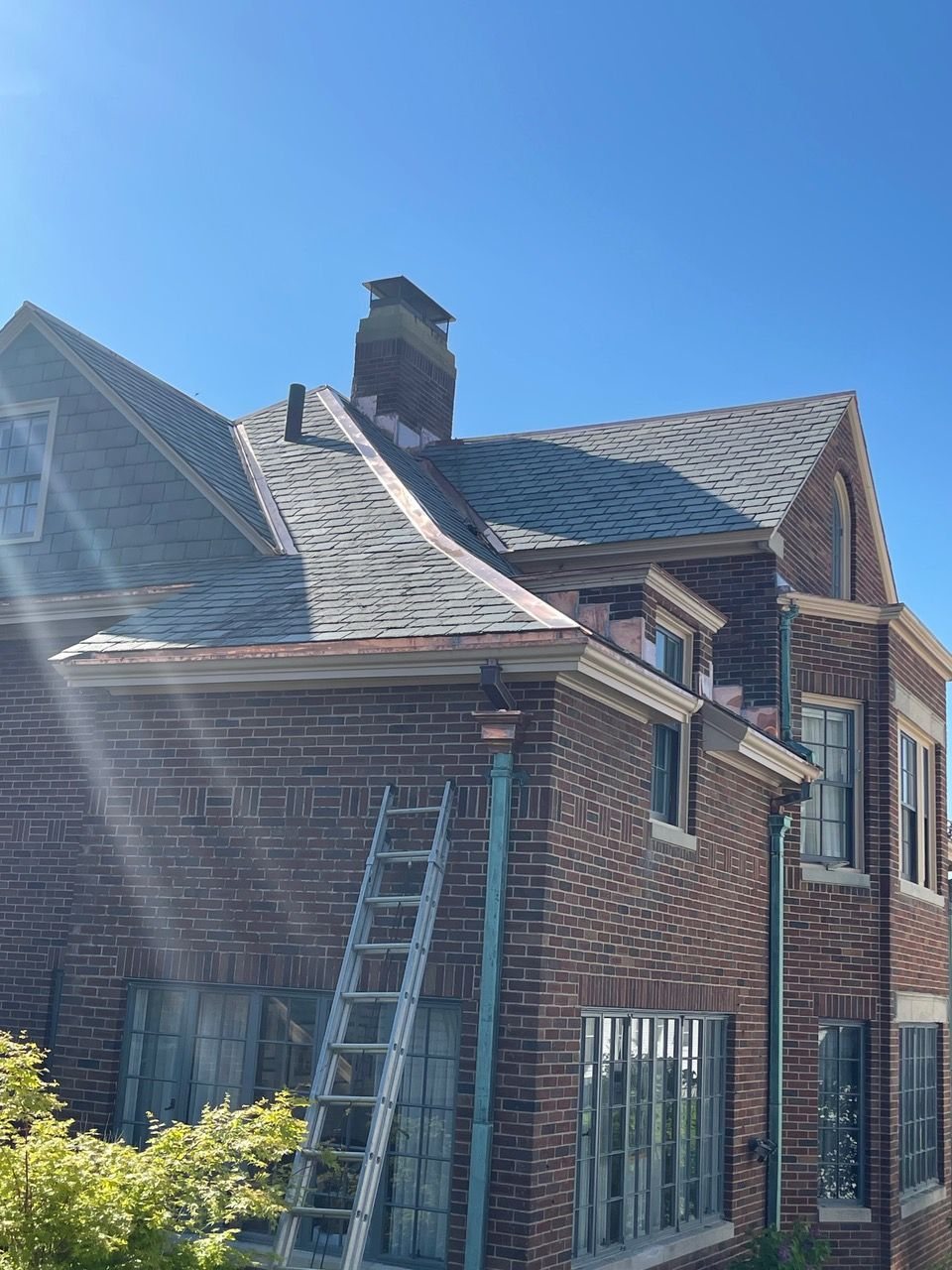
TL;DR: How long does a slate roof last? On a Greater Boston house, real slate runs 75 to 150 years, with the hardest Buckingham Virginia stone at the top of that range. But the stone is rarely what dies first. Slate roof lifespan around New England is usually capped by the copper flashing, the fasteners, and ice dam damage at the eaves. Look after those and the same roof outlives three asphalt roofs.
Slate · 13 min read
How long does a slate roof last? On a Greater Boston house, a real slate roof lasts 75 to 150 years, and the hardest Buckingham Virginia stone sits at the top of that range. That is the number most homeowners come looking for, and it is true. It is also only half the story.
Here is the part a quick article skips. The stone is rarely what dies first. On the roofs Arturo walks in Cambridge, Newton, and the South End, slate roof lifespan is almost never limited by the slate. It is limited by the copper flashing, the nails holding the slate up, and the damage New England winters do at the eaves. Get those right and the same roof outlives you. Get them wrong and a 150-year stone leaks in 30.
How long does a slate roof last? The short answer for New England
A properly installed natural slate roof lasts 75 to 150 years. That is the working range, and the National Park Service lands close to it. In Preservation Brief 29, the Park Service says slate roofs can last 60 to 125 years or longer depending on the slate type, the roof shape, and the climate.
Around Boston the high end is not a sales line. We still repair slate roofs framed in the 1890s and early 1900s on Victorians in Somerville, brick rowhouses in the Back Bay, and Colonials in Belmont and Lexington. Many are on their original stone. What they have replaced, sometimes twice, is the flashing.
So the honest answer has two numbers. The stone: 75 to 150 years. Everything else holding the roof together: 40 to 80 years. The roof lives as long as the shorter number gets renewed before it takes the longer one down with it.
Slate roof lifespan by stone type
Not all slate ages the same. The single biggest factor in how long slate roofs last is the stone itself, and it splits into hard slate and soft slate.
Hard slate
Hard slate is the stone people picture on an old roof that is still working. Two names come up constantly around New England:
- Vermont slate. Quarried a few hours north of Boston, in gray, green, purple, black, and unfading red. The National Park Service puts Vermont and New York slate at about 125 years.
- Buckingham Virginia slate. A dense blue-black stone at the top of the range. The National Park Service puts it at 175 years or more.
Hard slate handles freeze and thaw well, which matters more here than almost anywhere. It stays flat, holds its color, and rings when you tap it. On these roofs the nails and copper almost always fail first.
Soft slate
Soft slate is still natural stone. It just ages faster. Pennsylvania soft vein and ribbon slate are the common ones under older New England houses. The National Park Service puts soft vein slate at more than 60 years and calls ribbon slate less durable than clear stone, which is why ribbon slate is no longer made for roofing.
You can see it going. The face starts to flake. Thin layers peel off like pages. The stone turns powdery and the tap goes dull instead of sharp. Once a whole slope is delaminating, swapping one broken piece does not fix anything. The slate itself has reached the end.
The grading behind the numbers
There is a standard under all of this. ASTM C406 grades roofing slate by expected service life: S1 for more than 75 years, S2 for 40 to 75 years, and S3 for 20 to 40 years. Hard Vermont and Buckingham stone sits at S1. When a quote names the slate grade and the quarry, that is a good sign. When it just says “slate,” ask.
The National Slate Association ties the fasteners to the stone for the same reason: large-head solid copper nails are specified for S1 slate so the nail lasts as long as the roof it holds.
What actually fails first on a Boston slate roof
This is the part worth reading twice. When a slate roof leaks around here, the stone is usually fine. Something around it gave out.
Here is what Arturo looks for on a roof walk, in the order these parts tend to fail:
- Nails. Old cut-iron or steel nails rust. As they go, individual slates slip down out of their course and leave a dark gap. Copper or stainless nails do not do this. A roof fastened with steel in 1920 is living on borrowed time regardless of how good the stone is.
- Chimney and sidewall flashing. Counterflashing set into brick mortar joints loosens as the mortar ages. Water runs down the chimney and behind the slate. This is the leak we get called about most.
- Valleys. A copper valley carries the water off two slopes at once, so it wears faster than the field. Old valleys thin, crack at the folds, and let water track sideways under the slate.
- The eaves. Ice dams. More on those below, because in New England they do more damage than the other three combined.
Notice what is not on that list until near the end: the slate. A cracked slate here and there is normal and gets swapped in an afternoon. Wholesale stone failure is the exception, not the rule. If you own slate and are trying to read the warning signs yourself, we broke them down piece by piece in how to fix slate roof problems before the leak.
How New England weather shortens slate roof life expectancy
Climate is why a slate roof in Boston does not last as long as the same stone in a mild, dry place. Three things do the damage here.
Freeze-thaw. Water gets into a hairline crack or a soft slate’s layers, freezes, expands, and levers the stone apart. We run through this cycle dozens of times a winter. Hard slate shrugs it off. Soft slate does not, which is why Pennsylvania ribbon slate ages faster on a Newton roof than it would in a gentler climate.
Ice dams. Heat escapes the attic, melts the snow on the upper roof, and the meltwater refreezes at the cold eave. The ice backs up under the first few courses of slate and sits there. Slate sheds water running downhill. It was never meant to hold back a pond of standing meltwater pushing uphill. This is the single most common way a sound slate roof in Greater Boston starts leaking at the eaves and rotting the deck.
Coastal salt. On the North Shore, in Marblehead, Swampscott, and along the water, salt air is hard on the metal. Copper holds up. Any steel fastener or steel flashing corrodes faster near the coast, which moves the flashing failure earlier.
The fix for all three is the same idea. Keep the flashing sound, keep the eaves protected with ice and water membrane, and keep the attic ventilated so ice dams do not form. The stone can handle the winter. The details around it need help.
A decade-by-decade timeline for a Boston slate roof
Nobody else lays it out this way, so here is a realistic life for a hard slate roof in the Boston area, assuming reasonable care:
- Years 0 to 30. Almost no work if the install was right. Maybe a cracked slate from a fallen branch or a chimney sweep’s boot.
- Years 30 to 50. First real attention at the details. Chimney counterflashing may want resetting. A valley might get watched. Slates fastened with steel start slipping and get re-secured with copper.
- Years 50 to 75. The first flashing renewal comes due. Copper valleys and aprons that have carried water for two generations get rebuilt. The stone is still fine.
- Years 75 to 100. A second round of flashing work. On soft slate, this is often where the stone itself is done. On hard Vermont or Buckingham slate, the roof carries on.
- Years 100 and up. Hard slate keeps going. By now the roof has usually had two flashing cycles and countless individual slate swaps, all of it far cheaper than the tear-offs an asphalt house went through in the same century.
The lesson in that timeline is simple. Budget for flashing at 40 to 80 years. Do not budget for new stone unless the stone is soft or the original install was bad.
Slate roof maintenance that adds decades
Slate does not need coating, sealing, or pressure washing. It needs attention. Slate roof maintenance around here comes down to a short list:
- Keep the gutters clear so water leaves the roof instead of backing up at the eave.
- Manage ice dams: attic insulation, ventilation, and ice and water membrane at the eaves.
- Reset or renew copper flashing at chimneys, valleys, and sidewalls before it fails, not after.
- Swap cracked or slipped slates promptly so one gap does not wet the deck.
- Never walk the roof yourself. Slate breaks under foot traffic, and a wet slate roof is dangerous.
Do that and the flashing lasts longer, the deck stays dry, and the stone reaches its full run. Skip it and water finds the deck, the sheathing rots, and a roof that had 60 good years left starts failing at 40. Most early slate failures we see were not worn out. They were neglected. If yours is already showing trouble, start with our slate roof repair guide for Boston homes.
How slate roof lifespan compares to asphalt and metal
Put the numbers side by side and the math gets clear:
- Asphalt shingles in Greater Boston: about 18 to 25 years.
- Standing seam metal: 40 to 70 years.
- Natural slate: 75 to 150 years, hard slate at the top of that range.
Over the life of one hard slate roof, a house runs through three to five asphalt roofs. That is three to five tear-offs, three to five dumpsters, three to five crews. Asphalt wins on the price you pay on day one. Slate wins on the price you pay per year you own the house. For a home you plan to keep, or a historic house where the roof is part of the architecture, that changes the whole calculation.
Slate also brings fire resistance and rot resistance that the other two cannot match. The tradeoffs are weight, up-front cost, and the need for a crew that actually works in slate. We walk through those tradeoffs in the slate tile roof basics guide, and the full pricing side lives in our slate roof installation guide for Boston.
When the lifespan finally runs out: repair or replace
A long lifespan does not mean forever. At some point the question becomes repair or replace, and the answer is not about age alone. It is about condition.
Repair when the stone is mostly sound and the trouble is local: a few slipped slates, one tired valley, a chimney detail. Slate was built for this. Individual pieces come out and go back in, salvage stone keeps the color match close, and the sound roof stays put. If the fix is local like this and you are weighing who to call, our note on finding slate roof repair near you walks through what to look for.
Replace when the problems are everywhere at once. Slates sliding across a whole slope. Failing nails through the field. A soft slate roof flaking face by face. Tired flashing at every detail with a deck that has already taken water. We use the same condition tests every time, and they are laid out in when a slate roof needs replacement.
The mistake is assuming an old slate roof is a dead slate roof. Often it is a good stone roof wearing worn-out flashing. Those are very different bills.
Frequently asked questions
How long does a slate roof last?
A well installed natural slate roof lasts 75 to 150 years. Buckingham Virginia slate sits at the top of that range, and the National Park Service puts it at 175 years or more. Pennsylvania soft vein slate has a shorter record, more than 60 years by the same source. In every case the copper flashing and fasteners usually need work decades before the stone does.
What is the average slate roof lifespan in New England?
Around Boston we still walk slate roofs from the 1890s and early 1900s that are sound. A realistic slate roof lifespan here is 100 years and up for hard slate, provided the flashing gets renewed once or twice and ice dams are kept off the eaves.
What fails first on a slate roof, the slate or something else?
Almost always something else. Old steel or iron nails rust and slates slip. Copper valleys and chimney counterflashing wear after 40 to 80 years. Ice dams push water under the first courses. The stone often outlasts every one of those parts.
Do hard slate and soft slate last the same amount of time?
No. Hard slate such as Vermont unfading green or Buckingham Virginia black commonly passes 100 years. Soft slate such as Pennsylvania soft vein or ribbon slate ages faster, flakes, and delaminates, sometimes after little more than 60 years. The two look similar on day one and age very differently.
How does slate roof life expectancy compare to asphalt?
An asphalt roof in Greater Boston lasts about 18 to 25 years. A slate roof lasts 75 to 150. Over the life of one slate roof a house would go through three to five asphalt roofs, which is why the real comparison is cost over decades, not the price on day one.
Does slate roof maintenance really add decades?
Yes. Clearing gutters, keeping ice dams off the eaves, and renewing copper flashing before it fails stops a small problem from soaking the deck. Most slate roofs that fail early were not worn out. They were neglected until water got behind the stone.
Talk to the owner
The only honest way to answer how long your slate roof has left is to look at it. Not the stone alone, but the nails, the copper at the chimneys and valleys, the eaves, and the deck underneath.
Every slate roof Art Slate quotes gets walked by Arturo before a number goes on paper. Review our slate and copper roofing service for Greater Boston, or schedule a free assessment. Arturo can tell you whether your roof is a repair, a flashing job, or a stone that has genuinely reached the end.