Slate Tile Roof Basics for Boston Homes: Types, Cost, and Lifespan
Slate tile roof basics for Boston homeowners: natural slate tiles, installation, cost, lifespan, and when slate makes sense for an old house.
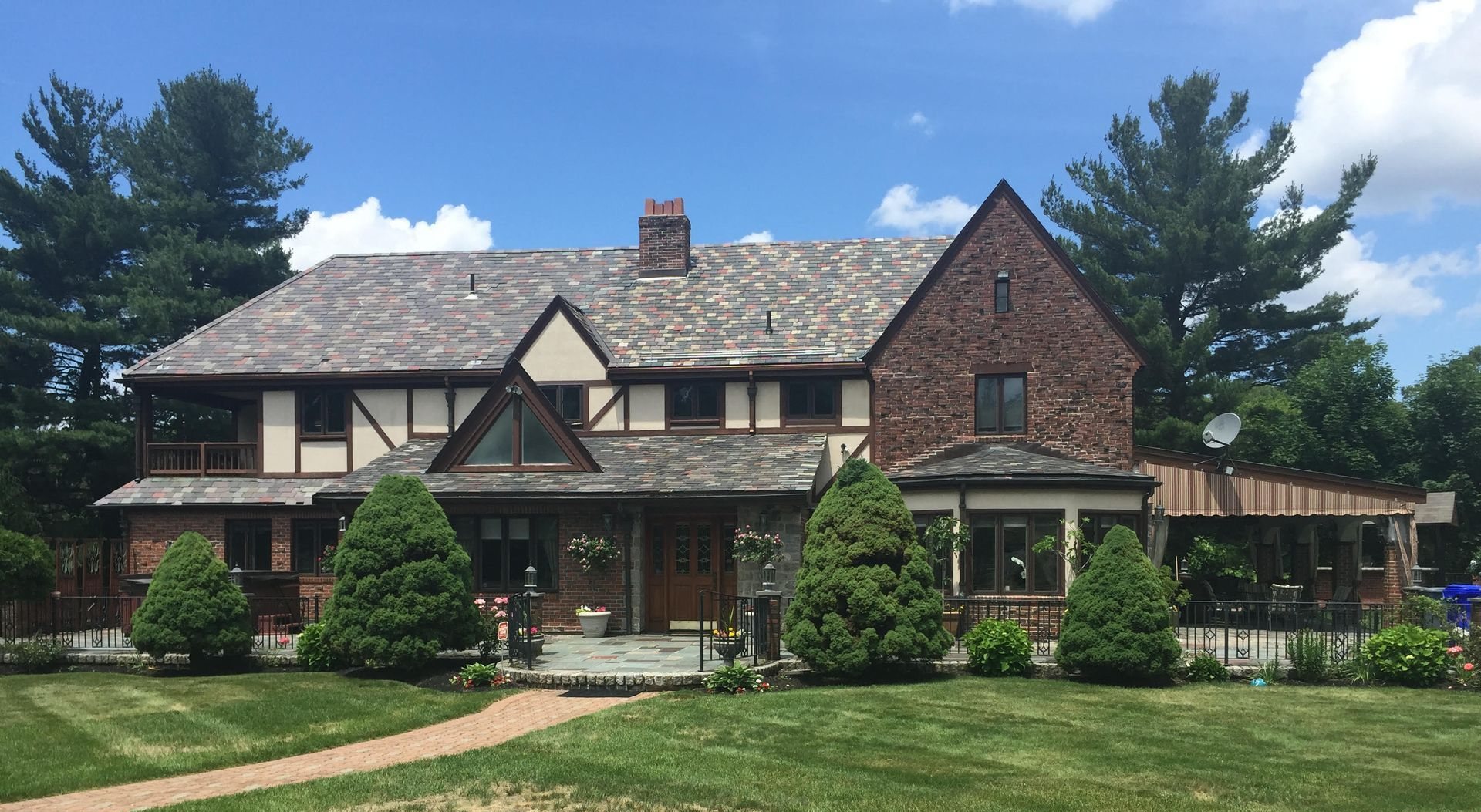
TL;DR: A slate tile roof is a roof made from individual pieces of quarried stone, hung in overlapping courses so water sheds down the face. On the right Boston house, natural slate roof tiles can run 75 to 150 years. The tradeoff is weight, labor, copper flashing, and cost. Most Greater Boston slate projects land in the tens of thousands, not the low asphalt range.
Slate · 12 min read
A slate tile roof looks simple from the street. Rows of stone. Copper at the valleys. Maybe a little color variation if the house is a Tudor or an older Colonial.
Up close, it is less simple.
Each piece has to hang right. Each course has to cover the nail holes below it. The chimney flashing has to be built before the slate hides it. The house has to carry the weight. Miss one of those things and a roof that looks expensive can still leak.
That is the part homeowners usually do not get from a quick quote.
Maybe you already have slate roof tiles and you are trying to decide if they are still good. Maybe your asphalt roof is near the end and someone mentioned slate. Maybe you are buying an old house in Cambridge, Newton, Brookline, Somerville, Beacon Hill, or the South End and the roof looks beautiful but expensive.
Fair questions.
The plain answer is this: slate is not a dressed-up asphalt shingle. It is a different roof. On the right Boston house, installed by people who work with slate all the time, it can last longer than almost anything else on the building. On the wrong house, or with the wrong crew, it becomes an expensive mistake.
What a slate tile roof actually is
A slate tile roof is made from pieces of quarried stone. Roofers usually call one piece a slate. Homeowners may call the same thing a slate tile, slate shingle, or slate roofing tile. The words move around. The roof does not.
Each piece overlaps the pieces below it. Water runs down the face of the stone and into the gutter. The roof stays dry because of slope, overlap, side offset, fasteners, and flashing, not because one piece of stone is magic by itself.
The hidden word is headlap.
Headlap is the overlap between a slate and the slate two courses below it. The National Slate Association includes headlap, exposure, and offset in its basic slate roofing principles because that is where water either gets blocked or finds a path.
On an 18 inch slate with 3 inches of headlap, only 7.5 inches shows. The rest is covered. From the ground you see the exposed face. The covered part is doing a lot of the work.
On a Boston roof, the surrounding details matter just as much:
- Copper flashing at chimneys, sidewalls, dormers, and valleys
- Ice and water protection at the eaves
- Sound board sheathing or plywood under the slate
- Copper or stainless fasteners that do not rust away early
- Enough roof pitch for slate to shed properly
- A slate size and layout that match the pitch and exposure
If one of those details is wrong, the stone can be perfectly good and the roof can still leak.
If you already own slate and are trying to decide whether the roof is still sound, start with our slate roof repair versus replacement guide. If you are pricing a new slate system, the installation details below pair with our Boston slate roof installation guide.
Slate tile roof types: what homeowners are really choosing
Most homeowners think the choice is slate or not slate. There are a few choices inside that word.
Hard slate
Hard slate is the material most people picture when they think of an old slate roof that is still doing its job. Vermont slate and Buckingham Virginia slate are the names Boston homeowners hear most.
Good hard slate can run past a century. It handles freeze and thaw better than softer stone. Many times the nails, valleys, or chimney flashing fail before the slate itself does.
That does not make every hard slate roof good. A good stone installed badly is still a bad roof. But if the roof is laid correctly, hard slate gives the house the longest runway.
Soft slate
Soft slate is still natural stone. It just ages faster. Pennsylvania ribbon slate is the common example around older New England houses.
It can look good for a long time. Then the face starts to flake. Thin layers peel. The stone turns powdery. At that point, replacing one broken piece does not solve the real issue.
A cracked hard slate can often be swapped and forgotten. A whole slope of soft slate that is delaminating is a roof-age problem.
Graduated slate
Some historic roofs use larger, thicker slate near the eaves and smaller slate near the ridge. That is a graduated slate roof. It gives the roof depth. You see it on better old houses where the roof was part of the architecture, not just the cap on top.
Repairs take more care. The new piece has to match color, size, and thickness. Put a thin piece into a thick lower course and the patch looks cheap. Put a thick piece up high and it can sit proud of the roof.
Random-width and patterned slate
Some slate roofs have consistent courses but different widths. Some mix colors: gray, green, black, purple, red. Tudor homes and larger historic houses can carry that look well.
Pattern is not only decoration. It affects sourcing. A plain gray slate repair may be straightforward. A mixed-color roof can take longer because the new pieces have to disappear into the old field.
Synthetic slate
Synthetic slate is not a natural slate tile roof. It is usually polymer, rubber, composite, or another manufactured product shaped to look like slate.
It can make sense. Weight may rule out stone. Budget may rule out stone. A rear slope or newer addition may not deserve natural slate.
But synthetic should be priced as its own roof, not as a quiet substitute for stone. It does not have the same 100-year history as quarried slate, and repairs are different. If a proposal treats synthetic and natural slate like the same item, ask exactly what is being installed.
That same material choice shows up in historic work. On regulated homes, the question is not only what looks close, but what the building originally carried and what the district will approve. We cover that approval path in our historic roof permit primer and in our historic roof restoration service.
Slate roof tiles and the Boston houses that suit them
Slate makes the most sense on houses that were built for it, or on houses with the shape and value to justify it. Greater Boston has plenty of both.
You see slate roof tiles on Victorians in Somerville and Cambridge, brick rowhouses in Boston, Tudors in Newton and Brookline, older Colonials in Belmont and Lexington, and historic homes across the inner suburbs. Many of those houses were framed when heavy roofs were normal. The pitch, dormers, chimneys, cornice lines, and trim were designed with slate and copper in mind.
On those houses, slate is not an upgrade pasted onto the roof. It is often the roof the house expects.
The caution is weight. Natural slate is several times heavier than asphalt shingles. A house that carried slate for 100 years has already answered part of that question, but Arturo still looks for cut rafters, sagging, old leaks, bad repairs, and framing changes. A house that never had slate should be reviewed before anyone gets serious about the price.
Pitch is the next issue. Slate wants slope. Low-slope roofs are usually the wrong place for it. On a steep roof, water moves fast. On a low pitch, water lingers and wind can push it sideways under the laps. That changes the roof design.
This is why a slate quote without a roof walk is thin information. The house decides a lot of the system.
Slate tile roof pros and cons
The main argument for slate is lifespan. Natural slate roof tiles can outlast several asphalt roofs. On a house worth keeping, that changes the math.
Slate is also fire resistant, rot resistant, and hard to fake visually. On a Boston home with brick, copper, old framing, and historic proportions, slate looks right because it usually is right.
The other advantage is repairability. One broken slate roof tile can be replaced. A copper valley can be rebuilt. A few slipped slates can be re-secured. You do not tear off a sound slate roof because one area failed.
Now the hard side.
Slate is heavy. It costs more up front. It needs a crew that knows slate, not just shingles. It breaks under careless foot traffic. Matching old slate can take time. A small slate repair can be reasonable; a full slate tile roof installation is not a budget roof.
Maintenance is different too. Slate does not need coating. It does need attention. Keep gutters clear. Watch chimneys and valleys. Look after storms. Fix small failures before water reaches the deck.
That is the trade. Slate gives you a long roof. It asks for the right house, the right installation, and some care over the years.
For the repair side of that trade, the common early warnings are missing slates, slipped slates, rust streaks, flaking stone, and stains at chimneys or valleys. Those signs are broken down one by one in fix slate roof problems before the leak.
Slate vs tile roof: the wording problem
Searches for slate vs tile roof get messy. In the United States, many homeowners say slate tile roof when they mean natural slate roofing. In other places, tile roof usually means clay or concrete tile, and slate is treated as a separate stone roof.
For a Boston homeowner, the material matters more than the wording.
Clay tile and concrete tile can last a long time, but they are not slate. They have different weight, fastening, breakage, underlayment, and repair details. They also look different on New England houses.
Clay belongs on some houses. Concrete tile belongs on others. A Cambridge Victorian or Beacon Hill rowhouse usually has a different question: preserve the slate, replace it with slate, or choose a substitute because the budget or structure requires it.
If a contractor writes “tile” in a proposal, ask what material that means. Natural slate, synthetic slate, clay tile, concrete tile, and composite tile should not sit under one vague price line.
Slate tile roof cost in Boston: what moves the number
Slate tile roof cost is the question everyone asks first. The honest answer is a range with reasons, not one neat number.
National cost guides put slate in a wide band. Homewyse lists a 2026 install range around the high teens to mid $20s per square foot before local job conditions are added. HomeAdvisor notes that size, access, old roof removal, support, and labor drive slate roof cost. Those numbers help with scale. They do not price a Boston roof by themselves.
In Greater Boston, the things that move a slate quote are usually:
- Roof size, measured in squares
- Roof pitch and staging difficulty
- Street access, parking, and dumpster logistics
- Number of chimneys, dormers, valleys, and sidewalls
- Whether copper flashing is being rebuilt or patched
- Deck repair found after tear-off
- Whether the house needs structural review
- Slate type, size, thickness, and color
- Whether matching salvage slate is needed
For a small repair, slate can be targeted: replace broken or slipped slate roof tiles, fix the flashing, and leave the sound roof alone. For a full natural slate roof replacement in Greater Boston, the number is usually in the tens of thousands. Many whole-roof jobs land around $35,000 to $80,000. Complex roofs can go above that.
Cost per square foot is useful only as a rough translator. A simple gable roof with two clean slopes is one job. A steep historic roof with four dormers, two chimneys, a copper valley, tight staging, and rotten eaves is another. Same square footage on paper. Very different roof.
That is why the real comparison is not slate versus asphalt on day one. Asphalt wins day one. The better question is how long the owner will keep the house, what the house is worth with the right material, and whether the existing slate can be repaired instead of replaced.
If you are comparing materials, read the full slate versus asphalt shingles breakdown before treating the lowest first-year number as the right number. If copper valleys, chimney flashing, or gutters are part of the estimate, our copper roof cost guide explains the metal side separately.
Slate tile roof lifespan: why the stone is not usually the weak point
Slate tile roof lifespan depends on the stone, the installation, the roof shape, and the climate. The National Park Service says in Preservation Brief 29 that slate roofs can last 60 to 125 years or longer depending on the slate type, roof configuration, and location. Around Boston, we still see roofs from the late 1800s and early 1900s doing useful work.
The stone gets the attention. The failures often start somewhere else.
Fasteners age. Old iron or steel nails rust until slates start slipping. Copper flashing thins and cracks after decades of movement. Valleys wear faster because they carry more water. Chimneys leak when counterflashing fails or mortar joints open. Ice dams push water under the first courses. Foot traffic breaks good slate before weather does.
That is why slate roofs can be repaired for so long. If the stone is sound and the failure is a nail, flashing, or isolated break, a slate roofer can often keep the original roof working. If the slate itself is delaminating across a whole slope, the conversation changes.
Think of lifespan in layers:
- Stone: often 75 to 150 years, sometimes more
- Copper flashing: long-lived, but not forever
- Nails: excellent if copper or stainless, a problem if old steel
- Underlayment: not the main waterproofing forever
- Deck: good until leaks or trapped moisture damage it
The roof lasts when those layers are checked and renewed before one failure damages the next.
How slate roofing tiles are installed
Good slate installation is slow. The layout has to be right before the roof looks finished.
The roof is stripped in sections. The deck is checked and repaired. Ice and water protection goes at the eaves and other weak areas. Underlayment goes down as temporary protection and a working surface, not as the thing that makes the roof last. Copper valleys, apron flashing, step flashing, and counterflashing are built before the slate covers them.
Then the slate starts at the eaves.
Each course follows a chalk line. Each slate gets fastened so it hangs, not clamps. Drive the nail too tight and the stone can crack around it. Leave the nail proud and the slate above can rock on the head. Side laps are staggered. Headlap is kept course after course.
On a simple roof, that sounds repetitive. On a Boston roof with dormers, a chimney, a low rear addition, and two valleys, it gets fussy fast. The visible field slate is the part that looks easy. The hard part is where slate meets copper, brick, trim, and roof geometry.
That is where many bad slate jobs fail. A crew can be good at asphalt and still miss slate details. Slate does not forgive much. It is too rigid, too heavy, and too expensive to treat like a thick shingle.
Chimneys are the detail we see misread most often. If a slate roof leaks near a brick chimney, the answer is usually copper flashing and counterflashing, not roofing cement smeared around the slate. The full detail is in our chimney flashing repair guide and on our chimney repair service page.
Repair, replace, or switch materials
If you already own a slate roof, do not start with replacement. Start with condition.
A repair makes sense when the slate is mostly sound and the trouble is local: a few broken tiles, a slipped course, a flashing leak, or one chimney detail that needs to be rebuilt. Slate is made for that kind of work. Individual pieces can be removed and replaced. Flashing can be renewed. Salvaged slate can keep the color match close.
Replacement enters the conversation when the problems are everywhere. Slate sliding across one slope. Many cracked or missing pieces. Failing fasteners through the field. Tired flashing at every detail. A soft slate roof flaking across a whole face is in the same category.
Switching materials is a separate decision.
Asphalt can be the right answer when the house is newer, the budget is fixed, or the owner is not staying long enough for slate’s lifespan to matter. Synthetic slate can be the compromise when the house wants the look but cannot carry stone. Natural slate is the choice when the house is built for it, the owner is thinking long term, and the details can be done correctly.
There is no shame in any of those answers. The mistake is pretending they are the same roof.
For a full replacement decision, the practical tests are slate condition, fastener condition, flashing condition, deck condition, and whether the roof still suits the house. We use those same tests in when a slate roof needs replacement.
How to inspect a slate tile roof before you call
You can learn a lot without climbing. Do not walk on slate. It breaks under foot traffic, and a wet slate roof is not a place for a homeowner.
From the ground, use binoculars or a phone zoom and look for:
- Missing slates leaving dark gaps
- Slates hanging lower than the course around them
- Cracked corners or broken pieces
- Rust stains running down from fasteners
- Powdery or flaking slate faces
- Wavy copper at valleys
- Dark staining around chimneys and dormers
- Gutters full of slate flakes
Then look from the attic after rain. Look for daylight, damp sheathing, stains at rafters, and old patchwork around penetrations. A dry attic does not prove the roof is perfect. A damp attic tells you where the roof is already losing.
Take photos from the same spots each season. Slate problems often show as movement over time: one course slips lower, one gap opens, one rust stain grows. That record helps a slate roofer tell whether the roof is stable, declining, or already leaking.
The bottom line for Boston homeowners
A slate tile roof is a long-term roof, not a quick roof. The stone can outlast several asphalt roofs, but the job has to be built around weight, slope, headlap, fasteners, copper flashing, and the shape of the house.
If your Boston-area home already has natural slate roof tiles, the first question is not “what will replacement cost?” It is “how much of this roof is still sound?” Many slate roofs need careful repair, not a tear-off.
If you are considering slate for a house that does not have it now, the first question is not color. It is structure. Can the house carry the load? Does the pitch work? Does the budget include copper details and deck repair? Is the crew actually trained in slate?
Answer those questions honestly and the decision gets clearer. Slate is expensive up front. It is heavy. It is slow. On the right Boston house, installed the right way, it can become part of the building instead of another roof you expect to replace.
Frequently asked questions
What is a slate tile roof?
A slate tile roof is made from individual pieces of quarried stone. Each slate hangs from nails or hooks and overlaps the courses below it. The stone sheds water, but the roof works only when the headlap, offset, fasteners, flashings, and deck are right.
How long do slate roof tiles last?
Good natural slate roof tiles commonly last 75 to 150 years, and hard slate reaches the top of that range when the roof is installed correctly. The fasteners and flashing usually need work before the stone does.
What does a slate tile roof cost in Boston?
A full natural slate tile roof in Greater Boston usually runs in the tens of thousands. Size, pitch, access, copper valleys, chimneys, deck repair, and whether the house needs structural review all move the number.
Are slate roofing tiles too heavy for an old Boston house?
If the house originally carried slate, usually not. Many older Boston homes were framed for it. If the house was built for asphalt and never had slate, the framing should be reviewed before anyone prices the job.
Can broken slate roof tiles be replaced one at a time?
Yes. That is one reason slate roofs survive so long. A slate roofer can remove a broken piece, match the size and thickness, and fasten a replacement without tearing off the whole roof.
Is synthetic slate the same as a natural slate tile roof?
No. Synthetic slate can be useful when weight or budget rules out stone, but it is a different material with a different lifespan and repair profile. Natural slate is quarried stone.
Talk to the owner
If you are trying to decide whether a slate tile roof is right for your house, the useful first step is not a generic square-foot number. It is one person looking at the roof, the framing, the pitch, the copper, the chimney details, and the condition of the slate already there.
Every slate roof Art Slate quotes gets walked by Arturo before a number goes on paper. Review our slate and copper roofing service, see a full slate re-roof on a Boston brick house, or schedule a free assessment. Arturo can tell you whether the roof is a repair, a replacement, or a material decision to think through before spending the money.