Fix Slate Roof Problems Before the Leak: 7 Early Warning Signs Boston Homeowners Can Spot
The early signs you need to fix slate roof problems, read from the ground and the attic by a Boston roofer, plus which signs mean watch and which mean call now.
TL;DR: Most slate trouble shows itself long before a ceiling stain. If you want to fix slate roof problems before they become leaks, watch for missing or slipped slates, cracks, flaking stone, rust at the nails, attic daylight, and damp sheathing. Caught early, most of it is targeted repair, not a new roof.
Slate · 9 min read
A slate roof rarely fails all at once. If you are trying to fix slate roof problems before they become leaks, the first job is learning what the roof is already telling you. It tells you it needs attention months, sometimes years, before a stain reaches your ceiling. The trouble is that the early signs are quiet, and by the time most homeowners call us the water has already found the wood deck. This is the post we wish every Boston slate owner read first: how to read the roof from the ground and the attic, what each sign actually means, and which ones can wait versus which ones need a call this week.
Two things before we start. First, do not climb on the roof. Slate cracks under a boot and turns slick the moment it is damp, and a homeowner walking a slope causes more broken slate than most storms do. Everything below you can check from the sidewalk with a pair of binoculars and from your attic with a flashlight. Second, spotting a sign is good news, not bad. Caught early, almost every one of these is a targeted repair on a roof that has decades left. The expensive outcome is the one you do not catch.
Start from the sidewalk: what a slate roof in trouble looks like
Pick a morning or an evening when the light is low and raking across the roof instead of straight down. Flat light hides problems; angled light throws every displaced slate into shadow. Stand across the street, look at the whole plane of each slope, and let your eye hunt for anything that breaks the pattern. A healthy slate roof reads as a clean grid of straight, tight courses. What you are looking for is the break in that grid: a gap, a shadow, a streak, a wave in a line that should be dead straight.
Cracked and slipped slates are an early sign the roof needs attention, not a tear-off.
That is the whole method. The seven signs below are the specific things that break the pattern, roughly in the order they tend to show up. You do not need to diagnose them perfectly. You need to notice one, name it, and know whether it is a watch or a call.
These are also the slate roof repair signs behind most searches for slate roof repair near me, fixing slate roof tiles, and slate roof leak repair. The words change, but the roof usually points to the same few failures: a missing slate, a slipped slate, nail sickness, cracked stone, tired flashing, or water already showing inside.
Sign 1: A missing slate and the dark gap it leaves
The clearest sign is the simplest. A slate has come off entirely and left a gap, and because the underlayment and the wood beneath are darker than the stone, that gap reads as a black rectangle against the grey field. One missing slate after a windy night is common and usually a quick fix. What matters is the felt or the deck now sitting exposed to the weather at that spot.
Water does not always come straight in through a single gap, because slate roofs shed water in overlapping layers. But an open slot lets wind drive rain sideways under the surrounding slates, and it lets the sun break down the underlayment. A missing slate is a repair you want done within a few weeks, not left through a season. If you count several gaps scattered across one slope, that moves up the priority list, and it is worth reading our repair or replace framework to understand where the line sits.
Sign 2: Slates that have slipped out of line
Look along the horizontal courses. On a sound roof every slate in a course sits at the same height and the same angle. When a slate has slipped, its lower edge drops below the line of its neighbors, or it slides sideways and cocks at an angle that catches the light differently. Sometimes it has not fallen yet, it is just hanging lower than it should.
A slipped slate almost always means the fastener failed rather than the stone. This is the visible face of nail sickness, and the pattern tells the story. One slipped slate is a fastener that gave out early. A straight horizontal run of slipped slates means one nailing batten or one course of nails let go underneath. Slates slipping all over a slope, in no clean order, is the sign that fasteners across the whole face are near done. That last pattern is the one that turns a repair conversation into a replacement conversation, so a patch of slipped slates is worth an assessment sooner rather than later.
Sign 3: Cracked, chipped, or broken slates
Cracks and chips come from impact: a fallen branch, hail, a dropped tool from an earlier trade, or an icicle breaking loose. From the ground a cracked slate can be hard to see, but a chipped corner shows as a small bright or dark notch that interrupts the clean edge of a course. Binoculars earn their keep here.
A single crack looks minor and is easy to ignore, which is exactly why it causes trouble. A hairline crack holds water by capillary action, and in our climate that water freezes overnight and levers the crack wider every cold night of the winter. A slate you could have swapped for a few hundred dollars in the fall becomes a broken slate and a wet spot on the deck by spring. Cracked slate is the cheapest sign to act on and one of the costliest to leave, so if you can see one, put it on the short list to fix.
Sign 4: Slate that is flaking or turning powdery
This one is about the stone itself rather than the fasteners or an impact. When a slate reaches the end of its service life it delaminates, meaning the thin layers that make up the stone begin to separate. From the ground it reads as a surface that looks powdery, matte, or scaled instead of smooth, and you may see thin flakes of stone collected in the gutter below. Tap-testing, where a roofer listens for a dull thud instead of a clean ring, confirms it up close.
The reason this matters for the repair decision is that flaking is not something you fix on a single slate. A powdery slate here and there gets swapped like any other. But when a whole slope is going matte and shedding flakes, the stone on that face is spent, and no amount of patching brings it back. That is the difference between the material types: Vermont slate runs about 125 years by the National Park Service’s count, while soft Pennsylvania slate can flake out after little more than 60. If your roof is flaking across a plane, the honest read is a planning conversation about that slope, not a repair ticket.
Sign 5: Rust streaks and the quiet problem of nail sickness
Here is the sign almost every generic checklist misses, and the one that matters most on Boston’s older housing. Look for rust colored streaks running vertically down the slates, starting from where the hidden nails sit. Those stains are the fasteners rusting away behind the stone. The slate is fine. The nails holding it are dissolving.
This is nail sickness, and the timing is specifically a Boston problem. A large share of the slate roofs we work on sit on triple deckers, rowhouses, and Victorians built roughly between 1890 and 1920, and many still wear their original cut or early galvanized nails. In this damp, freezing climate those nails tend to give out somewhere around the 90 to 110 year mark. Do the arithmetic on a 1905 house and you land in that window right now. The National Park Service makes the underlying point in its guide to historic slate roofs: where deteriorated nails or flashings caused the failure, the slate itself can usually be salvaged and reused (NPS Preservation Brief 29). Rust streaks with the slates still holding is your early warning, the stage before the slates start to slip. Catch it here and the fix can be a re-nailing program that saves the original stone.
Sign 6: Stains and rust at the chimney, valleys, and walls
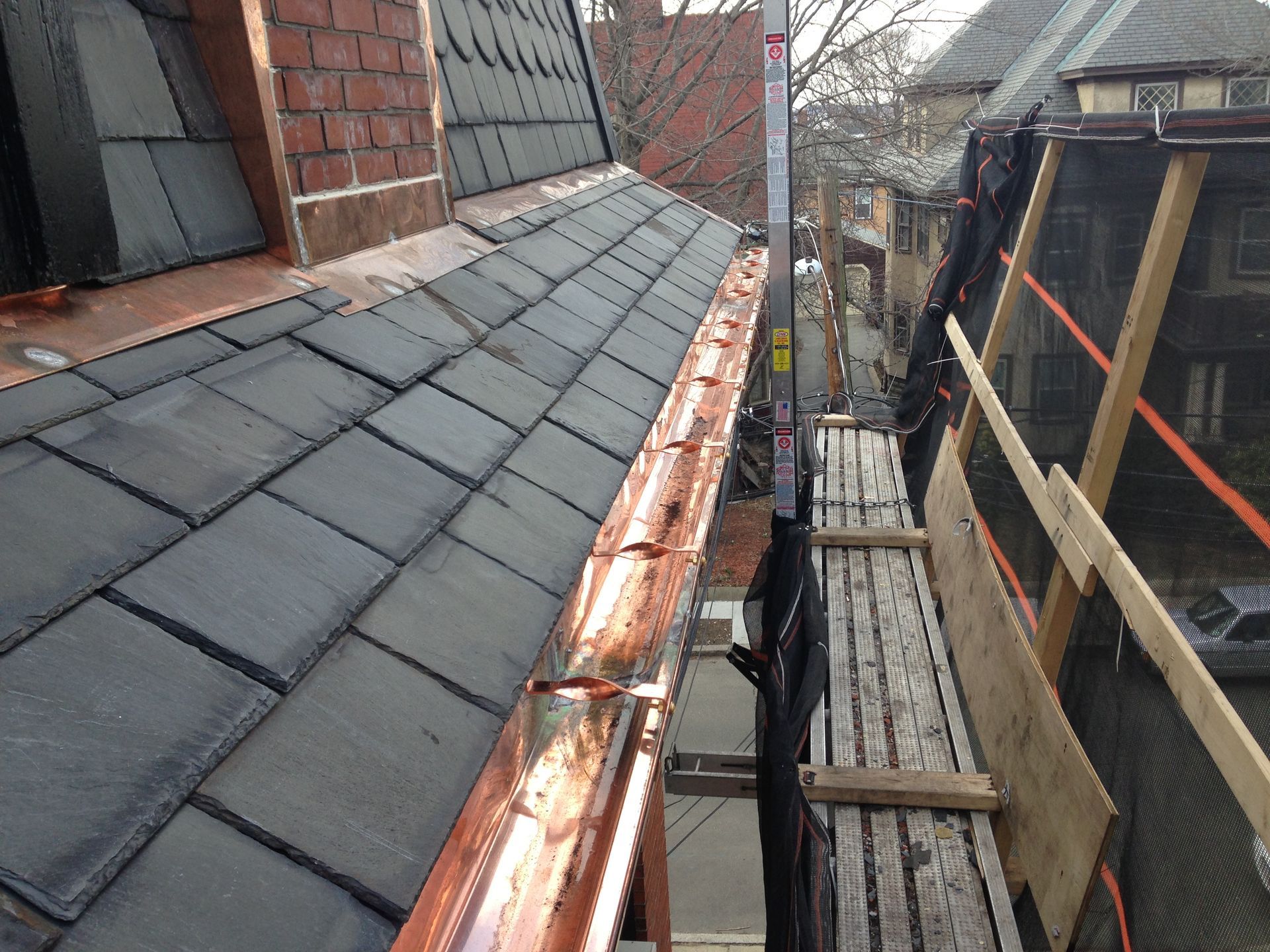
Now shift your eye away from the field slate and onto the metal. Look at the valleys where two slopes meet, the flashing where the roof meets a chimney or a wall, and the metal around dormers. You are looking for rust, dark staining, lifted or wavy metal, or failed sealant pulling away from a joint. On Boston roofs this is where the leaks actually start, far more often than in the field slate itself.
This is the single most useful thing to understand about slate leaks, because it flips the usual assumption. Most homeowners see a ceiling stain and picture a bad roof. Nine times out of ten the slate is sound and the water is coming in through tired flashing at a valley or a chimney. That is a good problem to have, because renewing a copper valley or a chimney flashing on an otherwise sound roof is a repair measured in a few thousand dollars, not a tear off. The National Slate Association draws the same line between a localized flashing fault and a systemic roof failure in its repair and restoration guidelines. If a contractor quotes a full replacement for what turns out to be a flashing joint, get a second opinion.
Sign 7: What the attic and your ceilings are telling you
The last signs come from inside, and the attic is the most honest room in the house. On a dry, bright day, go up with the lights off and let your eyes adjust. Pinpoints of daylight coming through the boards mean gaps in the roof above. Then go back after a good rain with a flashlight and look at the underside of the sheathing for dark water stains, damp wood, streaking down the rafters, or the musty smell of wood that stays wet. Water tracks along framing before it drops, so a stain in the attic is often uphill of where it enters.
Water stains on your ceilings or the tops of your walls are the latest sign in the whole sequence, and by the time they appear the water has already been in the structure for a while. A brown ring on the ceiling is not the start of a problem, it is the middle of one. If that is where you are, the roof is not necessarily in bad shape, but the path the water is taking needs to be found and closed before the deck rots. After a storm, that same attic check is the first move, which we walk through in the first 48 hours after storm damage.
Boston makes these signs move faster
Every sign above exists on slate roofs everywhere. Two things about Boston make them progress faster than a national checklist assumes. The first is freeze and thaw. Our winters swing across the freezing line over and over, and each cycle drives water into a crack, freezes it, expands it, and widens the gap. A single hard winter can turn a hairline into a broken slate. The Insurance Institute for Business and Home Safety documents how repeated freeze and thaw drives water intrusion damage in northern climates, and slate feels it at every crack and open joint.
The second is the housing stock. The dense belt of 1890 to 1920 triple deckers and rowhouses across Boston, Somerville, Cambridge, and Brookline puts a huge number of slate roofs into the exact age window where original nails and original flashing wear out together. Historic district rules in many of these neighborhoods also mean the repair has to match the original slate and detailing, which is another reason to catch problems while they are still small and local. Put those together and the lesson is timing: in Boston, act on a sign in the fall, before the freeze and thaw season turns a small repair into a wet deck.
When each sign means fix slate roof problems now, and when to watch it
You do not need to treat every sign as a five alarm fire. Here is how we triage them when a homeowner calls, so you can sort what you have seen. Use this to decide whether you fix the slate roof this week or simply put it on the calendar.
- Call this week: active dripping or a wet ceiling stain, daylight through the attic boards, a sagging or waving roof line, or slates slipping all over one slope. These mean water is getting in now or the structure is loaded wrong, and waiting makes the repair bigger.
- Fix this season: one or a few missing slates, a cracked or chipped slate you can see from the ground, rust streaks at the nails while the slates still hold, or staining at a valley or chimney flashing. None of these is an emergency, but each is an open door that a Boston winter will push on.
- Watch and plan: light moss on a shaded north slope, a slate or two starting to look matte, or a roof simply reaching the upper end of its material’s age. These are not repairs yet. They are reasons to book a proper assessment and get ahead of the next stage.
The through line is simple. A sign that lets water in, or that shows the structure moving, gets acted on. A sign that is cosmetic or slow gets monitored on a schedule. When you are unsure which bucket a sign falls into, that uncertainty is exactly what a real assessment resolves.
What to do the day you spot a sign
Note what you saw and where on the roof, take the clearest zoom photo you can from the ground, and do the attic check with a flashlight both dry and after rain. That short record tells a roofer more than you would think and often means we can give you a straight answer from a ladder and the attic without anyone walking the slate. From there the path forks the way we describe in our repair or replace guide: a sound roof with a local problem is a repair, and a roof with field wide slipping or a rotted deck is a different conversation.
The habit worth building is a look at the roof twice a year, spring and fall, from the sidewalk with binoculars and once through the attic. Fifteen minutes, no ladder, no risk. Owners who do this catch signs at the cheap end of the scale almost every time.
Frequently asked questions
What are the first signs a slate roof needs repair?
The earliest signs are usually visible from the ground: a single missing slate leaving a dark gap, one or two slates that have slipped out of line, or small chips and cracks catching the light. Inside, the first sign is often daylight through the attic boards or a damp patch on the sheathing after rain. None of these means a new roof. Each one means get it looked at before water finds the deck.
Can I tell if my slate roof is failing without climbing on it?
Yes, and you should not climb on it. Slate breaks under foot traffic and is slick when damp. Stand across the street with binoculars in flat morning or evening light. You are looking for gaps, slates sitting at a different angle than their neighbors, rust streaks running down from the nails, and a roof line that dips or waves instead of running straight. The attic gives you the rest without any ladder.
What does nail sickness look like from the ground?
Nail sickness shows up as slates that have slipped down or twisted in a line or a patch, even though the stone itself looks fine. The nails holding them have rusted through, so the slates slide. On Boston homes built between about 1890 and 1920, many roofs are wearing their first set of nails and are now at the age where those fasteners give out. A line of slipped slates is the tell.
Is a cracked or flaking slate an emergency?
A single cracked slate is not an emergency, but it is an open door for water, so it should be replaced within a season. Flaking or a powdery, layered surface is different. That is the stone delaminating from decades of freeze and thaw, and when it shows up across a slope it means that section is near the end of its life. One flaking slate is a repair. A whole face going powdery is a planning conversation.
How fast do slate roof problems get worse in Boston?
Faster than in a milder climate. Our freeze and thaw cycle drives water into a small crack, freezes it, and widens the crack every night it drops below freezing. A hairline you could have replaced for a few hundred dollars in October can be a broken slate and a wet deck by March. Ice dams at the eaves push meltwater back up under the slate. That is why we tell Boston owners to act on signs in the fall, not wait for spring.
What should I do the day I spot a sign?
Write down what you see and where, take a zoom photo from the ground, and check the attic with a flashlight for daylight or damp wood. Then book an assessment. Do not send someone up to walk the roof casually, because foot traffic breaks more slate than most storms. A roofer who works in slate can usually tell you from a ladder and the attic whether it is a same week repair or something to monitor.
Talk to the owner
If you have spotted one of these signs and cannot tell whether it is a watch or a call, that is exactly what an assessment settles. Every roof we quote gets walked by Arturo before a number goes on paper. See what a slate assessment covers on our slate and copper roofing page, or schedule a free assessment for a straight answer on whether it is a quick repair or something to plan for.