Copper Metal Roof Guide for Boston Homes: Cost, Patina, and Panel Options
A copper metal roof explained for Boston homes: how patina forms, standing seam vs snap lock vs flat seam, real copper vs copper colored panels, cost, and upkeep.
TL;DR: A copper metal roof is solid sheet copper, usually 16 or 20 ounce, formed into standing seam, snap lock, or soldered flat seam panels. Properly installed, it lasts 80 to 100 plus years, and IBHS says it can go well past 100. It starts shiny, turns brown, and slowly weathers to green. It is one of the most expensive roofing materials you can buy, and it needs a crew that knows cleats, solder, and thermal movement. Copper colored steel gives a similar look for less, but it never patinas.
Copper · 13 min read
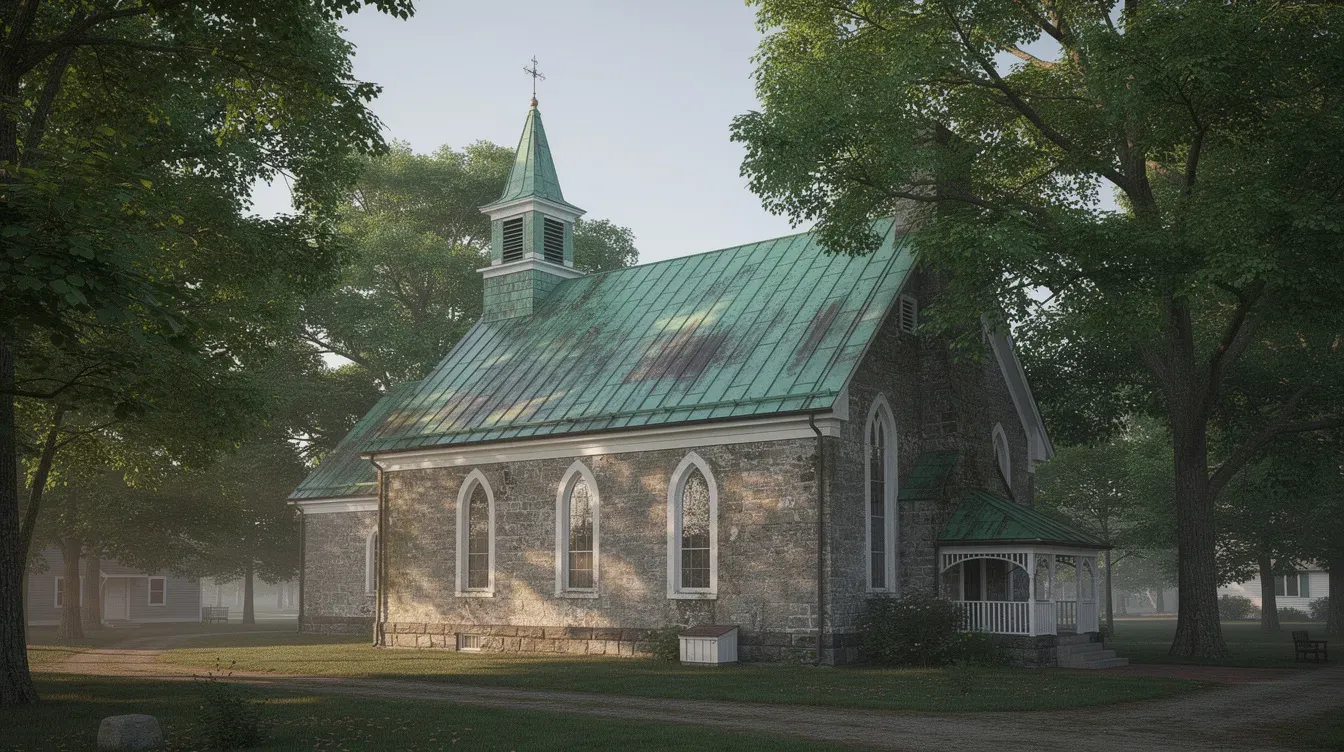
A copper metal roof is the roof people stop to look at. On a Back Bay bay window, a Newton porch, or a church steeple in a town green, it starts out a bright penny color and ends up the blue-green everyone recognizes. People call that timeless beauty, but the reason it lasts is chemistry. It also costs more than almost anything else you can put on a house, and it fails early when the crew installing it doesn’t understand the metal.
This guide covers what a copper roof actually is, how the color changes, the panel and seam styles, how real copper compares with copper colored steel, what it costs, and what upkeep looks like. Where we cite numbers, they come from sources we name in the text: the Copper Development Association (CDA), the Insurance Institute for Business and Home Safety (IBHS), This Old House, and panel maker Western States Metal Roofing. They are not Art Slate Roofing figures.
What a copper metal roof is, and how copper metal differs from other metal roofing
A copper metal roof is made from solid sheet copper, not a coating. The CDA’s Copper in Architecture Design Handbook says the sheet copper used in building is 99.9 percent copper and conforms to ASTM B370. That one material shows up on full roofs, porch and bay roofs, dormers, turrets, copper cupolas, flashing, and gutters.
“Copper roof” and “metal roofing” get used as if they mean the same thing. They don’t. Most metal roofing sold today is painted steel or aluminum. Those panels can resemble copper on day one, but they behave differently over time. The paint holds one color. Real copper keeps changing.
Copper thickness is sold by weight, not gauge. Per the CDA handbook:
- 16 ounce copper weighs one pound per square foot and is about 0.0216 inches thick, close to 23 gauge. It is the everyday roofing material weight.
- 20 ounce copper weighs 1.25 pounds per square foot and is about 0.027 inches thick, close to 21 gauge. It goes on long panel runs, low slopes, and rough exposures near the water.
Copper arrives from the mill in flat sheets or coils. The CDA notes that power pan formers can take flat or coiled copper and produce roofing pans on site, which is how long panels get made to fit the real roof.
How a copper roof changes color: patina from shiny to green
New copper is shiny, a metallic reddish orange that becomes the focal point of the building. Then weathering takes over. The CDA explains that acidic moisture in the air reacts with the copper surface and forms a patina that “eventually covers the surface and adheres tightly to it, thus providing a protective layer against further weathering.” In other words, the patina is a barrier, not a sign of damage.
The color moves in a rough order:
- Bright copper. The penny color you see the day the roof goes on.
- Browns. Within months the surface dulls to russet, then darker brown. The color can look uneven for a while, with streaks and patches.
- Green patina. Over years the brown gives way to blue-green or aqua green.
The timing is the part people want pinned down, and it can’t be. The change will happen on the weather’s schedule, not yours. The CDA’s natural weathering chart is drawn for moist industrial climates, runs out to 25 to 30 years for a full patina, and says plainly that the timespan varies. Western States notes that roofs near the sea often patina in under 10 years. Moisture, salt, pollution, slope, and exposure all affect the result. Inland Boston suburbs tend to sit in the brown stage longer than a roof a few blocks from the harbor.
Patina colors can include brown, blue-green, and aqua green, sometimes on the same roof as the faces age at different rates. If you want the green look on day one, prepatinated copper exists. If you want to hold the bright color, clear coatings slow the change for a while, but they wear off and the weathering starts anyway.
Benefits and limits of a real copper roof
A real copper roof has strong advantages. It also has a short list of real drawbacks. Here is each one as the sources actually support it.
The advantages
- Longevity. IBHS says copper roof systems “often remain intact for over 80 years” and that properly installed copper roof and wall cladding “can last well over 100 years.” That is why we describe a copper roof’s lifespan as 80 to 100 plus years. For comparison, natural slate runs 75 to 150 years and asphalt shingles 18 to 25 years around Boston. Copper isn’t the only century roof. Slate is in the same class.
- Corrosion resistance. The CDA calls copper a noble metal that resists attack “quite well under most corrosive environmental conditions.” The patina slows further weathering. That is strong resistance, not immunity. More on that below.
- No rust. Rust is iron oxide, and copper contains no iron, so it doesn’t rust. It doesn’t rot either, and Western States notes it won’t mold.
- Lightweight. Compared with slate or asphalt, copper is light. Sixteen ounce copper is one pound per square foot, about 100 pounds per roofing square. Asphalt runs about 250 pounds per square and natural slate 800 to 1,500. Less weight means less stress on the structure.
- Fire rating. The CDA handbook includes a 2008 Southwest Research Institute test of a typical 16 ounce standing seam copper roof over plywood, felt, and rosin paper. It met the Class A requirements of ASTM E108. Fire ratings belong to the tested assembly, so the deck and underlayment matter too.
- Weather. Copper is durable in rough weather. IBHS says properly installed copper systems withstand hail, wind, heat, and other environmental conditions.
- Recycling. The CDA says copper has an “infinite recyclable life” and that nearly all the copper ever mined is still in circulation, so a copper roof is 100 percent recyclable at the end. Western States puts the average recycled content of copper roofing at 75 percent. The CDA’s own figure is that 75 to 80 percent of copper production comes from recycled scrap.
- Looks. Copper is a premium material chosen for its appearance as much as its durability. The luxury appearance and long lifespan are why it shows up on the most visible parts of a house.
The limits
- Cost. The biggest disadvantage is price. Copper is among the most expensive roofing materials you can buy, and copper prices move with the commodity market.
- Specialized installation. Copper is cleated, folded, and soldered rather than nailed down like shingles. Fewer crews do that work well, and a general contractor without copper experience is a risk.
- Corrosion at the wrong contact. The CDA explains that copper won’t be harmed by contact with other common building metals, but it will corrode them. Aluminum and zinc are the main concern. Steel is usually not a problem unless its mass is similar to or smaller than the copper’s, which is exactly the case with a steel fastener. That is why copper roofs get copper cleats and copper, brass, or bronze nails.
- Concentrated acidic runoff. The CDA describes “erosion corrosion” when rain off a large slate, tile, wood, or asphalt roof pours onto a small copper flashing or gutter before the copper has patinated. It also warns about “line corrosion” where shingle edges sit directly on copper and hold moisture. This is why “completely resistant to corrosion” is the wrong way to describe copper.
- Staining. Runoff from copper can stain lighter adjacent surfaces. See the maintenance section for how that gets handled.
Copper roofing panels: standing seam, snap lock, and other roofing panels
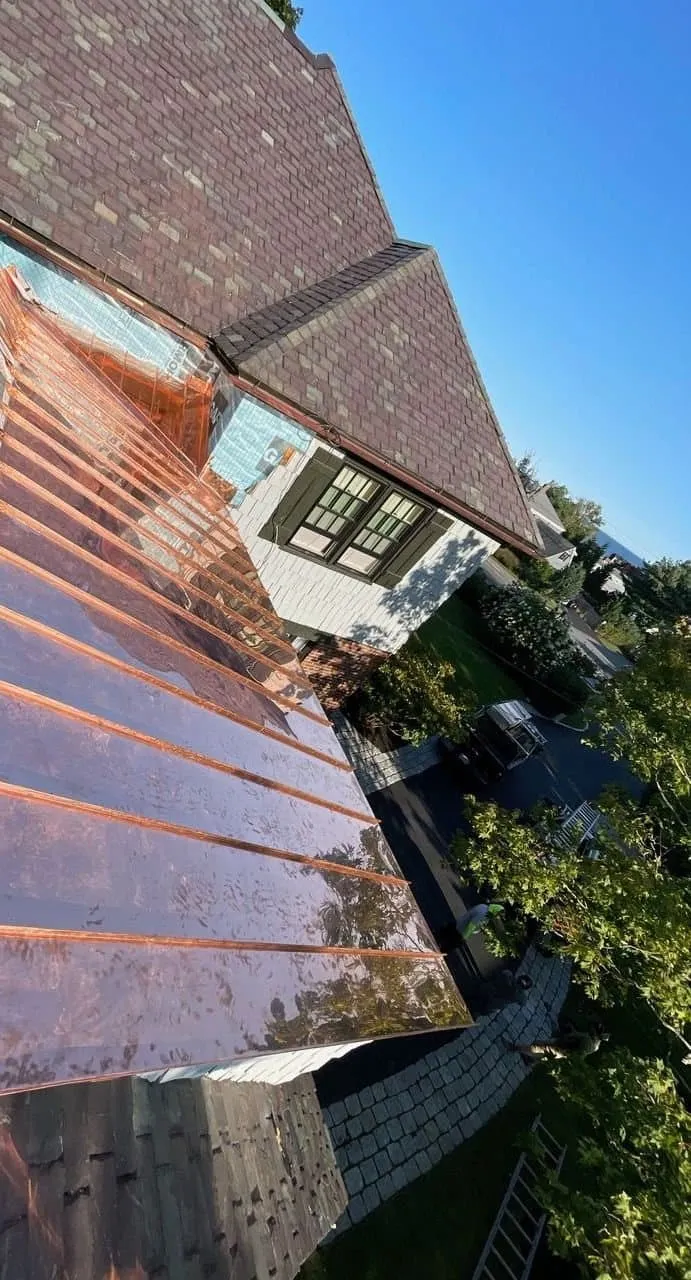
Copper roofing panels come in several seam styles. The roof pitch, the architecture, and the exposure decide which one belongs where. Every one of them has to handle thermal movement, because copper grows and shrinks with temperature.
Standing seam
Standing seam is the vertical rib roof most people picture. Long copper pans run from eave to ridge, and the raised seams lock over cleats nailed to the deck. The fasteners are hidden under the seam, so nothing goes through the face of the panel. The seams can be folded once or twice, by hand tools or a power seamer. A double lock seam holds out wind driven rain better on exposed roofs. Our standing seam copper roof guide covers seam types and detailing in more depth.
On one Art Slate project in Greater Boston, every panel was cut, braked, and formed on site to the real roof geometry. The vertical seams were locked and cleated, and the horizontal seams were hand soldered with 50/50 solder. The project page shows the details.
Snap lock
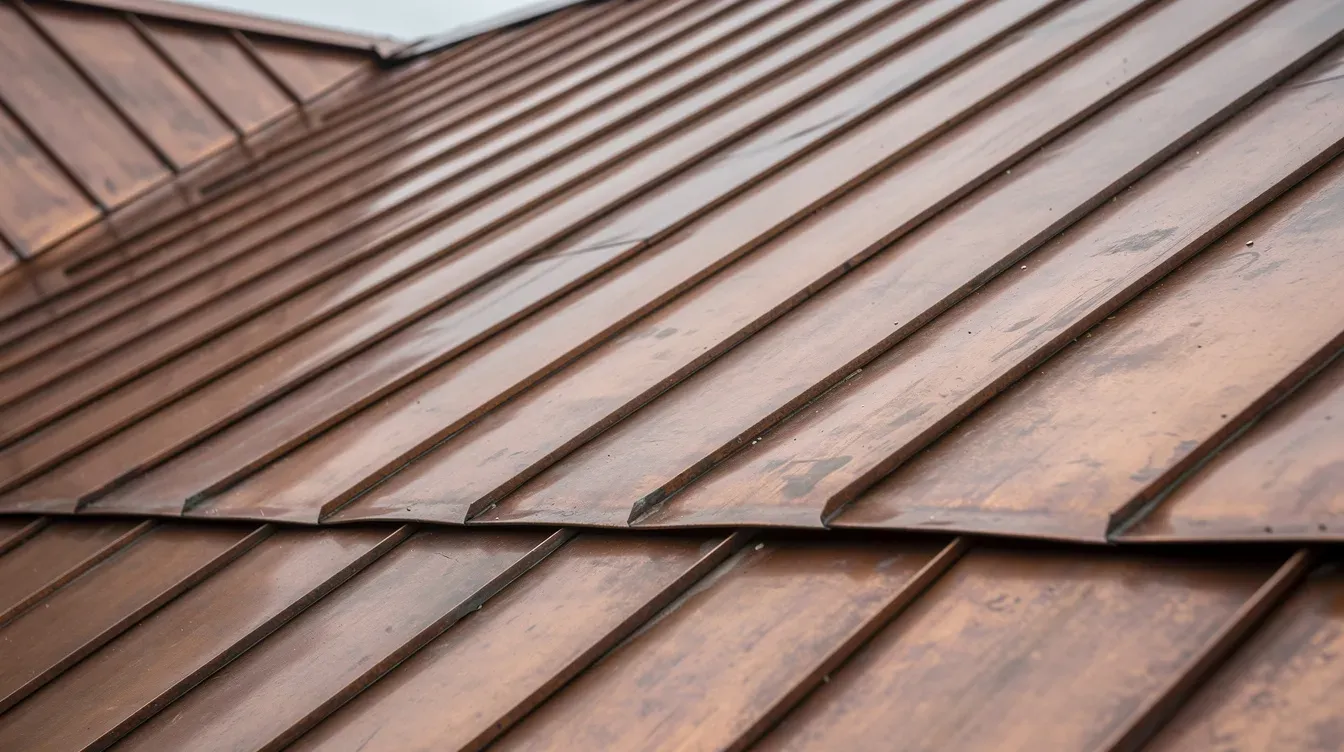
Snap lock is a variation of standing seam used in many prefabricated systems. The CDA handbook describes it this way: the edge with the lock is cleated to the deck, and the next pan is pressed over the lock until it snaps into place. It usually needs no field seaming, which speeds installation and leaves a clean, rigid rib. For low pitch roofs, the CDA says sealant may be added and the manufacturer should be consulted. Snap lock generally stays on steeper slopes, and mechanically seamed panels take the low ones.
Flat seam, batten seam, and corrugated copper roof panels
- Flat seam. Small flat sheets, 18 by 24 inch 20 ounce copper in the CDA’s standard detail, are folded, locked, and soldered into one continuous skin. The CDA notes that flat seam is the only copper roofing system built to be fully watertight against standing water. That makes it the system for low slope decks, bay roofs, and curved surfaces. It is also the most labor heavy, because every seam is soldered.
- Batten seam. Copper pans fold up against wood battens and get capped with copper. It is a traditional look on dormers and older roofs.
- Corrugated copper roof panels. Wavy profile panels with exposed fasteners. They show up on outbuildings, porches, and accents more than on formal residential homes.
Thermal movement
The CDA gives copper’s coefficient of thermal expansion as 0.0000098 per degree Fahrenheit. A 20 foot copper panel that swings 100 degrees between a January night and a July afternoon in the sun moves almost a quarter inch. Cleats let the pan slide. A layer of rosin paper between the copper and the felt underlayment keeps the metal from bonding to the deck, because the CDA warns that heat can soften asphalt in the underlayment and pin the copper in place. Copper screwed down tight fights that movement, and the stress lands on the fasteners and seams. Our post on how copper handles Boston winters goes deeper on freeze and thaw.
Real copper vs copper colored metal roofing panels
Plenty of homeowners love the copper look but not the copper price. Copper colored metal roofing panels are the usual alternative. They are steel or aluminum panels, often a Galvalume coated steel substrate with a PVDF paint finish, made to resemble copper at a stage of its life: bright penny, aged brown, or green patina.
| Real copper | Copper colored steel or aluminum | |
|---|---|---|
| What it is | Solid sheet copper | Steel or aluminum with a paint finish |
| Color over time | Weathers from shiny to brown to green | Stays the color you buy |
| Lifespan | 80 to 100 plus years (IBHS) | Decades, but not copper’s run |
| Price | Among the most expensive roofing materials | Western States puts painted panels 60 to 75 percent below real copper |
| Warranty | No paint finish to warranty; ask the installer about workmanship terms | Paint warranty, typically 20 to 30 years by color (Western States) |
A painted panel gives a similar look from the street for a lot less money. What it can’t do is age. Once the paint wears, you are looking at a painted steel roof, not a patina. On a plain addition or a back porch, copper colored steel can be a fair call. On the street side of a historic house, or anywhere you want the roof to keep improving with age, it has to be real copper. Ask any contractor to name the metal, the weight or gauge, and the finish in writing, so you know whether you are buying copper or a copper colored coating over steel.
What a new copper roof costs
A new copper roof sits at the top of the price range. Here are the published numbers and where they come from:
- National installed range: about $11 to $35 per square foot, per This Old House’s 2026 guide.
- Material and installed price: a 2020 guide from Western States Metal Roofing, a metal panel manufacturer, put copper material at $13 to $25 per square foot and the installed cost at $19 to $35. It listed $19 to $28 for a corrugated copper roof and $23 to $35 for standing seam. Copper has risen since 2020, so read those as dated national figures.
- Boston: our copper roof cost guide works through local pricing, including why hand soldered flat seam runs higher than standing seam.
Copper is a commodity, and its price changes with the market, so any quote is a snapshot. The other big driver is labor. Soldered seams, hand formed details around chimneys and dormers, deck repair, and substrate preparation all add to the cost of the project. In snow country, heating cable at the eaves can be part of the job too. We cover that on our ice melt systems page.
The long view still matters. A copper roof that lasts 80 to 100 plus years replaces several asphalt roofs at 18 to 25 years each. Whether that math works depends on how long you plan to own the house and how much of it you want in copper. Many homeowners put copper only where it shows or where water concentrates: the porch, the bay, the dormers, the valleys.
Maintenance, runoff, and what to expect over the years
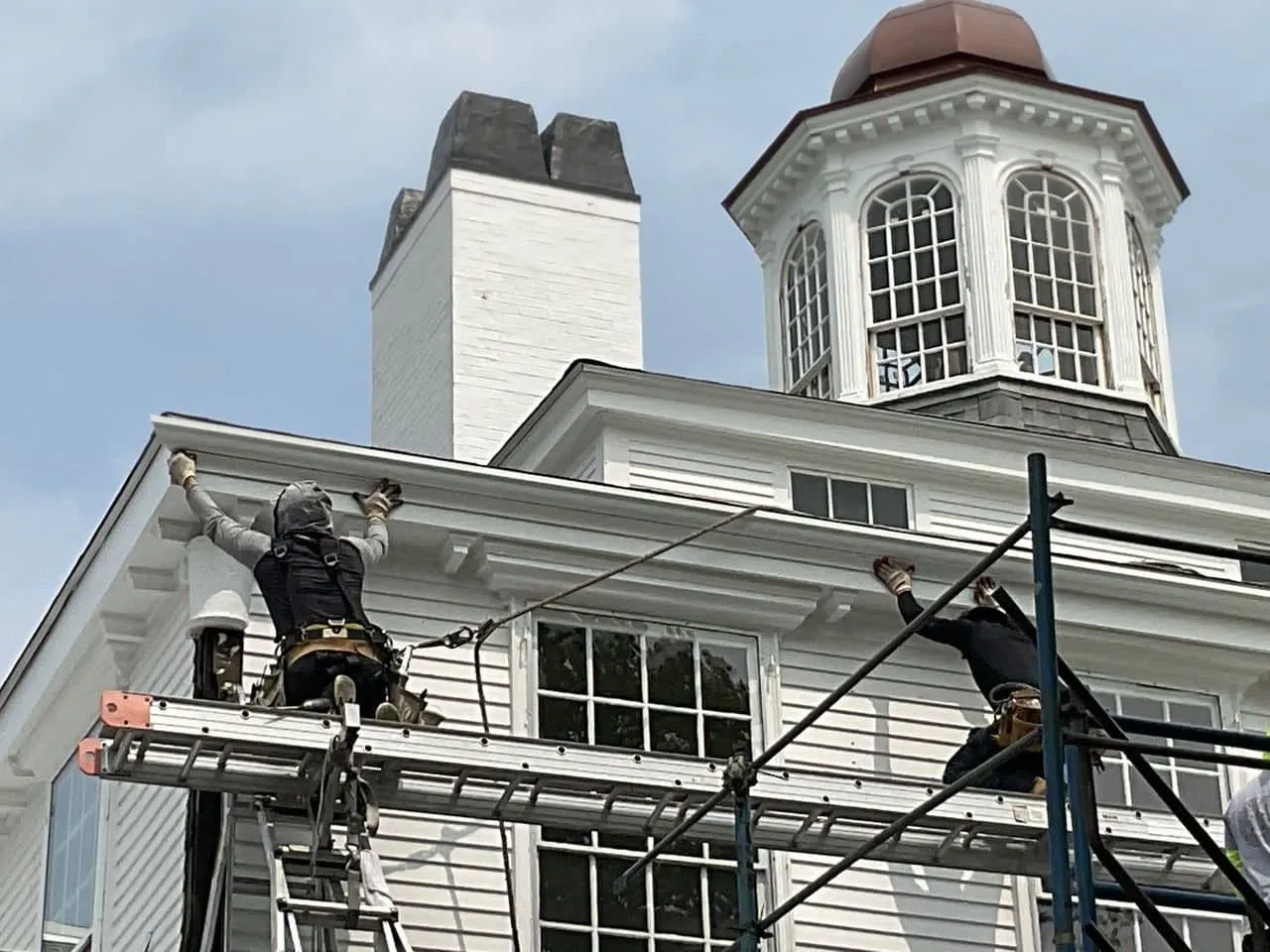
Copper needs very little maintenance. Cleaning is optional. Rain washes most dirt off, and Western States advises against pressure washing because it can disturb the patina. A gentle rinse is enough if you want one.
Low maintenance still means some maintenance:
- Routine inspections. Have the seams, fasteners, flashings, and soldered joints checked. IBHS says a roof level inspection tells you more than a look from the ground with binoculars. Look again after big storms.
- Watch the transitions. Chimneys, sidewalls, valleys, and the edges where slate or shingles meet copper are where trouble starts.
- Plan the runoff. The CDA explains that water running off copper picks up small amounts of copper salts. On porous, light colored surfaces like limestone, marble, and pale brick, the water soaks in and leaves a green stain as it dries. Heavy rain causes less of it, because the water moves fast. The fixes are gutters and downspouts that carry runoff away, drip edges of at least one inch, and a clear silicone sealer on porous surfaces below. Keep copper wash off exposed aluminum too, because copper salts can speed up aluminum corrosion.
- Keep other metals away. Any repair has to use copper or copper compatible parts. A steel screw or an aluminum drip edge against copper starts a slow failure.
If the roof is older and the patina has gone patchy, that is usually just uneven weathering, not damage. Thin spots, splits, and failed solder are what need repair.
Choosing a contractor for a copper roof
Copper work is a narrower trade than shingle work, and not every roofing business does it. A few questions sort it out quickly:
- Who will install it? Ask whether the crew on the roof is the company’s own or a subcontractor.
- How do you fasten it? The answer should be cleats and copper nails, with the metal free to move.
- Who solders, and with what? Hand soldered joints are the standard on flat seam work.
- What touches the copper? Every fastener, edge, and adjoining metal should be copper or compatible with it.
- What weight of copper, and why? A good answer ties 16 or 20 ounce to the slope, panel length, and exposure.
- How will runoff be handled? Ask how the design keeps copper wash off brick, stone, and siding.
Our copper roofing page explains how we handle each of those points on our own jobs.
Frequently asked questions
How long does a copper metal roof last?
A properly installed copper roof commonly lasts 80 to 100 plus years. The Insurance Institute for Business and Home Safety notes that copper roof systems often stay intact for over 80 years and that properly installed copper can last well over 100. The sheet rarely wears out first. Seams, fasteners, and the flashing details are what need attention over that span.
How much does a copper roof cost per square foot?
National guides put installed copper roofing at roughly $11 to $35 per square foot, per This Old House’s 2026 guide. A 2020 price guide from panel maker Western States Metal Roofing put the copper material alone at $13 to $25 per square foot and the installed price at $19 to $35. Copper is a traded commodity, so the price moves, and hand soldered flat seam work on a Boston house can run higher. Our copper roof cost guide breaks down local numbers.
How long does it take a copper roof to turn green?
It depends on the air. The Copper Development Association’s weathering chart, drawn for moist industrial climates, runs from bright copper through browns to full patina at around 25 to 30 years, and it notes the timespan varies. Salt air speeds it up, and roofs near the ocean can turn green in under 10 years. Inland roofs often stay brown for a long time first.
Is copper colored metal roofing the same as real copper?
No. Copper colored panels are steel or aluminum with a paint finish made to resemble copper. They cost far less and come with a paint warranty, typically 20 to 30 years depending on the color in Western States Metal Roofing’s line. They never develop a patina, and they don’t carry copper’s lifespan.
Will a copper roof stain my brick or siding?
It can. Water running off copper picks up small amounts of copper salts, and when that water soaks into porous, light colored surfaces it leaves a green stain. The Copper Development Association recommends collecting runoff in gutters and downspouts, using drip edges of at least one inch, and sealing porous surfaces below with a clear silicone sealer.
Is a copper roof heavy?
No. Sixteen ounce copper weighs one pound per square foot, so the metal on a 100 square foot roofing square weighs about 100 pounds. Asphalt runs about 250 pounds per square and natural slate 800 to 1,500. That lighter load puts less stress on the framing.
Talk to the owner
Whether copper makes sense depends on the house: which parts show from the street, where the water runs, what the copper will touch, and how long you plan to stay. That’s hard to judge from a photo.
Every customer gets the same first step: Arturo walks the roof before a price goes on paper. We run copper work with our own crew. See our copper roofing page and the slate and copper roofing service, schedule a free assessment, or call 617-913-1130. You get a straight answer on whether to do a full copper roof, copper accents only, or something else entirely.