Copper Snow Guards: Slate and Copper Roofs, Layout and What to Buy
A roofer's plain guide to copper snow guards: what they do, which ones fit slate, copper and other roofs, Freedom Gray, galvanic rules, how many you need and layout.
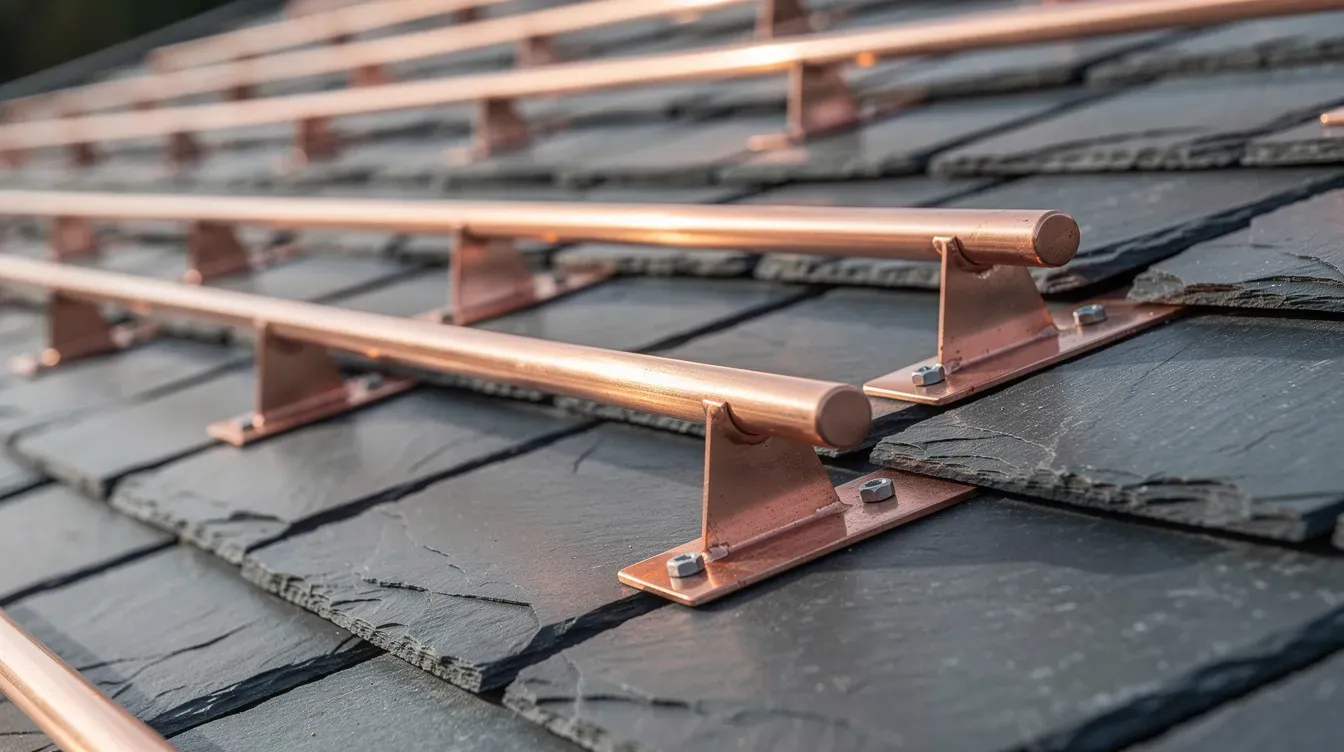
TL;DR: Snow guards hold snow on a steep roof so it melts off slowly instead of dropping all at once on a walk or a car. Copper guards suit slate and copper roofs because the metals get along, and they weather to match. Don't put copper on an aluminum or galvanized roof, since that metal corrodes. How many you need depends on the rafter length, the pitch and your snow load. Use the manufacturer's layout chart or an engineer, not a guess.
Copper · 13 min read
Picture a steep slate roof the sunny afternoon after a storm. The surface warms up a little, and the whole slope of snow lets go at once. Whatever is under the eave takes it, whether that’s a fence or a car or somebody on the front steps.
That’s what snow guards are for. Slate is hard and smooth, and a steep slate roof will hold a few feet of snow right up until it doesn’t. Then it all comes off together. Snow guards break that up so the snow stays where it is and melts off a little at a time.
This post is about copper snow guards, mostly on slate roofs and copper roofs, since that’s what I work on. I’ll cover what the guards do and where copper fits. After that comes sizing and layout. Last is what to look for in a listing. Product numbers come from maker spec sheets and catalogs. Galvanic rules come from the Copper Development Association. One thing up front. Our service pages don’t list snow guard installation, so this isn’t a pitch for it. It’s what I’d tell a neighbor.
What snow guards do
A snow guard is a small barrier fixed to the roof. Snow builds up behind it and it can’t slide. Put enough of them in the right pattern and you’ve got a snow retention system. It holds the snow in place, spreads the weight across the roof and lets it melt and drain off slowly.
They don’t stop every bit of snow and ice from moving. What they do is turn one big release into a lot of small ones, or none at all. That matters most over entryways and walks. Driveways count, and so do lower roofs. It matters over gutters too, because a sheet of sliding snow will rip a gutter off its hangers.
There are two main styles.
- Pad guards. Small individual pieces, each one on a strap, set in staggered rows. The pads break up the sheet so it can’t move as one piece. This is the traditional look on slate.
- Rail systems. Bars or pipes running across the roof on brackets. You see them on commercial metal roofs and on houses that get heavy snow, where a continuous line holds better than separate pads.
There’s also a loop style for wood roofs. It’s an exposed wire loop on a strap you can’t see once it’s in.
Why copper snow guards
Copper is the premium choice and it’s priced like one. You do get something for the money.
It’s durable. IBHS puts a copper roof at 80 to 100 plus years, and a copper guard is the same metal. I’m not going to promise the guard outlives the fastener holding it. That fastener has to be copper or brass. Stainless steel works too. Anything else goes first.
It gets along with slate. Slate is stone, so there’s no metal for copper to react with.
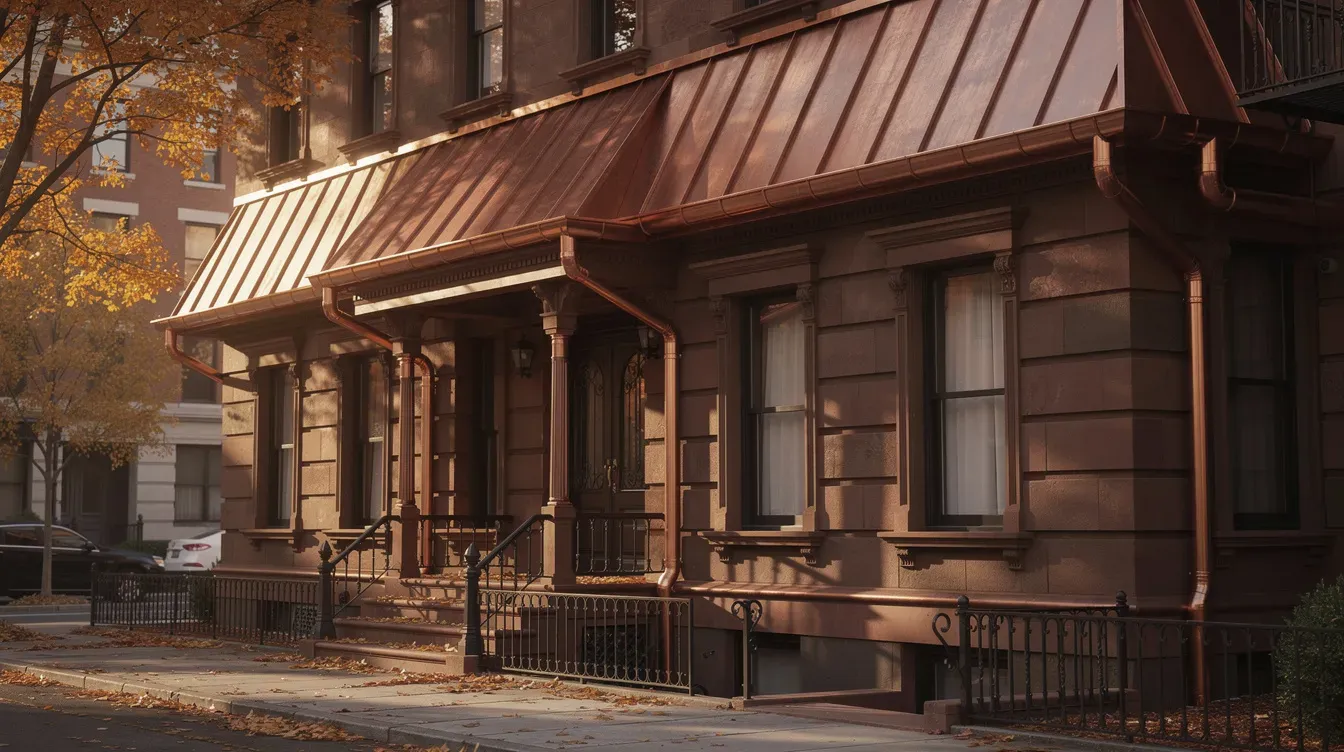
It matches. If your house already has copper gutters or copper flashing, copper guards weather along with them. They go brown first. Over years they turn the green patina you see on old Boston copper. That patina is a thin protective layer. It’s part of why copper lasts, and you don’t have to do anything to get it.
It holds up in the cold. Copper doesn’t go brittle in a Boston winter. Strength still depends on the design, so look at the tested numbers for the model you’re buying, not the metal.
Copper vs. other materials
Galvanized steel guards cost less. The zinc coating protects the steel until it wears through, and then the steel rusts. On a slate roof that can leave rust stains running down the slate.
Aluminum guards are light and cheap, and most of them come painted. Rocky Mountain Snow Guards makes its Yeti series in aluminum, and says it has a load rating of more than 800 pounds. Roofing Contractor reported it also comes in copper. Rocky Mountain’s own pages list the Yeti for asphalt shingle and metal roofs. Synthetic roofs are on the list. Natural slate isn’t.
Plastic guards are made of polycarbonate. The SnoBlox Deuce is one. Its maker says it held 3,456 pounds when attached with #14 screws in Intertek/ATI testing, and 1,379 pounds with SB-190 adhesive. The guard didn’t break in those tests. The screws or the adhesive let go first. That’s a metal roof product, though. It’s not a copper snow guard and it’s not something I’d put on slate.
Stainless steel is strong and doesn’t rust. It just doesn’t look like anything else on an old copper and slate house.
Coated copper and Freedom Gray
Some guards and roofs use coated copper instead of bare copper. The one people ask me about is Freedom Gray.
FreedomGray is made by Revere Copper. It’s copper sheet hot dipped on both sides with a tin and zinc alloy. The mix is about half of each, with no lead in it. Underneath, it’s still copper. Revere sells it for roofs and gutters and flashing. Those are the same places you’d use plain copper. The difference is color. It weathers to a soft gray instead of brown and then green.
So if your roof or trim is Freedom Gray, a bare copper guard will look wrong as it ages. Look for guards made from the same material, or ask the guard maker what they pair with it. Revere’s spec calls for copper or copper alloy fasteners with it. Series 300 stainless is allowed too. That’s the same rule as plain copper. Revere also says to be careful with it in some salt air locations, so check with them near the water.
Copper snow guards on slate roofs
This is the main use, and slate is where the details matter most.
A slate guard has a pad on the front and a long strap behind it. The strap lies on the roof deck under the slate. On new work the strap gets nailed down as the courses go on. On an existing roof you need a guard that can go in without tearing off good slate.
Berger’s Pro #100 is a retrofit guard for that. It has a copper shoe with a brass gusset and strap. You slide the slotted bar up under the slate, catch a nail in one of the slots, and pull it tight. Berger says it was tested to take a 300 pound point load on the gusset side. Its install guide says to use a slate ripper to loosen the slate, so you don’t break it.
Alpine SnowGuards in Vermont makes copper pad guards for new slate. Its PD10 instructions say to set the guard low enough on the slate to leave a gap of at least 5/8 inch, or three times the slate thickness, whichever is more. Then attach it with at least two fasteners compatible with the guard and the roof.
That gap matters. If the pad sits tight against the slate above, it can crack it under load. Thin or old slate breaks easily. I’d rather lift a slate carefully and do it right than force a strap under and leave a crack nobody sees until spring.
Copper roof seams: clamp-on guards
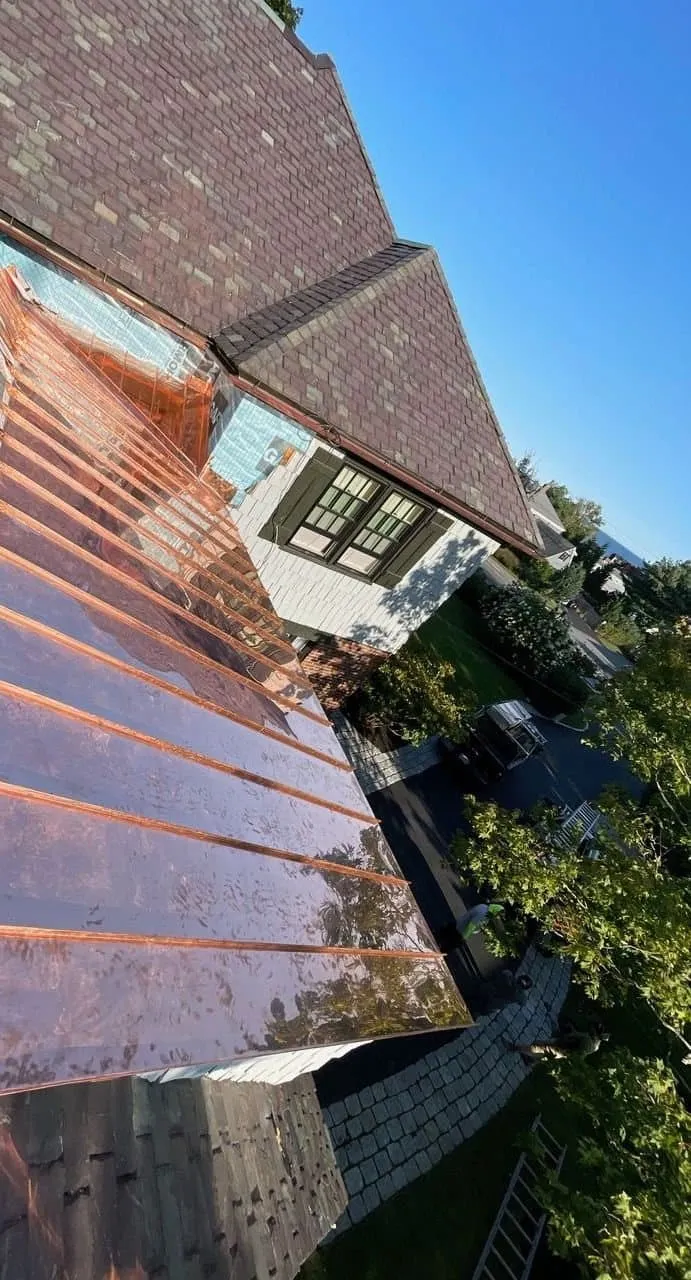
On a standing seam copper roof you don’t drill through the panels. You clamp the guard onto the seam.
Berger’s RT series does that. It clamps on with two stainless set screws and needs no glue or sealant. It comes in cast aluminum or cast bronze, and the bronze one is the version for copper roofs. Berger’s catalog gives two sizes.
- RT 200 fits seams up to 3/16 inch thick, for lighter metal like 16 ounce copper.
- RT 300 fits seams up to 9/32 inch thick, for heavier metal like 20 ounce copper.
Both are for double lock or mechanically seamed roofs, with seams no taller than about an inch. Measure your seam and confirm the fit before you order. The install guide also warns against over tightening. Berger gives a 20 foot pound maximum.
Flat seam copper, the kind on old bays and turrets, has no raised seam to clamp. There the guard is usually soldered on. Rocky Mountain’s spec says copper guards can be soldered to copper shingles or panels, and calls for at least 6 square inches of soldered area per guard.
Copper on a metal roof: usually no
This is the one rule I’d repeat to anybody.
When copper touches another metal with water around, one of them corrodes. It’s the less noble metal, not the copper. On a roof that means the zinc loses. So does galvanized steel. Aluminum loses too. The Copper Development Association also warns that water running off copper onto aluminum or galvanized metal will corrode it.
So don’t put copper snow guards on an aluminum or galvanized metal roof. Use guards made for that roof, in whatever metal its maker approves. On a copper roof, guards in copper are fine, and bronze works as well. On slate, copper is fine.
Thin panels are another reason to be careful. A guard holds a lot of weight. Screwing it through thin sheet metal with nothing solid behind it is asking for a leak or a torn panel. On a seamed roof, clamp to the seam. The Berger spec and the Rocky Mountain spec both say to make sure the structure can carry the snow you’re about to hold up there.
Cedar shingle, shake and tile
A cedar shingle is sawn and fairly even. A shake is split and thicker. Both use a strap guard that goes under the course above, like slate. Wood swells and shrinks with the weather, so the strap has to sit flat without splitting the shingle. Alpine’s PD10 instructions list new cedar shingle roofs, and the same rule applies. Leave a gap of 5/8 inch or three times the butt thickness of the shingle, whichever is more.
Watch the metal with wood too. Revere warns that acid runoff from some wood types is a problem for Freedom Gray. If you have a cedar roof, ask the guard maker what metal they recommend.
The same idea carries across roofing applications. Tile is its own case. Berger lists the Pro #100 for flat concrete or tile roofs. Mission tile isn’t on that list, and neither is raised tile. Curved tile needs a guard made for that shape.
How many snow guards a roof needs
There’s no single formula, and I’m not going to make one up. The number depends on how long the rafters are from eave to ridge, and on the pitch. It also depends on the snow loads where you live and what’s underneath.
One manufacturer handles it this way. Alpine SnowGuards publishes a layout chart for its PD10 pad on slate and other roofs up to a 16/12 pitch.
| Layout | When it applies | Spacing | Alpine’s estimate |
|---|---|---|---|
| 3 row pattern | Rafters 15 feet or less, up to 75 psf ground snow | 3 rows at the eave, 24 inches on center, middle row staggered 12 inches | 17 per 10 feet of eave |
| 2x4 pattern | Rafters over 15 feet, up to 75 psf | Rows 2 feet apart vertically, 4 feet horizontally, to within 10 feet of the ridge | 12 per roofing square |
| 2x3 pattern | 75 to 110 psf | Rows 2 feet apart vertically, 3 feet horizontally | 18 per roofing square |
| 2x2 pattern | 111 to 150 psf | Rows 2 feet apart both ways | 24 per roofing square |
Every Alpine layout starts with that 3 row pattern at the eave. The longer patterns add rows above it, with the rafter length deciding how far up they go. Note that these numbers are for Alpine’s own guard. Another product rated differently will have its own chart.
A roofing square is 100 square feet. Your ground snow load comes from the state building code for your town, and the roof load is then adjusted for slope and exposure. That’s work for an engineer or the guard maker. Berger’s RT spec and Rocky Mountain’s spec both say spacing should be recommended by the manufacturer or a building engineer. Most makers will do a layout if you send them the roof measurements.
A couple of things I’d add from the roof.
Don’t just put a few guards near the eave over the front door and call it done. Snow from the rest of the slope will push past them. And don’t decrease quantity below what the chart says to save money. A row that’s too thin can fail. Then the snow comes down with the guards, and it takes the gutter with it.
A snow retention system is a layout, not a few pieces
The point of a snow retention system is to give the snow many places to stop. One row can be overloaded. Several rows share it. Spacing matters as much as strength. A strong guard every ten feet does less than a lighter one every two.
Proper design and installation decide whether the whole thing works. Location matters too. The guards should be installed where they hold excess snow above the spots people use, allowing it to melt in place. The guard can be fine and still fail if the strap was nailed into rotten roof deck. The fastener matters just as much.
Reading listings when you order online
Plenty of people buy guards online and hand them to their roofer. That’s fine. A few tips on reading the product page before you add anything to the cart.
- Check what roof the guard is designed for. A listing that says “slate, shingle and tile” may still exclude Mission tile or thin synthetic slate.
- Check the material of every part, not just the pad. Some copper looking guards have brass straps, which is fine, or steel parts, which isn’t.
- Check the test rating and how it was tested. A rated load means little if you don’t know whether it’s screws or adhesive.
- Order the quantity your layout calls for, plus a few spare. Some suppliers charge a restocking fee on returns. One listing I read for Berger guards charged 25%.
- Read reviews for fit and install problems, not looks. A guard that looks good in a photo can still be the wrong size for your seam or slate.
Several sellers carry many models from Berger and Alpine. Rocky Mountain Snow Guards shows up a lot too. Art Slate doesn’t sell any of them.
Installation methods
There are three attachment methods. Choose the one the guard was designed for.
Mechanical. Screws or nails through a strap into the roof deck, under the roofing. This is the norm on slate and cedar. Asphalt shingle too. Use fasteners that match the guard. Each fastener is required to reach solid roof deck. Copper guards take copper or stainless.
Clamp-on. Set screws onto a standing seam. No holes in the panel. This is what you want on a seamed metal roof.
Adhesive. Some plastic guards are glued on. SnoBlox tests its guards with SureBond SB-190, and its spec calls for that adhesive on floating standing seam roofs. Only use an adhesive the guard maker names for your exact roof. Rocky Mountain’s spec says sealant has to be approved by the roofing material manufacturer. Glue isn’t how copper guards go on slate.
Whatever you use, follow the manufacturer’s instructions. Don’t climb an icy roof to do any of this. Plan it for late summer or early fall, before the first snow.
Care and lifespan
Copper guards don’t need much, but they do need someone to look. After a big storm, check from the ground for a guard that’s bent or missing. A leaning one is a sign too. Look for cracked or slipped slate near a guard, and for gutters that are pulling away. In spring, a closer look at the straps and fasteners is worth it.
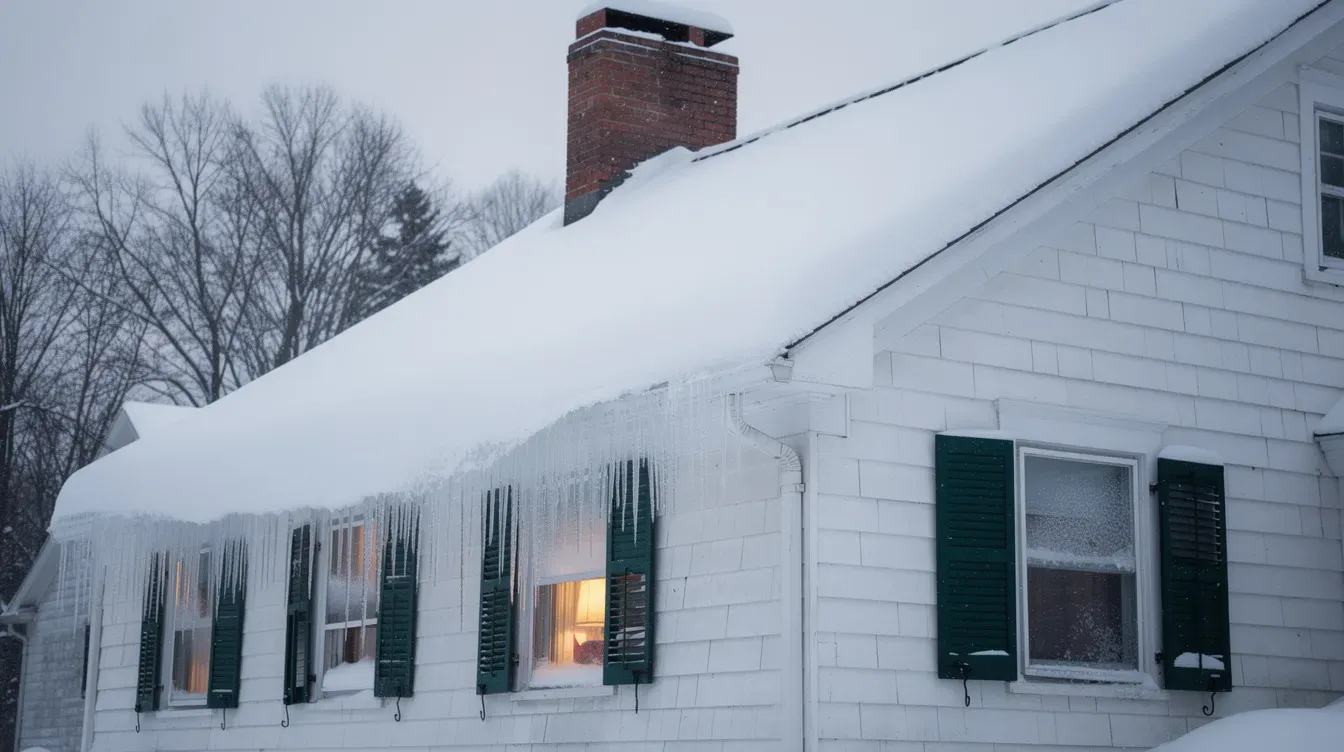
Snow guards don’t stop ice dams. If you get big icicles along the eave, the cause is heat and meltwater. It isn’t sliding snow. An ice melt system or better insulation is a separate fix.
Frequently asked questions
Do copper snow guards work on slate roofs?
They’re the traditional pairing. Copper and slate don’t react with each other, and a copper pad guard on a strap slips under the course above. Berger’s Pro #100 is one made for retrofit. The strap goes under the slate and hooks on a nail, so you don’t have to pull good slate to put it in.
How many snow guards do I need?
It depends on the roof. One maker’s chart, Alpine SnowGuards for its PD10 pad, starts every roof with three rows at the eave, 24 inches apart with the middle row shifted 12 inches. Longer rafters or heavier snow add rows higher up. Ask the maker or an engineer for your layout.
Can I put copper snow guards on a metal roof?
Not on aluminum or galvanized steel. Copper is the more noble metal, so the roof is the one that corrodes, and runoff off the copper can eat at it too. On a copper roof, sure. On a painted steel or aluminum roof, use guards made of a matching or compatible metal.
What is Freedom Gray?
It’s Revere’s copper sheet with a tin and zinc coating hot dipped on both sides. It’s still copper underneath. It just weathers to a soft gray instead of going brown and then green.
How long do copper snow guards last?
I won’t give you a number for the guard itself. IBHS puts a copper roof at 80 to 100 plus years, so the metal lasts. What fails first is usually a fastener. Sometimes it’s the strap or the slate around it. Check them after a big winter.
Talk to the owner
Snow guards are a small part of a roof, but they decide where a few tons of snow end up. Whether you need them, and how many, depends on the roof and what’s under it.
Our work is slate and copper roofing in Greater Boston. See our slate and copper roofing page and our copper roofing repair page. Snow guards aren’t listed on our service pages, so ask me directly about your roof. The estimate is free. Request a free estimate or call 617-913-1130.