Synthetic Slate Roofing vs Natural Slate for a Boston Home
Synthetic slate roofing vs natural slate for Boston homes: compare cost, weight, lifespan, repair, winter durability, and historic district approval before you reroof.
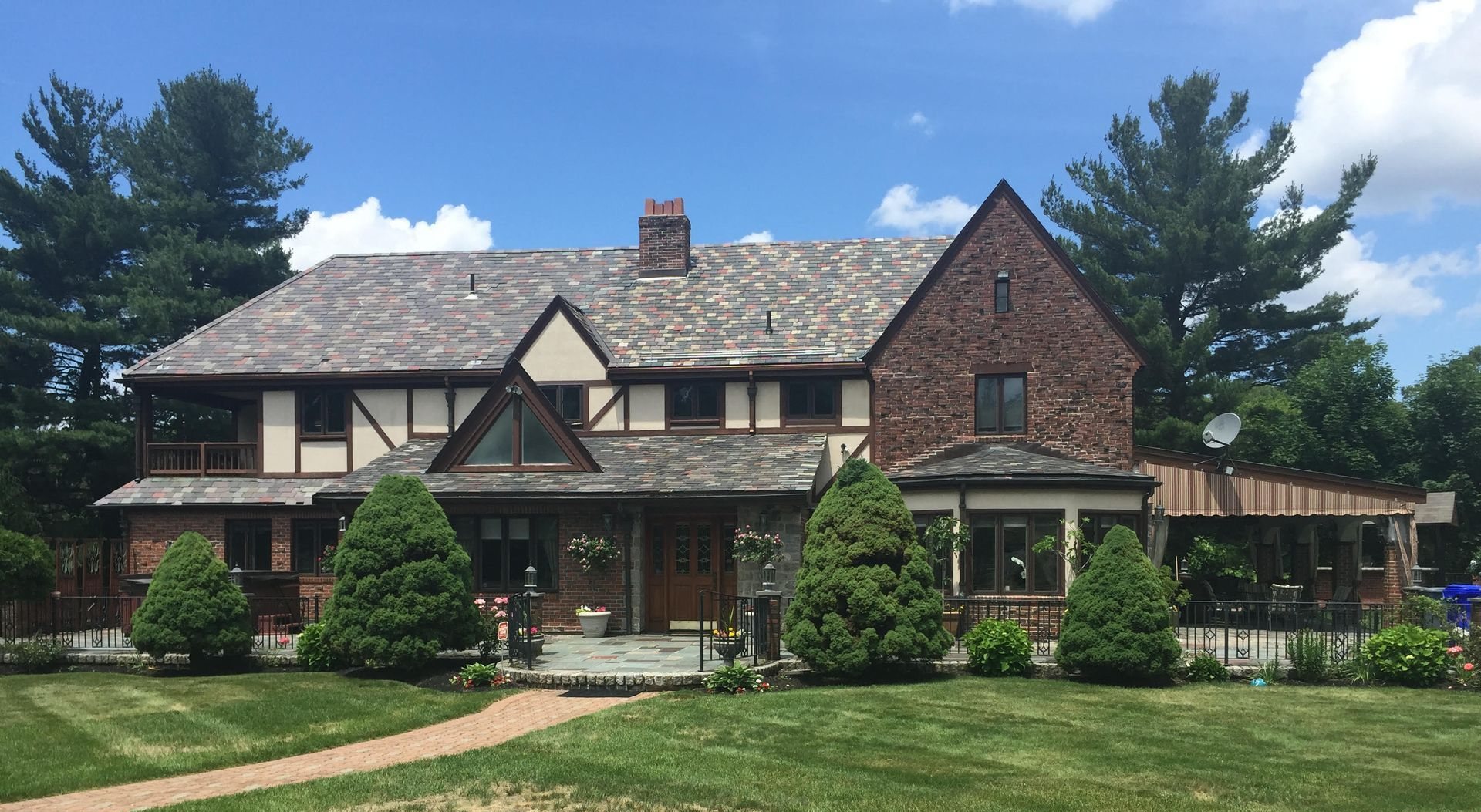
TL;DR: Synthetic slate roofing vs natural slate comes down to load, budget, lifespan, and historic approval. Synthetic slate costs roughly $9 to $20 per square foot installed, weighs about a quarter of natural slate, and carries 50-year warranties. Natural slate costs about $20 to $30 or more per square foot and can run past a century. On a Boston house framed for stone in a regulated district, natural slate is often still the right call. When weight or budget rules out stone, a good synthetic slate roof can be the honest answer.
Slate · 15 min read
Synthetic slate roofing vs natural slate is the choice homeowners ask about when they love the look of stone and flinch at the quote. Synthetic slate is a manufactured tile, usually polymer or a rubber and plastic blend, molded and colored to pass for slate from the street. The pitch is simple: most of the character, a fraction of the weight, and a smaller number on the estimate.
The trade is real, and it is not the same trade on every house. For a Boston home, synthetic slate roofing lives or dies on four questions that national cost articles tend to skip: can the framing carry stone at all, will the local historic district sign off on a composite, how does the material hold up to a New England winter, and how long do you plan to own the house. Answer those and the choice usually makes itself.
I install natural slate for a living, so read the rest with that in mind. But I have also talked plenty of homeowners out of stone they did not need. This is meant to be fair, not a sales page.
Synthetic slate roofing vs natural slate: the short version
Here is the side-by-side, before the details:
- Cost: synthetic slate roughly $9 to $20 per square foot installed. Natural slate roughly $20 to $30 or more per square foot.
- Weight: synthetic near 150 to 300 pounds per square. Natural slate commonly 700 to 1,500 pounds per square.
- Lifespan: synthetic carries a 50-year warranty. Natural slate 75 to 150 years.
- Impact and fire: most quality synthetic slate is Class 4 impact rated and Class A fire rated. Natural stone is fire resistant by nature and hard to crack from hail, but brittle underfoot.
- Winter: both handle freeze and thaw well; synthetic shrugs off ice impact, stone sheds snow and has the longer cold-climate record.
- Repair: natural slate swaps one piece at a time with salvage stone. Synthetic needs a matching product that may be discontinued years later.
- History: slate has a century-plus track record on New England roofs. Synthetic has only a few decades of real field data.
A “square” is 100 square feet of roof, the unit roofers actually price in. Keep that in mind whenever you see a per-square number.
What synthetic slate roofing actually is
Synthetic slate goes by a few names. Composite slate roofing, faux slate, imitation roof slates, synthetic slate tiles, and synthetic roof tiles all point at the same idea: a molded product engineered to mimic stone. Some homeowners search “imitation slate” or “composite roof tiles” and land on the exact same category.
The material varies by maker. Some tiles are virgin polymer with UV and thermal stabilizers and a fire retardant blended in. Others use recycled rubber and plastic, sometimes with a fiberglass reinforcement.
DaVinci Roofscapes molds a hard resin tile; you can read the DaVinci composite slate specs directly, and they list a Class 4 impact rating, a Class A fire rating, wind certification, and a lifetime limited material warranty on homes. Brava molds its Old World Slate from a poured process that captures real stone texture. EcoStar leans on recycled content. Inspire and Ply Gem are other molded single-width lines homeowners cross-shop.
Not every synthetic line has aged gracefully. Some early composite and plastic products faded, curled, or cracked well before their warranties ran out, and a few brands developed a reputation for early failures. That history is exactly why the maker matters. A $9 per square foot composite and a $20 per square foot composite are not the same roof, and “50-year warranty” means little if the company behind it does not last 50 years.
Natural slate is the opposite of manufactured. It is quarried stone, split into pieces, and hung in overlapping courses. If you want the full picture of how stone roofs are built and priced, our slate tile roof basics guide covers types, cost, and lifespan in depth. The short version: the stone itself is rarely the part that fails. Fasteners, flashing, and valleys usually go first.
Weight: the number that decides more Boston jobs than cost
Weight is where I start on an old house, not price.
Natural slate is heavy. A slate roof can put 700 to 1,500 pounds on every 100 square feet, depending on thickness. Synthetic slate lands near 150 to 300 pounds per square. That is roughly a quarter of the load, sometimes less.
Why does that matter in Greater Boston? Because a lot of the housing stock was framed for a specific roof. A Somerville triple-decker or a Cambridge Victorian that carried slate for a century has already answered the load question. The framing was sized for stone. Putting slate back on it is not a structural gamble.
A house that never had slate is a different conversation. If a 1960s Colonial in Newton was built for asphalt and someone wants a stone look, the framing was never designed for that weight. You either pay an engineer to review and reinforce the structure, or you choose a synthetic slate roof and skip the problem. In that case, composite is not a compromise. It is the sensible answer.
That is the single most useful thing I can tell a Boston homeowner: on many houses the roof choice is not aesthetic, it is structural, and synthetic slate exists mostly to solve the weight problem.
Cost: what you pay day one, and what you pay over a lifetime
Day one, synthetic wins. It is not close.
Synthetic slate roofing installed runs roughly $9 to $20 per square foot, with mid-grade composites near $12 to $16. The tile alone lands around $300 to $1,200 per square from DaVinci, Brava, or EcoStar, and labor adds most of the rest. Natural slate installed runs about $20 to $30 per square foot and climbs from there on complex roofs.
Independent cost data backs the spread; Fixr’s synthetic versus natural slate breakdown puts composite at roughly half the material and labor of stone. Our own Boston slate roof cost guide runs the local stone numbers in more detail.
On a typical Boston roof of 2,000 to 2,600 square feet with a couple of dormers and real copper work, synthetic lands in the low-to-mid five figures installed, while the same roof in natural slate can run roughly double. The exact number swings on pitch, staging, and how many chimneys and valleys the crew has to detail.
Two things drive that gap. Stone costs more per piece, and stone is slow. A slate roof needs a crew that lays copper valleys, keeps headlap course after course, and does not crack good stone underfoot. That labor is the real premium. Synthetic tiles nail down faster and forgive more.
Now stretch the timeline. A 50-year synthetic roof is one roof in the life of a house you keep for 40 years. A natural slate roof at 100-plus years is one roof across two or three synthetic ones.
On a house you plan to hold for the long term, or pass down, the lifetime cost of stone can undercut composite even though the first check is bigger. On a house you expect to sell in ten years, that math never gets a chance to work, and synthetic is the cheaper call.
If you are weighing slate against the budget option instead, our slate vs asphalt shingles comparison runs the same day-one versus lifetime numbers against asphalt.
Cold, snow, and ice: how each holds up to a New England winter
Boston roofs earn their keep between November and April, and this is where a lot of national comparisons go quiet.
Freeze and thaw is the test. Water gets into a small flaw, freezes, expands, and works the flaw wider. Good natural slate is dense enough to shrug this off for a century; that is why hard Vermont and Buckingham stone lasts here. Cheap, soft slate is a different story and can spall in a few decades.
Quality synthetic slate is engineered for cold-climate cycling and does not absorb water the way soft stone does, so it holds up well through New England winters. Both materials are freeze-thaw friendly when the product is good. Both fail faster when it is not.
Impact is where synthetic pulls ahead. A Class 4 rated composite takes a hit from ice, a falling branch, or hail that would crack a natural slate. After a bad ice storm I have seen natural slate chip at the exposure while a composite next door came through clean.
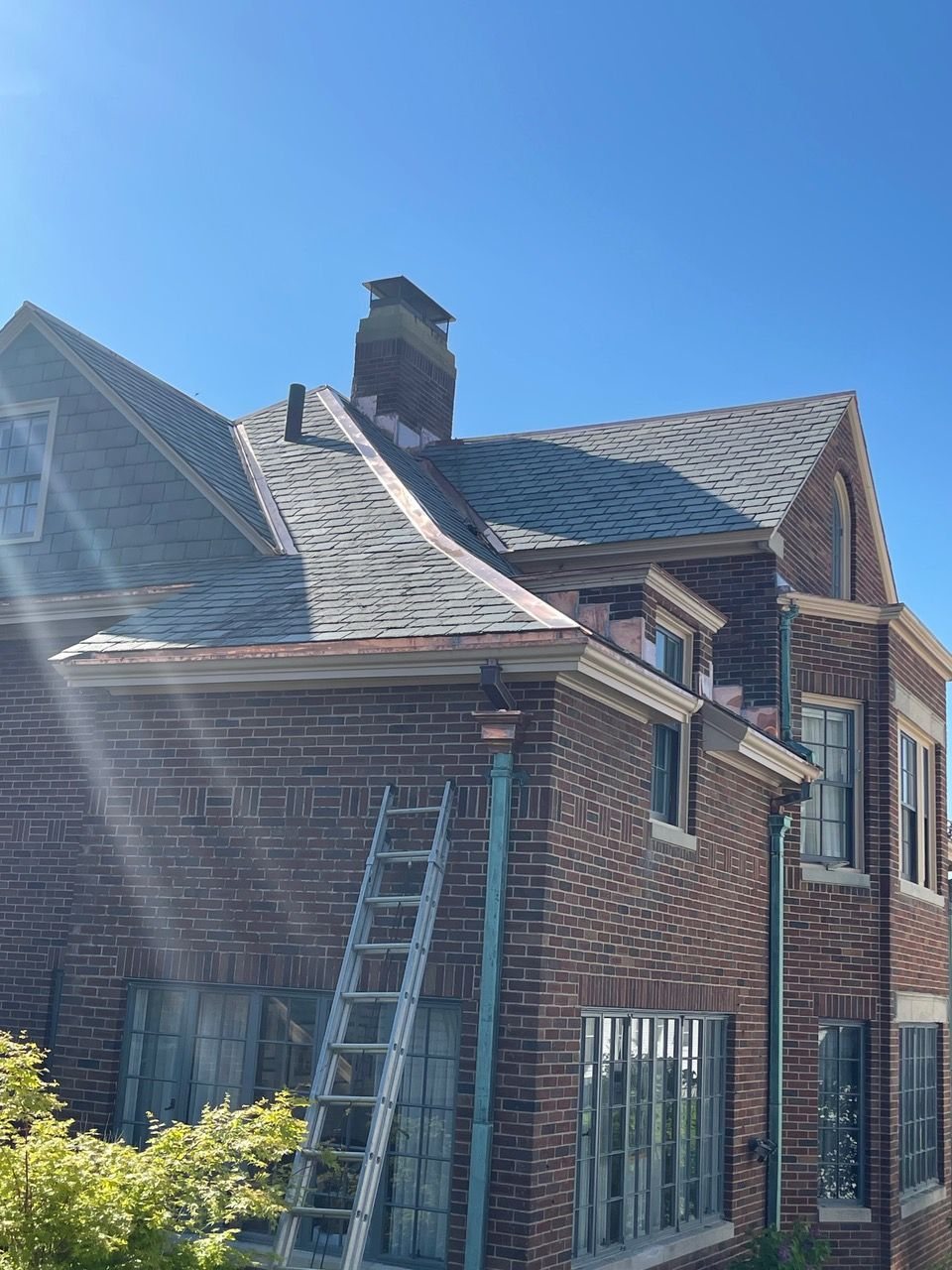
Snow load and ice dams are a roof-system question, not a tile question. Slate and synthetic both shed snow well because they are smooth and steep-friendly, but neither one stops an ice dam on its own. That comes from ventilation, insulation, and flashing details, which we cover in our guide to preventing ice dams in New England. Whichever tile you choose, the ice-and-water membrane at the eaves and the copper in the valleys are what keep a Boston winter outside.
Lifespan and durability: field history versus warranty
This is where honesty matters, in both directions.
Synthetic slate is tough in ways stone is not. Most quality composite is Class 4 impact rated, the highest rung, so it shrugs off hail and falling branches that would crack a natural slate. Class A fire rating comes standard on the good lines. Wind ratings run high, often 110 mph and up, which matters on an exposed Boston Harbor-facing slope.
But durability and lifespan are two different claims. Synthetic slate carries 50-year warranties. That is a manufacturer’s promise, not a century of roofs sitting on real houses. The oldest composite slate roofs are only about 40 years old. We do not yet know how a polymer tile looks at year 80.
Natural slate has that record. The National Park Service, in Preservation Brief 29, notes slate roofs lasting 60 to 125 years or longer depending on the stone and the roof. Around Boston I still work on roofs laid in the 1890s.
Hard Vermont and Buckingham Virginia slate outlast the nails and flashing under it. The stone is usually the last thing to fail. Our guide to how long a slate roof lasts walks through what actually ends a stone roof’s life, and it is almost never the stone.
So the fair statement is this: synthetic is more impact resistant, natural is more time-tested. If a hailstorm is your fear, composite has the edge. If you want a roof your grandchildren inherit, stone has the record.
Repairability: the difference that shows up in year 30
Both roofs can be repaired. They repair differently, and the difference bites later.
A natural slate roof is built for single-piece repair. A good slate roofer pulls one broken slate, matches size and thickness from salvage stone, and fastens a replacement without touching the rest of the roof. Slate quarried in 1900 and slate quarried today are the same rock. Matching is a sourcing problem, not an impossibility.
Synthetic slate ties you to a product line. If a tile cracks in year 30 and the manufacturer has changed the mold, retired the color, or gone out of business, the match gets hard. Composite also weathers as a set. The field fades together, so a brand-new tile dropped into a 30-year roof can stand out even when the part number is right.
Neither is a dealbreaker. It is a factor most homeowners never think about at the estimate stage and then meet years later. If you already own slate and are trying to decide between fixing and replacing, we walk through the tests in when a slate roof needs replacement.
Historic districts: the Boston-specific catch
Here is the piece the national articles miss, and it decides a lot of local jobs.
Greater Boston is full of regulated neighborhoods. Beacon Hill, the Back Bay, parts of Cambridge, Newton, Brookline, and Somerville all have historic commissions with a say over what shows from the street. On a house inside one of those districts, the roof is not only your decision.
Some commissions require the roof to match what the house originally carried. On a house that was built with slate, that usually means natural slate, full stop, and a synthetic substitute gets denied no matter how good it looks.
Other districts, and other cases, approve a close composite match, especially on rear slopes or where the original material is long gone. It genuinely varies by commission and by house. Synthetic has been approved in Greater Boston historic districts before, usually on rear slopes or where the original material was gone long ago, so it can be done.
It is never a given. Before you fall for a product, read our historic roof permit primer and ask the commission what they will accept on your specific house.
My advice is unglamorous: call your local historic commission before you fall in love with a material. Find out whether they will consider a composite at all. The National Park Service is cautious about synthetic substitutes in restoration work because artificial slate can look rigid and may fade differently over time, which is exactly the kind of issue a visible Boston roof can run into.
We lay out the paperwork side in our Boston historic roof permit primer, and the restoration side in our historic roof restoration service. Getting a denial after you have signed a contract is an expensive way to learn the rules.
Synthetic slate on a mansard or a steep Boston roof
Boston has more mansards than most cities its size, and they change this decision.
A mansard puts the roof at eye level. The steep front slope of a Second Empire house in the South End or Davis Square is basically a wall you look straight at, so any tell in a synthetic tile, a repeated texture or a too-even face, shows more than it would two stories up on a hip roof. That is the argument for stone on a prominent mansard.
The counter-argument is weight and framing. Mansards carry a lot of tile on a near-vertical plane, and the fastening has to be right or the field slips over time. On a mansard that was not built for stone, a lighter synthetic slate can be the safer structural choice, as long as the commission signs off on the look.
We get into the details of these roofs in our guide to slate work on Boston mansards. The short version: the more the roof faces the street, the more the appearance gap between stone and composite matters.
Installation: why the crew matters more than the material
A roof is only as good as its details. Both materials fail at the same places when the work is careless: valleys, chimneys, sidewalls, and eaves.
Natural slate is unforgiving. Drive a nail too tight and the stone cracks around it. Leave it proud and the slate above rocks. Headlap has to stay right course after course, or water finds the nail holes. The National Slate Association lays out the basic principles of slate roofing, and they are the same principles a good crew follows on every stone roof.
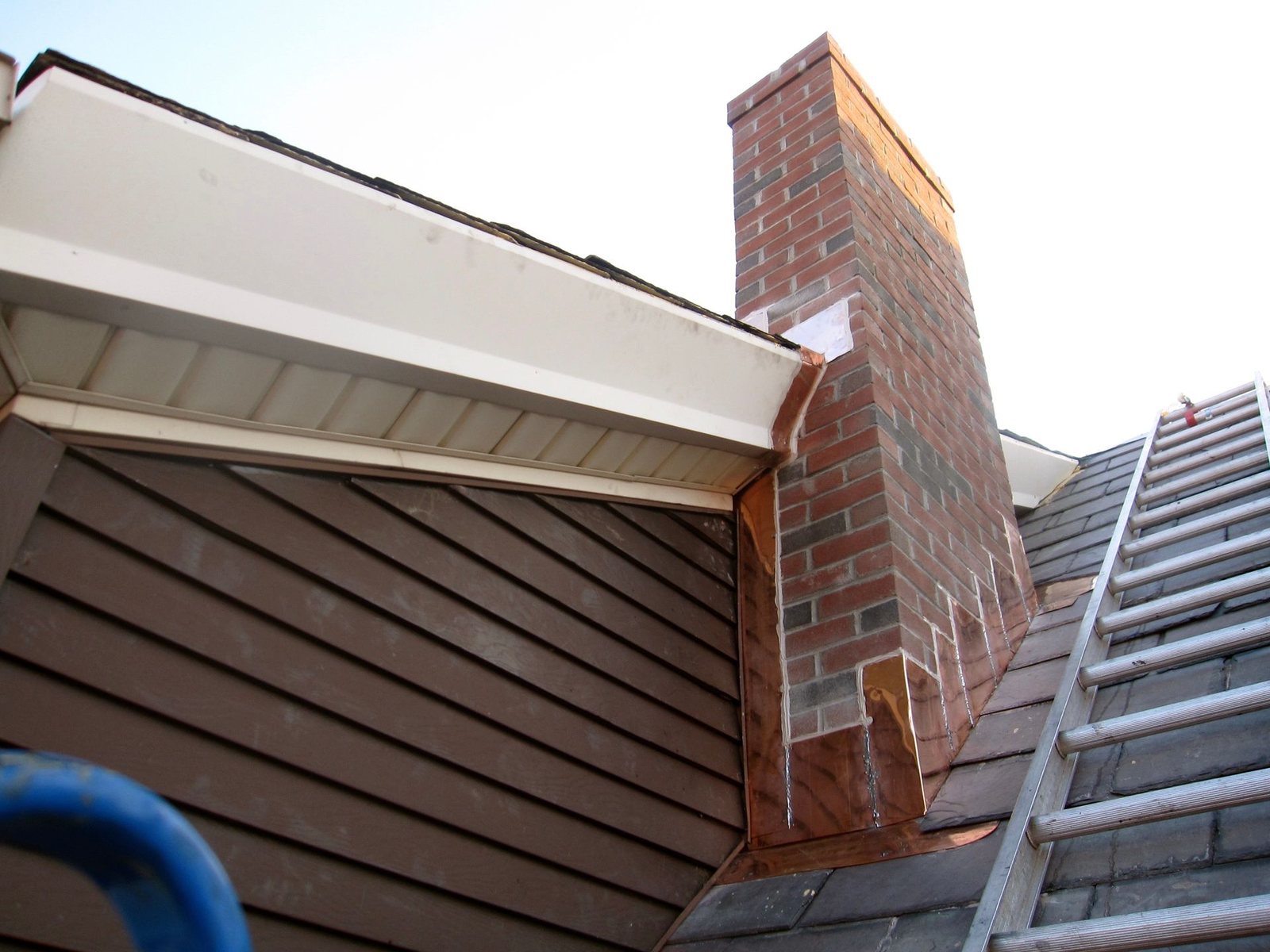
Synthetic is more forgiving to install, which is part of its appeal, but it is not foolproof. The flashing still has to be copper or the right metal. The fasteners still have to hit the pattern the manufacturer specifies, or the warranty is void. I have seen composite roofs leak at a chimney because the crew treated the tile as the waterproofing instead of the flashing under it.
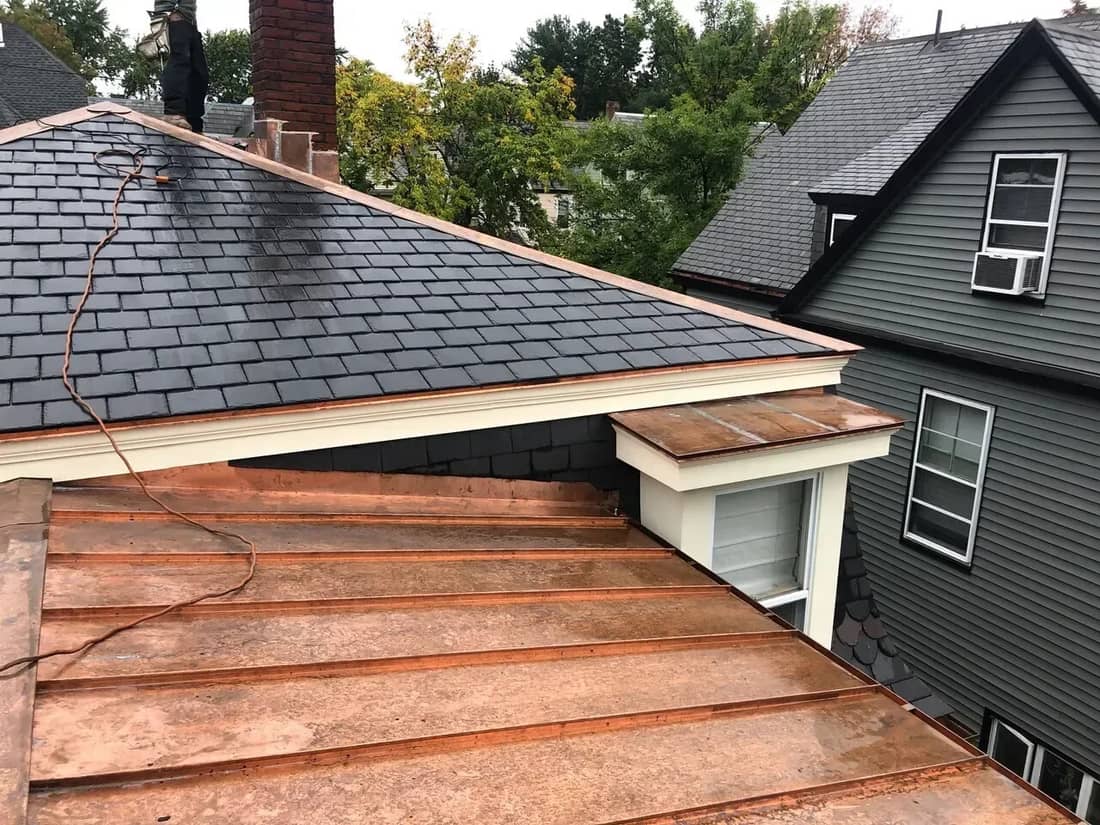
Whichever material you pick, the copper and the flashing details decide whether the roof stays dry. On a Boston house with two chimneys, four dormers, and a low rear addition, that work is the job. The field tile, stone or composite, is the easy part.
When I recommend synthetic, and when I recommend stone
People expect a slate installer to push stone on everyone. I do not, and here is the honest split.
I recommend a synthetic slate roof when:
- The framing was never built for stone and reinforcing it is not worth the cost.
- The budget is fixed and the number has to land under natural slate.
- A hail-prone or storm-exposed slope makes Class 4 impact resistance a real advantage.
- The house is not in a district that will require matching stone, and the owner is not staying long enough for slate’s lifespan to pay off.
I recommend natural slate when:
- The house was built for it and already carried stone, so the load is a solved problem.
- The house sits in a historic district that requires matching the original material.
- The owner is thinking in generations, where a 100-year roof beats two 50-year roofs.
- The architecture is worth it: a Tudor in Newton, a brick rowhouse in the South End, a Victorian in Cambridge where stone is part of the building, not a costume on it.
There is no shame in either answer. The mistake I watch for is a proposal that quietly swaps synthetic in under a “slate” line item without saying so, or one that prices stone on a house that cannot carry it. If an estimate says “slate,” ask exactly what is going up there.
The two are not interchangeable. They are different roofs with different lifespans, different repair paths, and different rules once a historic commission is involved, and treating them as the same thing is where homeowners get burned.
Frequently asked questions
What is synthetic slate roofing made of?
Synthetic slate roofing is a molded tile, not quarried stone. Most lines are engineered polymer with UV and thermal stabilizers and a fire retardant, or a blend of recycled rubber and plastic, sometimes reinforced with fiberglass. DaVinci molds a hard resin tile, Brava pours a resin that captures real stone texture, and EcoStar leans on recycled content. The look is stone; the material is plastic and rubber built to mimic it.
How much does a synthetic slate roof cost in Boston?
Synthetic slate roofing runs roughly $9 to $20 per square foot installed, with mid-grade composites near $12 to $16. Tile alone is about $300 to $1,200 per square (100 square feet) for DaVinci, Brava, or EcoStar. On a typical Boston roof of 2,000 to 2,600 square feet with dormers and copper work, that lands in the low-to-mid five figures. Natural slate is closer to $20 to $30 or more per square foot installed.
How long does synthetic slate roofing last compared to natural slate?
Most synthetic slate carries a 50-year warranty, and that warranty is the only long number behind it. Natural slate commonly runs 75 to 150 years, with hard Buckingham slate at the top of that range. Synthetic is newer, so it does not yet have a century of field history behind it, and a few early composite lines faded or failed sooner than their warranties promised.
Will a Boston historic district approve synthetic slate roofing?
It depends on the district. Some commissions in Cambridge, Newton, and Boston require the roof to match what the house originally carried, which usually means natural slate. Others approve a close synthetic match, often on rear slopes or where the original material is long gone. Check with the local historic commission before you price the job, not after.
Is synthetic slate lighter than natural slate?
Much lighter. Natural slate is commonly cited at 700 to 1,500 pounds per square, while synthetic slate tiles land near 150 to 300 pounds per square, roughly a quarter of the stone. That weight difference is often the whole reason a homeowner looks at composite in the first place, especially on a house that was never framed for stone.
Can synthetic slate roofing be repaired like natural slate?
Both can be repaired, but differently. A single natural slate can be pulled and matched with salvage stone decades later. A synthetic tile has to be matched to a product line that may be discontinued by the time you need it, and color can drift as the field weathers, so a fresh tile can stand out in an older roof.
Talk to the owner
The useful first step is not a square-foot estimate off a satellite map, and it is not picking synthetic or stone off a website. It is one person up on the roof, in the attic, and at the chimneys, looking at what your house actually has, and whether the framing and the historic district even leave you a choice.
Every slate roof Art Slate quotes gets walked by Arturo before a number goes on paper. See our slate and copper roofing service or schedule a free assessment, and Arturo will tell you whether synthetic or stone is the honest answer for your house.