Are Gutter Guards Worth It? A Boston Roofer Runs the Numbers
Are gutter guards worth it? A Boston roofer compares 2026 guard and cleaning costs, payback, the types, ice dams, heavy rain, and when guards aren't worth buying.

TL;DR: Gutter guards are worth it when trees hang over the roof and the gutters are hard or costly to reach. Angi's 2026 Boston figures put installed guards at $7 to $15 a linear foot and a cleaning at $130 to $250 a visit. Under heavy canopy, guards can pay back in a few years. On an open lot, they may never pay back. They cut cleaning but don't end it, they don't stop ice dams, and they only belong on gutters that are already sound.
Gutters · 13 min read
I get asked this one a lot, usually from the bottom of a ladder in October. Are gutter guards worth it? My honest answer is sometimes. It depends on what grows over your roof and how hard your gutters are to get to. It also depends on the shape of the gutters before anything goes on top of them.
This post is about that decision, not the install. If you’ve already decided and want the steps, our gutter guard installation guide walks through them. Here I’ll go through what guards cost and what cleaning costs. Then where the money comes back, and where it doesn’t.
Cost numbers come from Angi and This Old House, and I give the date of each. Wildfire points come from NFPA and FEMA. Warranty wording comes from GAF. None of them are Art Slate prices.
So, are gutter guards worth it on your house?
Start with the trees. Homes surrounded by big oaks and pine trees get the most out of gutter guards, and that’s the single biggest factor in whether they pay. Heavy tree cover means more debris and more cleanings. It also means more chances for clogged gutters between visits. A house under a big canopy in Newton or Brookline is the obvious benefit case.
Then look at height. A one story ranch where you can clean gutters from a short ladder in an hour is a weak case. A two and a half story colonial with a steep roof pitch over a brick walk is a strong one. Every cleaning there costs more, and it’s a more dangerous ladder job if you do it yourself.
Last, your own situation. Many homeowners I talk to are fine on a ladder twice a year. Others have physical limitations, or just don’t want to pay for three visits a year. For them, reduced maintenance is worth paying for.
If two or three of those line up, guards are probably worth a quote. If none do, they probably aren’t.
How gutter guards work, and the kinds you’ll see
All gutter guards do the same basic job. They’re protective covers or inserts that sit over or in the gutter, blocking debris like leaves and twigs while rain still gets through to the downspout. How they let water in is what separates them, and gutter guard systems are not created equal.
- Gutter screens are metal or plastic panels with fairly big holes. They stop large leaves. Small debris and seeds drop right through.
- Mesh guards use a finer weave. Plastic mesh is cheap and sags under wet leaves and snow. Fine metal mesh holds its shape.
- Micro mesh is a very fine stainless screen on a rigid frame. It’s the one that can block small debris like pine needles and shingle grit. Needles still sit on top and need brushing off.
- Reverse curve guards are solid gutter covers with a rounded nose. Surface tension pulls water around the curve into a slot, while the debris slides off the front edge. That’s why you’ll see them called surface tension or solid guards.
- Foam inserts sit inside the trough like a long sponge. Water soaks through. They hold moisture and seeds can sprout in them.
- Brush guards look like giant pipe cleaners with stiff bristles that lie in the gutter. Leaves catch on top and water runs underneath.
Not every type handles every kind of debris, or other debris like seed pods and roof grit. Coarse screens let needles through. Brush and foam trap wet leaves on top until somebody pulls them out. Micro mesh stops the most, but its surface fills with pollen and grit. That’s why the trees matter more than the brand. For a full rundown of gutter guard options by tree type, the installation guide covers it.
What clogged gutters really cost you
A packed gutter doesn’t drain.
In a storm it spills over at the low spot, and the water lands in the same bed by the same corner of the house every time. Over the years that’s how foundation problems and wet basements start.
Water that backs up can also run behind the gutter. It rots fascia boards and soffits and stains brick. On older houses that trim is expensive to replace, sometimes impossible to match. Standing water and wet leaves sitting in a trough for months also wear on the metal at seams and joints.
Then there’s the pest side. The CDC lists gutters and downspouts among the places mosquitoes lay eggs when they hold water. A trough full of rotting leaves is also a spot birds and squirrels like to nest in. Guards can help with all of this. They help prevent water damage to the roof edge and foundation by keeping water moving. They cut down on the standing water mosquitoes need, they deter pests from nesting in the trough, and they can extend gutter life by keeping wet muck off the metal. Guards that prevent debris from collecting won’t stop pest infestations that have nothing to do with gutters.
The math on gutter protection in Boston
Here are the dated numbers I trust, then a sample house.
| Item | Range | Source |
|---|---|---|
| Guards installed, Boston | $7 to $15 per linear foot, most jobs $952 to $2,176 | Angi Boston, June 2026 |
| Guards installed, national | $6 to $13 per linear foot | Angi national guide, 2026 |
| National brand pro installs | about $40 per linear foot on average | This Old House 2026 survey |
| DIY materials | $1.50 to $6 per linear foot | This Old House 2026 survey |
| Gutter cleaning, Boston | $130 to $250 per visit | Angi Boston, June 2026 |
| Gutter cleaning by height | $145 to $250 one story, $180 to $360 two story, $210 to $450 three story | Angi, August 2026 |
You’ll see $10 to $25 a linear foot quoted all over the web. That’s a fair middle, more than Angi’s local range and well under the big brands. Our gutter replacement cost guide adds HomeGuide’s $15 to $45 for full branded systems. You’ll also see $4 to $5 a foot for DIY materials. That sits inside This Old House’s $1.50 to $6. So every one of those numbers is real, they’re just measuring different products.
Now a sample. Say a two story colonial with 150 feet of gutter. At Angi’s Boston range the guards run $1,050 to $2,250. With few trees, you clean twice a year at $180 to $360 a visit. Guards might drop you to one check a year, so you save $180 to $360. That’s a payback of about 3 to 12 years.
Put that same house under big pines. Angi’s own table says homes near pines need about four cleanings a year. If guards cut that to one, you save three visits, $540 to $1,080 a year, and the upfront cost comes back in roughly 1 to 4 years. That’s where the 2 to 5 year payback you see online holds up. At $40 a foot for a national brand, the same 150 feet is $6,000. That takes a lot longer to earn back.
One more caution on savings claims. I’ve seen “cuts cleaning by up to 90%” passed around. I couldn’t find a source for that as a cleaning figure. This Old House’s 90% was how much debris one product blocked in testing. Angi says guards can cut cleaning costs, sometimes by up to 50%. I’d plan on that end and be happy if you do better.
Where guards actually help a gutter system
Most homeowners notice the first benefit right away. There are fewer gutter clogs, and water flow stays steady, so rain gets to the downspouts instead of over the front. Gutter guards provide a few other wins too.
- Fewer ladder trips. Guards reduce professional cleaning visits, which is where the payback comes from.
- Less water at the foundation, because a clear gutter can direct water to the downspouts and away from the house.
- Less weight on the hangers. A gutter full of soaked leaves is heavy.
- Longer gutter life, since less debris buildup sits against the seams.
Those are the many benefits that make guards worth a look. They only show up with proper installation on a gutter that already drains right.

Your existing gutters come first
This is the part people skip. A guard is a lid. It doesn’t fix the pot.
Guards should only go on gutters in good condition. If the trough sags, has no proper pitch, leaks at the seams, or pulls off the fascia, a guard just hides it. Water still pools at the low spot, now under a cover where you can’t see it. Undersized gutters and downspouts overflow in a storm whether there’s a guard on them or not.
So before installing gutter guards, check your existing gutters. Look for proper drainage to every outlet. The hangers should be solid and the wood behind them sound. We cover hanger problems in our gutter hangers post. If the gutter needs repair, do that first. Otherwise the guard money is wasted.
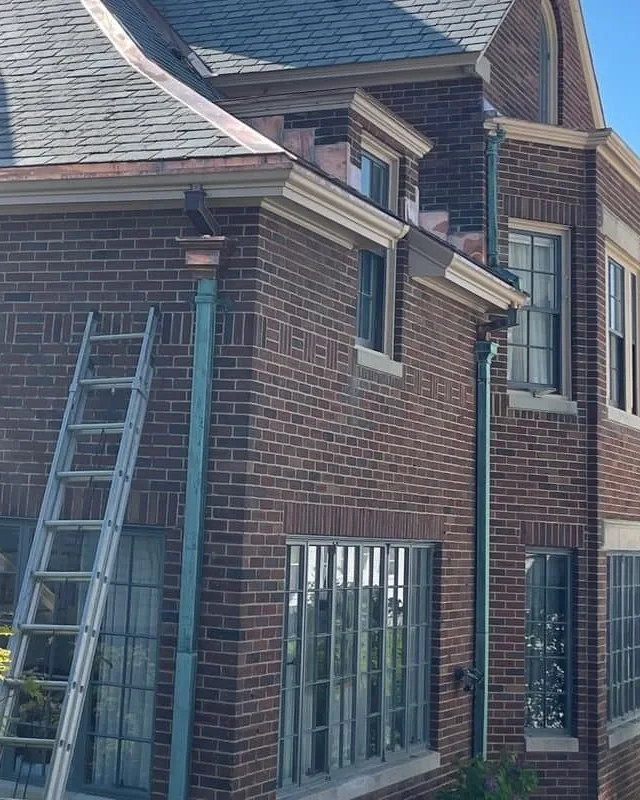
Ice dams and gutter guards
You’ll read that guards “reduce the risk of ice dams.” I’d be careful with that. An ice dam starts up on the roof, not in the gutter. Heat from the house melts snow on the upper roof, the melting snow runs down to the cold eave, and it freezes again. The ice ridge grows and water backs up under the roof shingles or slate.
A clean gutter helps a little. Meltwater can flow freely on a mild afternoon instead of sitting in a pile of leaves and freezing. Some guard designs keep ice from building up quite as much at the lip. That’s the honest version of the claim.
The flip side is real too. Guards can hold snow and ice right at the edge. Ice dams can still form with guards on, and foam is the worst for holding water. Cheap guards can buckle through freeze thaw cycles, and a solid hood can let snow pile up and slide off in one sheet. In cold climates like ours, I’d never sell a guard as an ice fix.
What real ice dam prevention looks like
Real ice dam prevention happens in the attic. Air sealing stops warm air leaking up, insulation keeps the heat in the house, and venting keeps the roof deck cold. Our ice dam guide goes through the order. For a stubborn eave, heat cable can help, and we cover that on our ice melt systems page. A guard must never cover or pinch the cable.
How guards do in heavy rain
Good metal micro mesh and screens handle a normal New England downpour fine on a gutter with the right pitch and enough downspouts. In a real cloudburst, things change. Fast water off a steep roof can shoot past a reverse curve and over the front. Low quality guards can overflow in a downpour. It gets worse once pollen or needles mat the surface.
Most of the time, overflow in heavy rain points back at the gutter, not the guard. The gutter may be too small or too flat. It may be short on downspouts. Once the guards installed on your house have seen one big storm, go out and watch. Water flowing properly should drop in and come out the downspout. If it sheets over, call whoever put them on.
When gutter guard installation goes wrong
Installation quality matters as much as the product. Most problems I see come from how the guard went on, not what it’s made of.
The roof is the big one. Many micro mesh and reverse curve guards tuck their back edge under the first course of shingles. GAF’s technical bulletin on gutter covers says most professionally installed covers don’t affect its shingle warranty. It warns against products that need fasteners through the shingle, removal of shingles or drip edge, or installation under the underlayment. It also says its warranty won’t cover the guard or damage from installing it. So a bad install can cost you warranty coverage on that part of the roof. Ask exactly how the guard attaches before anyone gets on a ladder.
On slate, nothing slides under the slate and nothing gets nailed through it. Slate lasts 75 to 150 years and an asphalt roof 18 to 25, and a prybar at the eave can shorten either one. Clip on or fascia mounted guards leave the roof alone. Our copper gutter guards guide covers fitting copper and half round profiles.
Gaps are the other problem. Loose seams and open corners let needles in, and the gutter clogs under a guard that looks fine from the ground. Professional installation is worth it on tall walls and on slate or copper. On a one story run with sound gutters, a careful homeowner can do it and save money. Optimal performance comes from a tight fit either way.
When guards aren’t worth the money
Guards aren’t worth it if your gutters rarely clog. An open lot with no trees close by doesn’t drop more debris than one fall cleaning can handle. A single story house where you can reach everything from a step ladder is another one. Gutters that need replacing soon are a third. Put the money into the gutter instead.
And don’t buy them expecting completely maintenance free gutters. No guard is. That’s the biggest letdown I hear about.
Gutter maintenance with guards on
Guards change the maintenance requirements. They don’t remove them. Plan on a yearly inspection, and with heavy tree cover I’d go spring and fall. Brush or rinse whatever sits on top. Lift a section and look under it, since some debris gets past every type. Foam and brush need pulling and cleaning, and replacing sooner than metal.
That still beats regular gutter cleaning three or four times a year, and it’s why occasional cleaning is the realistic goal. In This Old House’s 2026 survey of 1,000 owners, a little over half said they’d stopped cleaning or only clean once a year after guards. The other side of that is plenty of people still clean twice a year. Our gutter repair page explains why we recommend a cleaning in fall and one in spring on most houses either way.
Wildfire embers, and why Boston mostly doesn’t need to worry
Out in fire country, the dry stuff in a gutter is fuel. NFPA’s Firewise home ignition zone checklist says metal gutters don’t ignite, only the debris that collects in them, and that’s why keeping them clean matters. FEMA’s wildfire guidance goes a step further and recommends noncombustible metal mesh or metal hood leaf guards, noting plastic can melt and mesh still lets pine needles collect.
So metal guards help keep the fuel out. Plastic and foam don’t count. Wildfire risk around Boston is low, so I wouldn’t buy guards for this reason here. If you also own a place out west, it’s worth knowing.
How long gutter guards last
This Old House lists aluminum guards at 10 to 20 years and stainless steel at 20 plus. Plastic gets 5 to 10, brush 3 to 5 and foam 2 to 5. That lines up with the 10 to 20 years you’ll see quoted, as long as you mean metal. Put that next to the payback math. A $2,000 plastic system that’s done in six years has to earn its money back fast. A metal one has time.
Local weather patterns shorten all of those numbers. Snow load and summer sun wear guards out faster in New England than in a mild climate. They can come loose too. Check the fasteners after a hard winter.
Frequently asked questions
Are gutter guards worth it for most homes?
Depends on the trees. If big oaks or pines hang over your roof and you’re paying somebody to clean two or three times a year, yes, usually. If your yard is open and the gutters hardly ever fill up, I’d hold onto the money.
How much do gutter guards cost in Boston?
Angi’s June 2026 Boston page says $7 to $15 a linear foot installed, with most jobs around $952 to $2,176. National brand systems cost a lot more. This Old House’s 2026 survey found an average near $40 a foot for professional installs, and buying materials yourself runs about $1.50 to $6 a foot.
Do gutter guards stop ice dams?
No. Ice dams start with heat leaking out of the house and melting snow up on the roof. That water freezes again once it reaches the cold edge. Guards can keep a gutter from being packed with leaves going into winter. They can also hold snow and ice right at the eave. Air sealing and insulation in the attic are what fix it.
Do I still have to clean gutters with guards?
Yes, just not as often. Leaves and needles pile up on top. Grit gets under. I’d look them over every year and brush or rinse them off. Lift a section now and then too. In This Old House’s 2026 survey, a little over half of owners said they’d stopped cleaning or now do it once a year. The rest still clean twice or more.
How long do gutter guards last?
Depends what they’re made of. This Old House gives aluminum 10 to 20 years and stainless steel 20 plus. Plastic gets 5 to 10, brush 3 to 5 and foam 2 to 5. How well they were put on matters about as much.
Can gutter guards void my roof warranty?
They can if they’re put on wrong. GAF’s bulletin on gutter covers says most covers installed by a pro won’t touch its shingle warranty. It warns about ones that need nails through the shingles. Same for pulling off shingles or drip edge. It also won’t cover damage from the install. Read your own warranty and ask exactly how the guard fastens.
Talk to the owner
Whether guards make sense comes down to your trees and the gutters under them. That’s easier to judge standing in the yard than reading a cost table.
We don’t install gutter guards as a default. We’ll quote them if you want them, but on most houses we recommend cleaning twice a year and fixing whatever makes the gutter clog or spill. The estimate is free. See our gutter repair page, request a free estimate, or call 617-913-1130.