Gutter Hangers: Types, Spacing, and How to Choose for a Boston House
Gutter hangers explained: hidden hangers, spikes and ferrules, brackets, roof straps and T-bars, wrap-around hangers, spacing for snow, matching metals, and how to install them.
TL;DR: Gutter hangers hold a gutter to the house, carry the weight of water, ice and leaves, and keep the slope that moves water to the downspouts. The common types are hidden hangers, spikes and ferrules, exposed brackets, and roof straps for eaves without a usable fascia. Industry guidance puts hangers no more than 36 inches apart, with tighter spacing where ice and snow sit for weeks. Match the hanger metal to the gutter metal, and screw into solid wood.
Gutters · 12 min read
Gutter hangers are small pieces of metal that do a big job. They hold the gutter to the house, they carry everything that lands in it, and they set the slope that moves water toward the downspouts. When hangers fail, the gutter sags, water spills over the front, and the fascia behind it starts to rot.
This guide covers what each type of hanger does, which ones hold up in a New England winter, how far apart they go, which metals can touch, and how a hanger gets installed. Where we cite numbers, the source is named in the text: the Copper Development Association (CDA), This Old House, and the published installation guides from gutter and hanger makers.
What gutter hangers do for a house and its roof
A gutter hanger has three jobs.
- Holds the gutter on. Hangers secure the gutter to the fascia, the board that runs along the roof edge, or to the roof itself when there is no usable fascia.
- Spreads the load. Water, wet leaves and ice are heavy. Spacing hangers along the run spreads that weight across the fascia instead of piling it on a few points.
- Keeps the slope. Water only reaches the downspout if the gutter runs downhill. This Old House gives the standard pitch as 1/4 inch per 10 feet of gutter. A hanger that loosens lets that section flatten or dip, and water sits there.
A gutter is only as good as its hangers. When a run sags, the trough itself is often fine. The hangers let go, or the wood behind them rotted.
The main types in a gutter hanging system
Sources slice this up differently. One common breakdown lists seven types: hangers fastened to the fascia board, hidden hangers, spikes and ferrules, exposed brackets and straps, hangers secured to the roof deck, T-bar or T-strap hangers, and wrap-around hangers. Several of those overlap. In practice you’ll run into five on Boston houses.
Hidden hangers: the hanger that sits inside the gutter
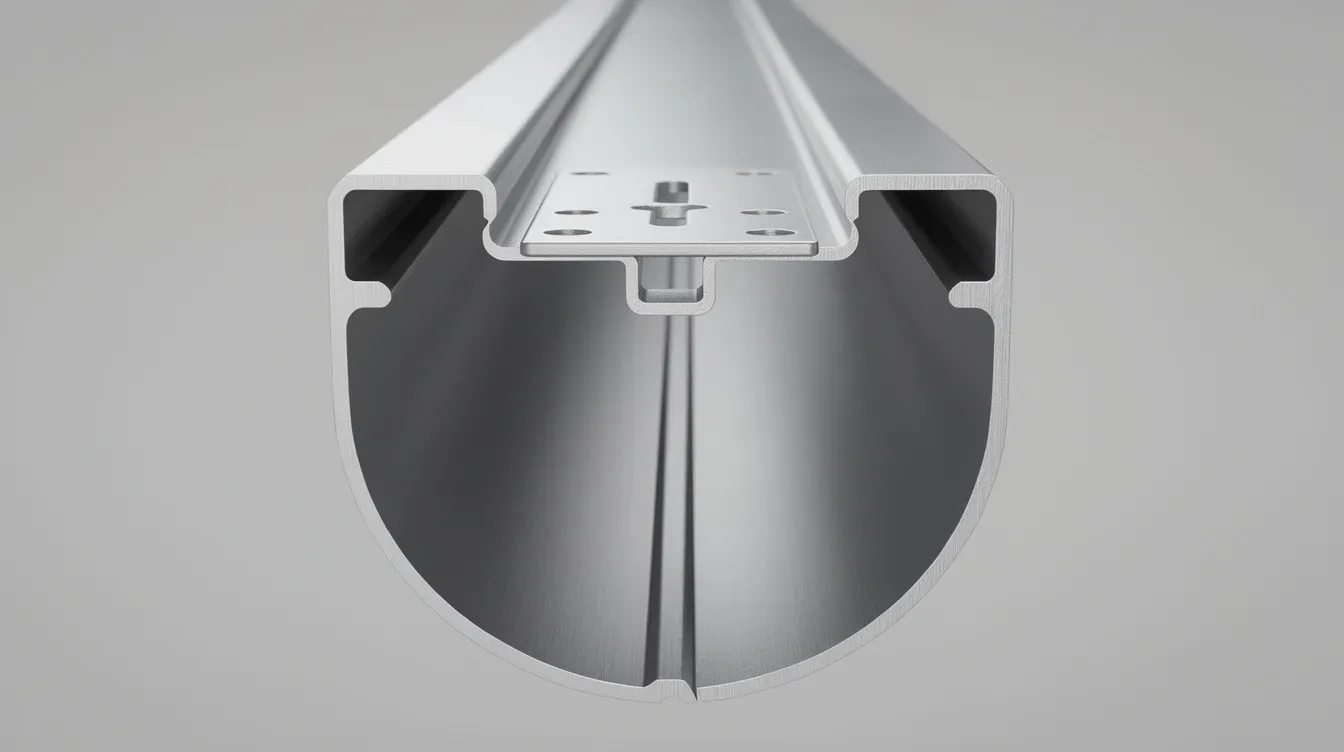
A hidden hanger is a bar that spans the inside of the gutter. The front end hooks under the front lip, and a screw passes through the back of the hanger and the back wall of the gutter into the fascia. Since the hanger sits inside, under the lip, you can’t see it from the ground.
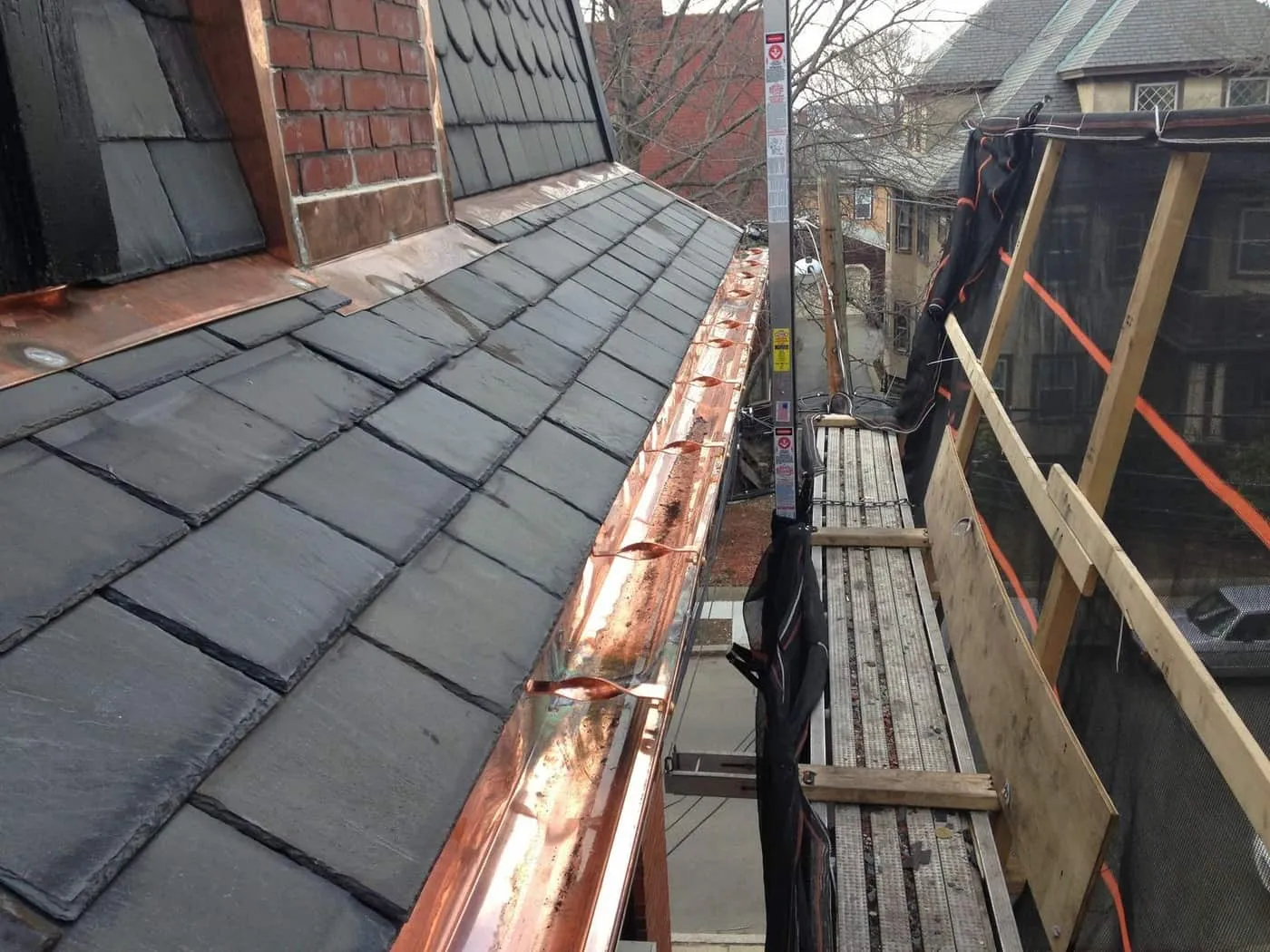
They’re strong. A threaded screw grips wood far better than a smooth spike, and many hidden hangers come with the screw already loaded. They’re common on new K-style aluminum work. On older Boston homes, our gutter repair page calls half-round copper gutters on hidden hangers the standard, and on our jobs the hidden hangers go into rafter ends, not just sheathing.
Spikes and ferrules
This is the old way. A long spike goes through the front face of the gutter, through a metal tube called a ferrule that keeps the gutter from crushing, through the back wall, and into the fascia. It’s cheap and quick.
It also loosens. Wood swells and shrinks every season, ice adds weight each winter, and a smooth spike slowly works its way out. Each spike puts two holes through the gutter, and once it loosens, those holes can leak. On our Back Bay copper gutter project, we put it plainly: spike-and-ferrule gutters and crimped seams are what fail first on a period home.
Exposed brackets fastened to the fascia board
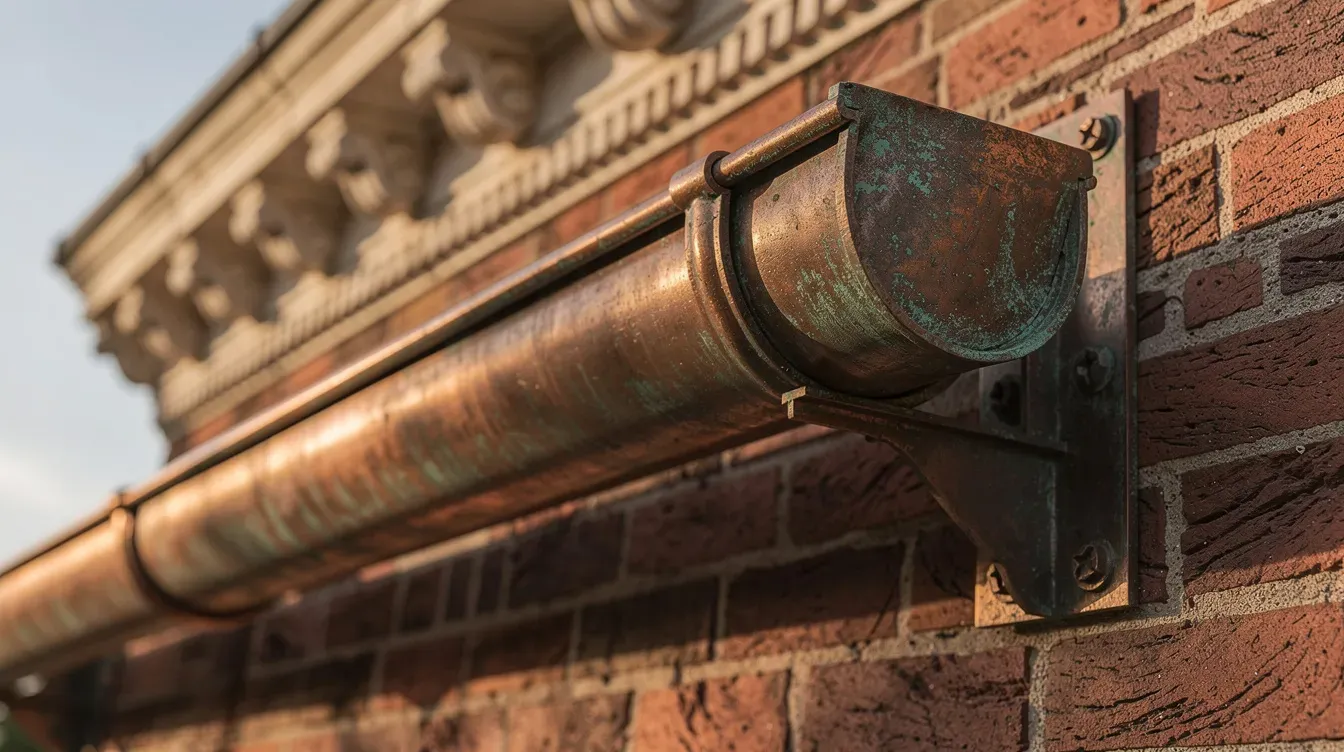
An exposed bracket is screwed to the face of the fascia, and the gutter sits in its cradle. Half-round gutters are often hung this way, and on an old house with good trim the brackets can look right at home.
You’ll read that exposed brackets reduce corrosion. That’s not accurate. Being out in the open doesn’t make a bracket last longer. What controls corrosion is the metal. The CDA’s Copper in Architecture Design Handbook calls for cleats, straps and hanger brackets made of the same material as the gutter. A copper bracket under a copper gutter is fine. A plain steel bracket under copper isn’t, whether you can see it or not.
Roof straps and T-bar hangers attached to the roof deck
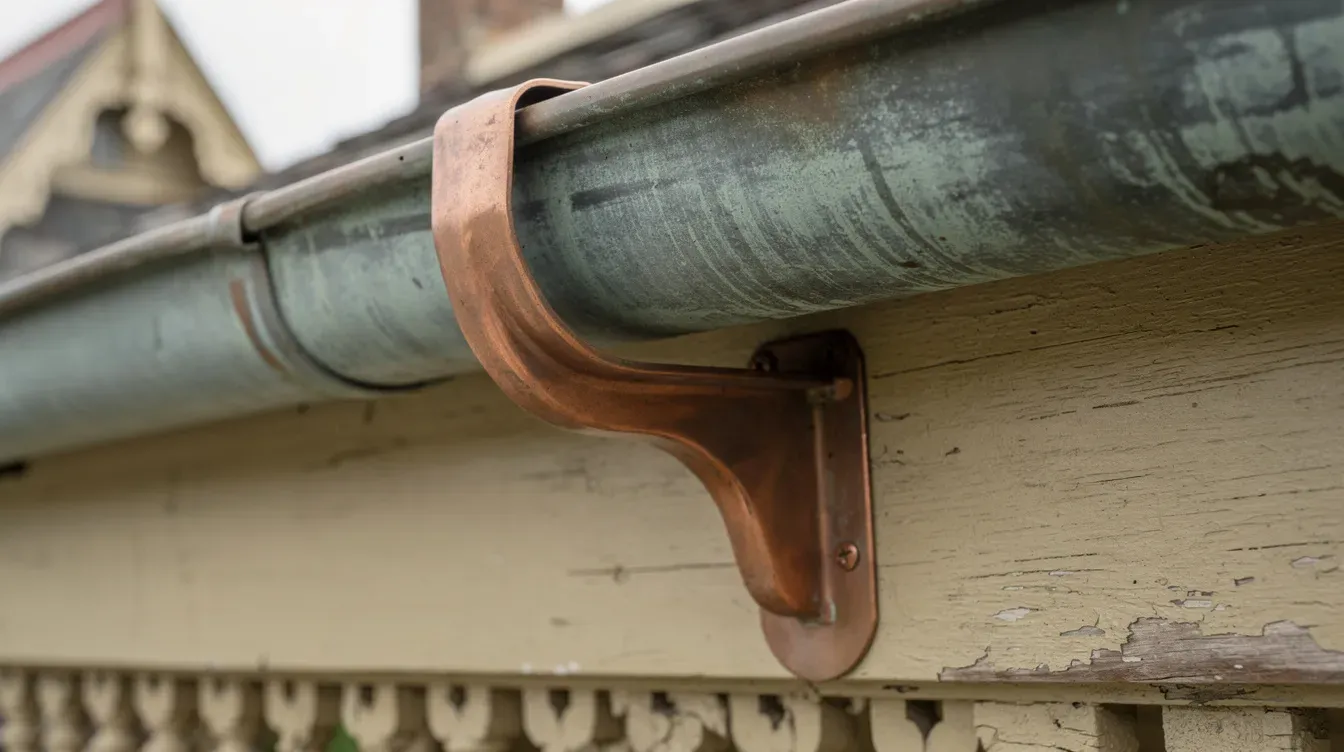
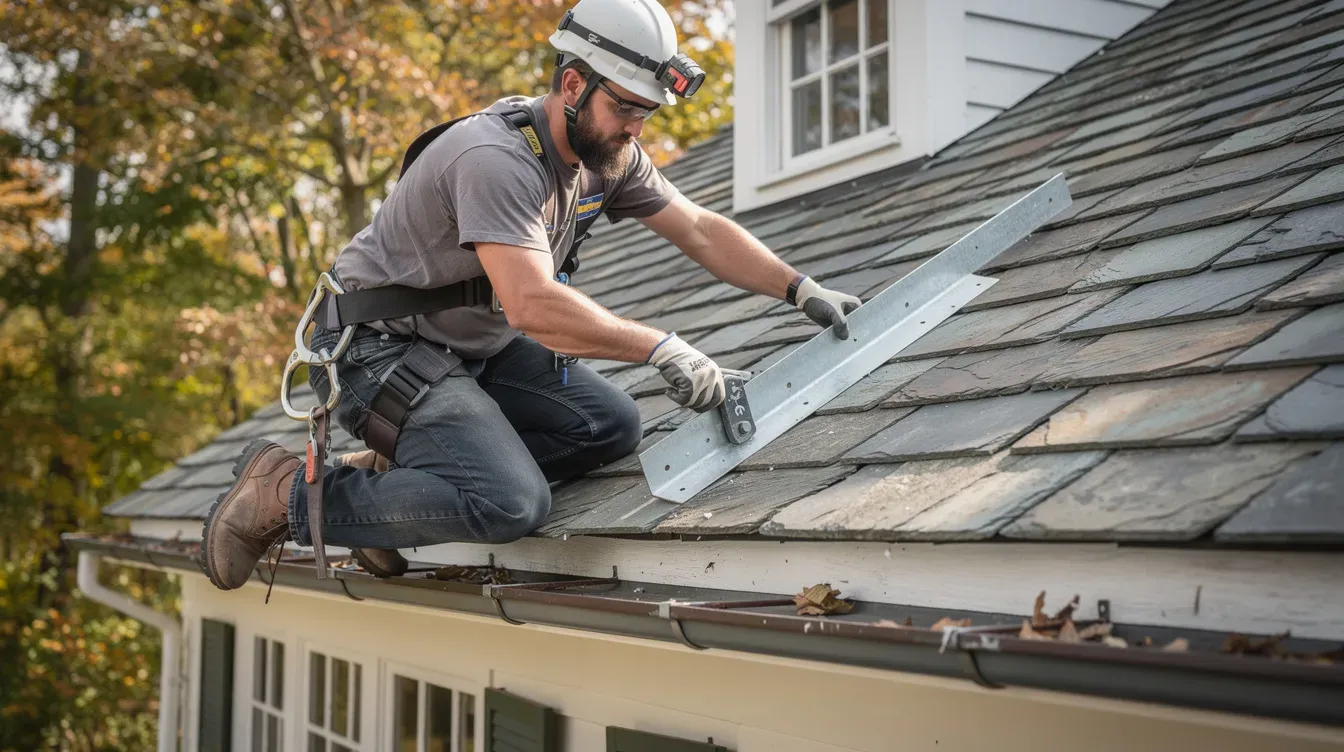
Some houses don’t have a fascia that can hold a screw. The board may be missing, too thin, or set back behind a trim detail. That’s where strap hangers come in. A metal strap is fastened to the roof deck, runs out past the edge, and carries the gutter. T-bar or T-strap hangers are one version of this, built with a stiff bar that bridges the gutter.
Spectra Metals, a hanger maker, sells a 5 inch aluminum hanger with strap for 5 inch K-style gutters. Its listing says to use it only when no fascia board exists, and the strap goes up under the roofing and gets fastened to the roof.
Some guides say T-bar hangers eliminate fascia fasteners. That’s only half the story. The fasteners don’t go away. They move from the fascia to the roof deck, under the roofing. To set them, the bottom courses of shingles or slate have to be lifted or removed. On asphalt that can break the shingle seal. On slate it means pulling and resetting eave slates. That’s why straps make the most sense when the roof is being replaced anyway.
The CDA handbook also uses straps on heavy copper work. It recommends brass or copper straps, with a brass stiffening bar, for gutters wider than 6 inches or where ice and snow get severe. The straps run 30 inches apart, extend at least 6 inches up onto the roof, and are fastened to the sheathing with brass screws.
Wrap-around hangers for extra support
A wrap-around hanger cradles the bottom of the gutter and fastens to the fascia, so the weight sits on a band of metal instead of hanging from one screw. They add strength on long runs, wide gutters, and eaves that catch snow sliding off a steep roof.
How to choose hangers for your roof and fascia board
There isn’t one right hanger. Roof design and the condition of the wood decide a lot of it. Ask these questions:
- Is there a sound fascia board? If yes, hidden hangers or brackets screwed to it are the usual answer. If it’s soft or rotted, replace it before rehanging, as This Old House advises. If there’s no usable fascia, look at strap hangers.
- What’s the gutter profile? K-style aluminum gutters usually take hidden hangers. Half-round gutters take brackets, hidden hangers made for half-round, or straps.
- What’s the roof? A steep slate or metal roof can dump a sheet of snow at once. A gutter installation guide from Amerimax Home Products, a gutter maker, says to set the gutter below the line of the roof plane so sliding snow and ice clear it. Straps on a slate roof mean working under the slate, so they fit a re-roof better than a repair.
- What metal is the gutter? Match it. More on that below.
- How does it look from the street? Hidden hangers disappear. Brackets show. On a historic facade, that can be a reason to choose one over the other.
Hanger spacing and support for snow and ice
The most common rule is a hanger about every 3 feet. The Amerimax guide, which repeats long-standing sheet metal industry text, says hangers should be spaced at a maximum of 36 inches on center, and reduced to 18 inches where ice and snow are long lasting. Gutterall, a hidden hanger maker, lists 24 inches as standard spacing for its hanger and 16 inches for heavy snow.
For copper, the CDA handbook says hung gutters should be supported by brackets or hangers no more than 36 inches apart, or 30 inches in snow areas. Strapped copper gutters get straps every 30 inches.
In Greater Boston, snow and ice can sit on a roof for weeks. That’s the long-lasting case the guidance describes, so tighter spacing than 3 feet is worth paying for. On our estimates, hanger spacing is a line item, along with downspout count and placement, so you can see what you’re buying.
Spacing only helps if the wood holds. If ice dams are part of the picture, our post on ice dam prevention and our ice melt systems page cover the other half of the problem.
Fasteners and metals: avoiding galvanic corrosion
When two different metals touch and water gets between them, one of them corrodes faster. That’s galvanic corrosion. The CDA handbook lists it plainly: copper corrodes aluminum and zinc, and steel suffers when it is small next to the copper, which describes a fastener. It also warns against letting water from copper drain onto aluminum.
Gutter hangers come in three main materials:
- Aluminum for aluminum gutters, the most common setup.
- Steel, usually galvanized or stainless. Stainless is the safe partner for copper. Galvanized steel is not.
- Copper or brass for copper gutters.
The rule is simple. The hanger, the strap and the screw should match the gutter, or be a metal that’s known to be compatible. For copper, the CDA lists copper, brass, bronze and stainless as compatible. Aluminum gutters get aluminum hangers and the fasteners the hanger maker supplies. If you’re weighing materials, our posts on copper vs aluminum gutters and half-round gutters go deeper.
How to install hidden hangers: screw placement and slope
Here is the general sequence for a fascia-mounted run. It’s a summary, not a substitute for the instructions that come with your hangers.
- Check the wood. Push a screwdriver into the fascia. If it sinks in, the board needs replacing first.
- Snap the slope. Start at the high end, farthest from the downspout. This Old House says to mark 1/4 inch lower for every 10 feet of run, snap a chalk line between the points, and set the hangers on that line.
- Lay out the hangers. Mark the spacing, closer together for snow. Put one near each end and near each seam and outlet.
- Clip them in. Hook each hidden hanger under the front lip of the gutter so it sits inside the trough.
- Lift and drive the screw. Hold the gutter to the chalk line and drive each screw through the back of the gutter into the fascia. Where you can, catch a rafter tail behind it.
- Test it. Run a hose at the high end and watch the water reach the outlet without pooling.
Two stories up on a ladder, with a 20 foot gutter, is hard work for one person. Strap hangers on a slate roof are a job for a roofer.
Signs your gutter hangers are failing
- The gutter dips between hangers or pulls away from the fascia.
- Water sits in the gutter a day after rain.
- Water spills over the front during a storm while the downspout runs slow.
- Spike heads stick out of the gutter face.
- Rust or stain streaks run down from the hangers.
- The fascia behind the gutter is soft, stained or peeling.
Sagging is usually the first sign. Re-pitching sagging runs and replacing loose hangers is standard gutter repair work. If the whole run is tired, our gutter replacement cost guide lays out what a new system costs, and our short gutter repair video shows what a repair looks like.
Frequently asked questions
How far apart should gutter hangers be?
Industry installation guidance puts gutter hangers no more than 36 inches on center, so about 3 feet is the usual figure. Where ice and snow stay on the roof for long stretches, that guidance drops to 18 inches. Some hidden hanger makers list 24 inches as standard and 16 inches for heavy snow. For copper, the Copper Development Association calls for 36 inches at most, or 30 inches where snow is expected.
What type of gutter hanger is strongest?
Screw-in hidden hangers set close together hold far better than spikes and ferrules, because threads grip the wood and a smooth spike works loose. A wrap-around hanger or a roof strap adds more strength where loads run heavy. The wood behind the hanger matters as much as the hanger. A hanger driven into soft, rotted fascia won’t hold, so the screw has to reach sound wood.
Can a gutter be hung without a fascia board?
Yes. Strap hangers handle eaves where the fascia is missing or too weak to hold a screw. The strap runs up under the roofing and is fastened to the roof deck. Spectra Metals sells a 5 inch aluminum hanger with strap made for this, and its listing says to use it only when no fascia board exists. On a slate roof, the eave slates have to come up to set the straps, so it’s simpler to do during a re-roof.
Why do spikes and ferrules pull loose?
A spike is a smooth nail driven through the face of the gutter, through a tube called a ferrule, and into the fascia. Wood shrinks and swells with the seasons, and ice adds weight each winter, so the spike slowly backs out. It also leaves two holes through the gutter, and those holes can leak once the spike loosens.
Can I use aluminum hangers on copper gutters?
No. Copper in contact with aluminum, with wet weather in between, sets up galvanic corrosion, and the aluminum is what wears away. The Copper Development Association calls for hangers made of the same metal as the gutter. For copper that means copper or brass hangers and copper, brass, bronze or stainless fasteners.
How can I tell if my gutter hangers are failing?
Look for a gutter that dips between hangers, pulls away from the fascia, holds standing water a day after rain, or spills over the front in a storm. Spike heads sticking out of the face, rust streaks, and peeling paint on the fascia behind the gutter are other signs. In winter, a run that sags after an ice storm needs a look before the next one.
Talk to the owner
The right hanger depends on the house: the gutter metal, the shape of the eave, the state of the fascia, and how much snow that roof holds. That’s hard to judge from the ground or from a photo.
Every gutter project starts the same way: Arturo walks it before a price goes on paper, and that walk is free. See what we repair and install on our gutter repair page, schedule a free assessment, or call 617-913-1130. You get a straight answer on whether your gutters need new hangers, a new fascia, or a whole new run.