Half Round Gutters for Historic Boston Homes
Compare half round gutter systems, profiles, materials, sizing, brackets, downspouts, guards, installation, and maintenance for historic Boston homes.
TL;DR: Half round gutters suit many historic homes because their curved shape, visible brackets, and round downspouts fit older rooflines. Pick the profile and material before buying hangers, end caps, or guards, since the pieces are not interchangeable. Size the system from roof area, pitch, local rainfall, outlet capacity, and downspout layout. Clean and inspect it at least twice a year, even when gutter guards are installed.
Gutters · 12 min read
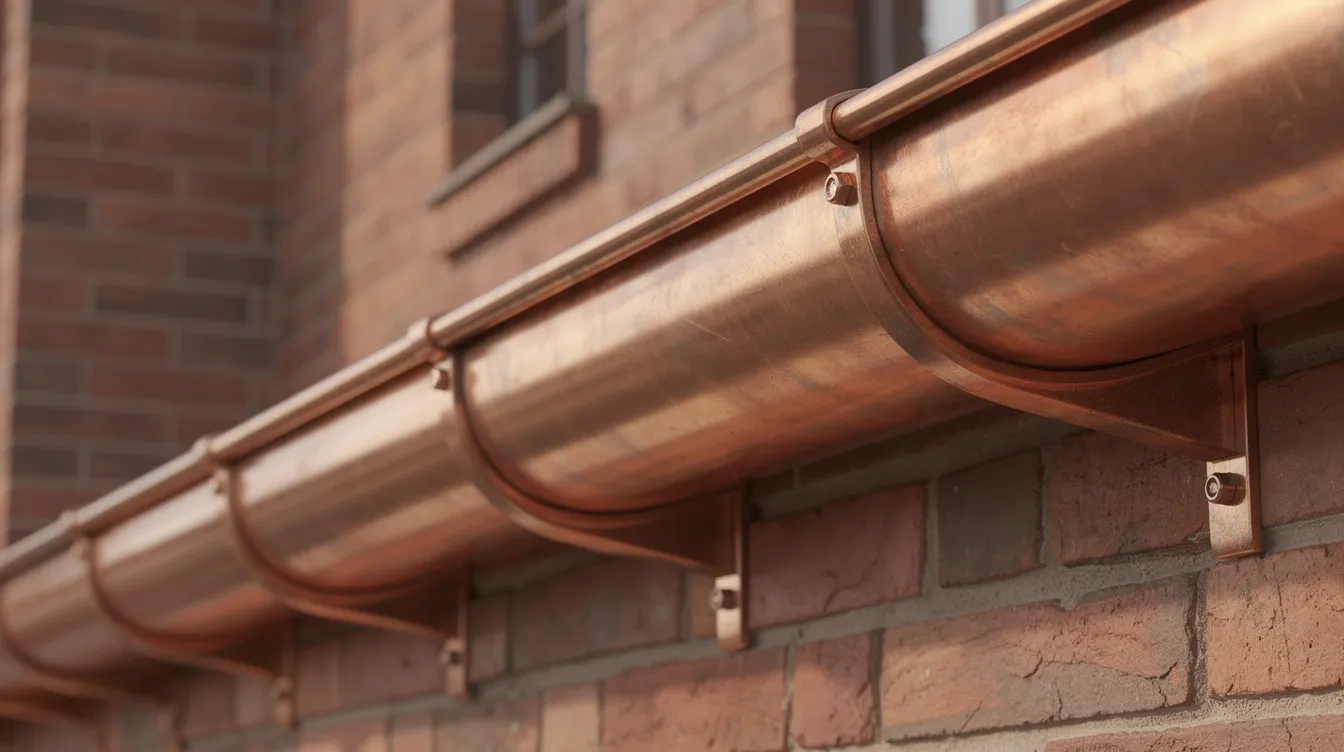
Half round gutters are easy to recognize. The trough is a clean semicircle, the supports are often visible, and matching round downspouts finish the system. That simple shape can look at home on a brick rowhouse, a slate-roofed Victorian, or a Colonial Revival house. It can also be the wrong choice if the original building had another profile.
The planning matters more than the label. Profile, gutter material, roof area, outlet size, fasteners, and hanger locations have to work as one system. If one part is guessed, water finds the weak point.
half round gutters: the quick answer for a Boston home
Half round gutters provide a classic appearance that complements historic architecture. They are often chosen for high-end residential architecture because of that curb appeal, and they can be specifically suited for historic and upscale homes when the visible shape agrees with the building’s original character.
That does not make them automatically correct for every house built before 1950. Old photographs, existing brackets, paint lines, cornice details, and local preservation rules are better evidence. The National Park Service recommends retaining character-defining materials and matching replacement features in design, color, and texture rather than relying on a broad age rule.
The tradeoffs are practical. Half round gutters are more complicated to install than K-style, they may need more exposed support, and the fittings usually cost more. Their curved interior has fewer corners, which can make cleaning easier. It cannot keep leaves, needles, roof grit, or ice out on its own.
half round vs k style gutters
A half round gutter has a curved trough. K style gutters usually have a flat back against the fascia, a flat bottom, and a shaped face. Do not select capacity by profile name alone. Pitch, roof area, design rainfall intensity, run length, the supplied cross-section, outlets, and downspouts decide real capacity.
Many familiar half round systems hang from visible brackets rather than mounting flat against the fascia like K-style gutters. Face-mounted, roof-mounted, and compatible hidden hanger types also exist, so the structure and profile must be checked before hardware is ordered. The idea that half-round gutters always require more brackets than K-style gutters is not a safe rule. Support spacing depends on the complete system and local loads.
People often say half-round gutters are less likely to clog than K-style. The curved bottom does give debris fewer corners to settle into. It does not prevent a blockage at an outlet. Half-round gutters can still collect debris and become blocked. Material, gauge, support, and impact govern dents; the profile alone does not establish which gutter will show more damage.
gutter profiles: what the bead changes
The bead is the rolled edge at the top of the gutter. It stiffens the face and determines which hangers, end caps, miters, and gutter guards fit. Pick the gutter profiles first. Accessories sold for another bead direction may not attach or seal correctly.
Traditional single bead has a rolled front edge and an open rear edge. It often uses visible brackets or straps. The visible hardware can become part of the appearance rather than something to hide.
reverse bead hardware must match the profile
A reverse bead rolls toward the building. That changes how hangers and covers engage the gutter. A product specifically designed for a traditional front bead should not be forced onto a reverse bead run. Check the manufacturer’s system details before ordering pieces.
double bead gutter and high-back forms
A double bead gutter has rolled edges at both the front and rear. The rear bead changes the cross-section and requires compatible brackets and fittings. High-back half round gutters use an extended rear wall or apron where a roof edge or cornice detail calls for it.
High-back is not a cure for bad flashing. Water still needs a deliberate path from the roof into the trough, and every transition must be detailed so water cannot run behind the gutter. On an irregular historic roof, custom corners and miters may be the hard part of the job.
half round gutter systems start with compatible materials
Half round gutter systems are commonly manufactured in copper, aluminum, zinc, and galvanized steel. The right gutter material depends on the roof, nearby metals, finish, budget, exposure, and the character the owner wants to keep.
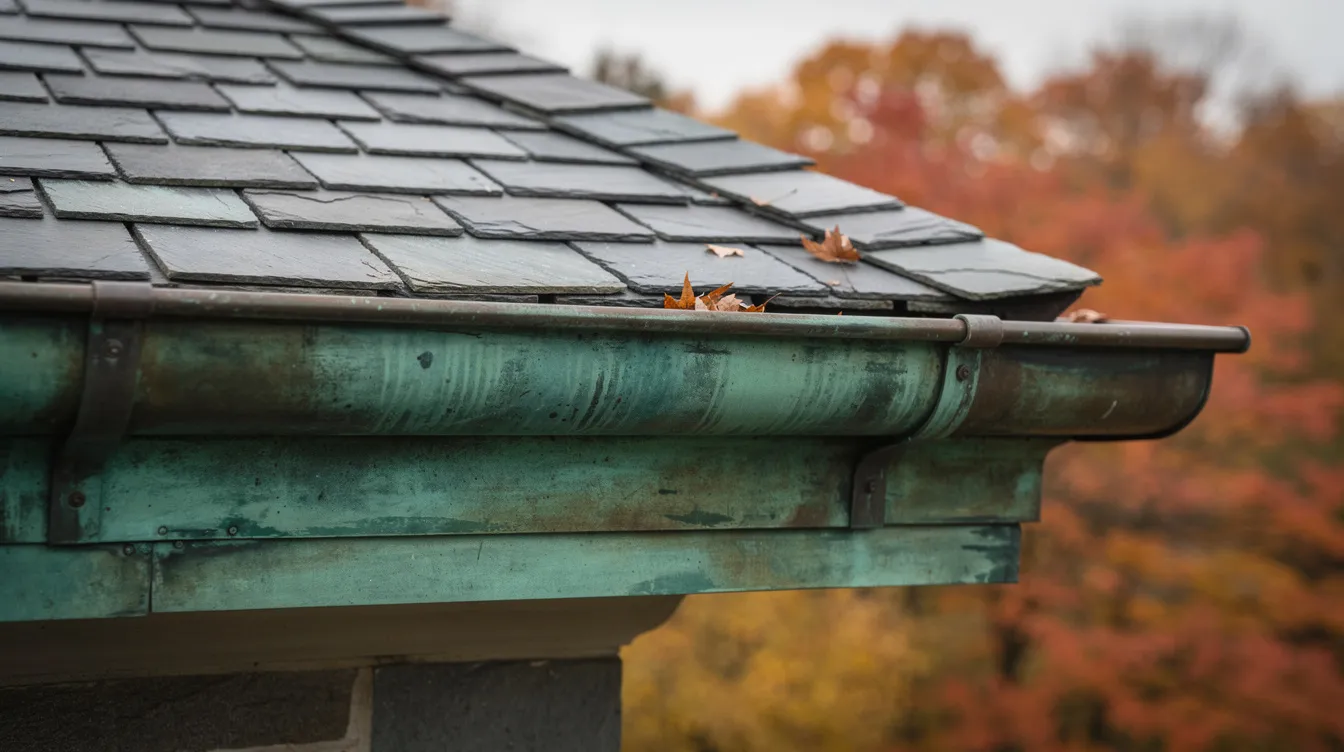
Natural copper starts with a salmon color and changes through brown and gray tones as it weathers. Depending on exposure, it may eventually develop a blue-green or gray-green patina. Copper Development Association guidance describes that patina as protective, but also warns that copper runoff can accelerate corrosion of aluminum below it.
Painted aluminum is lighter and available in many stock colors. Zinc develops its own subdued surface. Galvanized steel offers a firm traditional form, but cut edges, scratches, and salt exposure deserve attention. Cleaning methods should suit the selected gutter material; harsh or abrasive products can damage finishes or alter patina.
freedom gray, copper, aluminum, zinc, and steel
Freedom Gray is copper sheet coated with a tin-zinc alloy, giving it a gray appearance without waiting for bare copper to weather. It is still a particular material system, so solder, flux, fasteners, sealant, and accessories must be compatible with the manufacturer’s instructions.
The HUD useful-life table uses planning estimates of 50 years for copper gutters and downspouts and 20 years for aluminum. Those numbers are not warranties. Shape alone does not set the service life of a half round system.
Galvanized steel has no single service-life number that applies to every product. Some major catalogs list galvanized steel Half Round gutters in 5-inch and 6-inch profiles, but coating, cut edges, paint, salt exposure, drainage, and maintenance all affect how long the installed assembly lasts.
Extreme temperatures do not create one fixed penalty, but repeated thermal movement, ice loading, and freeze-thaw cycles can shorten gutter lifespans when joints or supports cannot move correctly. This is why material choice cannot be separated from installation details.
half round gutter systems need sizing, not a guess
Common sizes for half-round gutters range from 4 to 8 inches, although the sizes available depend on material, profile, and supplier. Five-inch gutters are widely used for residential work. That does not mean 5-inch gutters are suitable for most residential applications without checking the roof.
Depending on the roof and runoff calculation, the correct gutter sizes may differ between the main eave and a smaller porch. One fixed size for every elevation is convenient to order, not necessarily correct.
Half-round gutters can be installed in larger sizes to accommodate greater water runoff. A steep roof, a large drainage area, a long run, or a valley that concentrates water may point toward a 6-inch or larger system. It may instead call for another outlet or shorter lengths between outlets.
Round downspouts must be sized with the outlets. Matching round downspouts look right with round gutters, but diameter and placement matter more than match alone. An undersized outlet can choke a large trough. Downspouts also need a safe discharge path away from the foundation.
The National Park Service used 6-inch half-round gutters with 4-inch round downspouts in one historic church plan, but that is a project example, not a template for every residential roof. A qualified installer should size each system from roof geometry and local design rainfall.
half round gutters seamless or sectional?
The search phrase half round gutters seamless describes how straight runs are formed, not a bead style. A roll-forming machine can produce long runs with no joints between the ends. Corners, outlets, and transitions still need connections.
Fewer straight-run seams may mean fewer places for sealant or solder to fail. That is useful, but the blanket statement that seamless half round gutters last longer than traditional gutters is too broad. Material thickness, expansion, brackets, fabrication quality, corrosion, and maintenance can outweigh the number of seams.
Sectional copper and zinc systems can perform for decades when joints are formed and soldered correctly. They can also accommodate jobs where access, roof shape, or custom details make one continuous length impractical. Never choose between sectional and seamless by one word on a website. Choose the assembly that fits the building.
end caps, miters, outlets, and matching round downspouts
The small components decide whether the system works. End caps close the runs. Miters turn corners. Outlets connect the trough to round downspouts. Brackets carry the water, metal, snow, and debris. Every item has to match the profile, bead, size, and material.
Copper caps and miters are commonly joined with solder. Aluminum and coated steel often use mechanical fastening and compatible sealant. Those are broad material patterns, not job instructions. Surface preparation, expansion allowances, and product directions still control the work.
Complex bay windows, turrets, and angled roof edges can require custom cut corners. Poorly fitted pieces leave a weak seal and interrupt the slope. More half round gutters do not solve a bad outlet layout; sometimes one correctly placed outlet is worth more than another long run.

gutter guards on half round gutters
Gutter guards do not eliminate the need for maintenance. A cover may block large leaves while fine grit, seeds, needles, and ice remain. Debris can also collect on the face or gather at the roof edge. The system still needs access for inspection and cleaning.
The guard has to fit the bead, diameter, brackets, and roof edge. A reverse bead cover may attach differently from one made for a traditional front bead. Snow behavior matters too. A guard that looks tidy in summer may hold frozen material against the eave in winter.
Art Slate’s published gutter repair and cleaning service says guards can be quoted when requested, while twice-yearly cleaning is usually recommended. It does not claim that one guard product works on every half round profile.
installation on historic homes
The installation of half-round gutters requires specialized brackets and fittings. On some historic homes the fascia is narrow, decorative, damaged, or missing. Roof-mounted supports, shanks, wedges, or masonry attachments may be needed, and each choice changes load paths and visible details.
Historic half round work often calls for a qualified installer familiar with the selected system. That is especially true where access is steep, tall, or over a fragile slate roof. Fabricating outlets and miters, planning thermal movement, and joining copper are skilled construction tasks. Gutters should never be used as ladder supports.
Before anything is installed, inspect the fascia, cornice, roof edge, and existing flashing. A new trough attached to rotted wood is not a repair. The National Park Service maintenance guide calls out sagging gutters, split downspouts, accumulated debris, failed connections, and incorrect slope as conditions to correct.
In a regulated historic district, confirm whether a visible profile or material change needs review before submitting an order or permit package. That check is cheaper than replacing approved-looking products that do not match the building.
cleaning, inspection, and maintenance
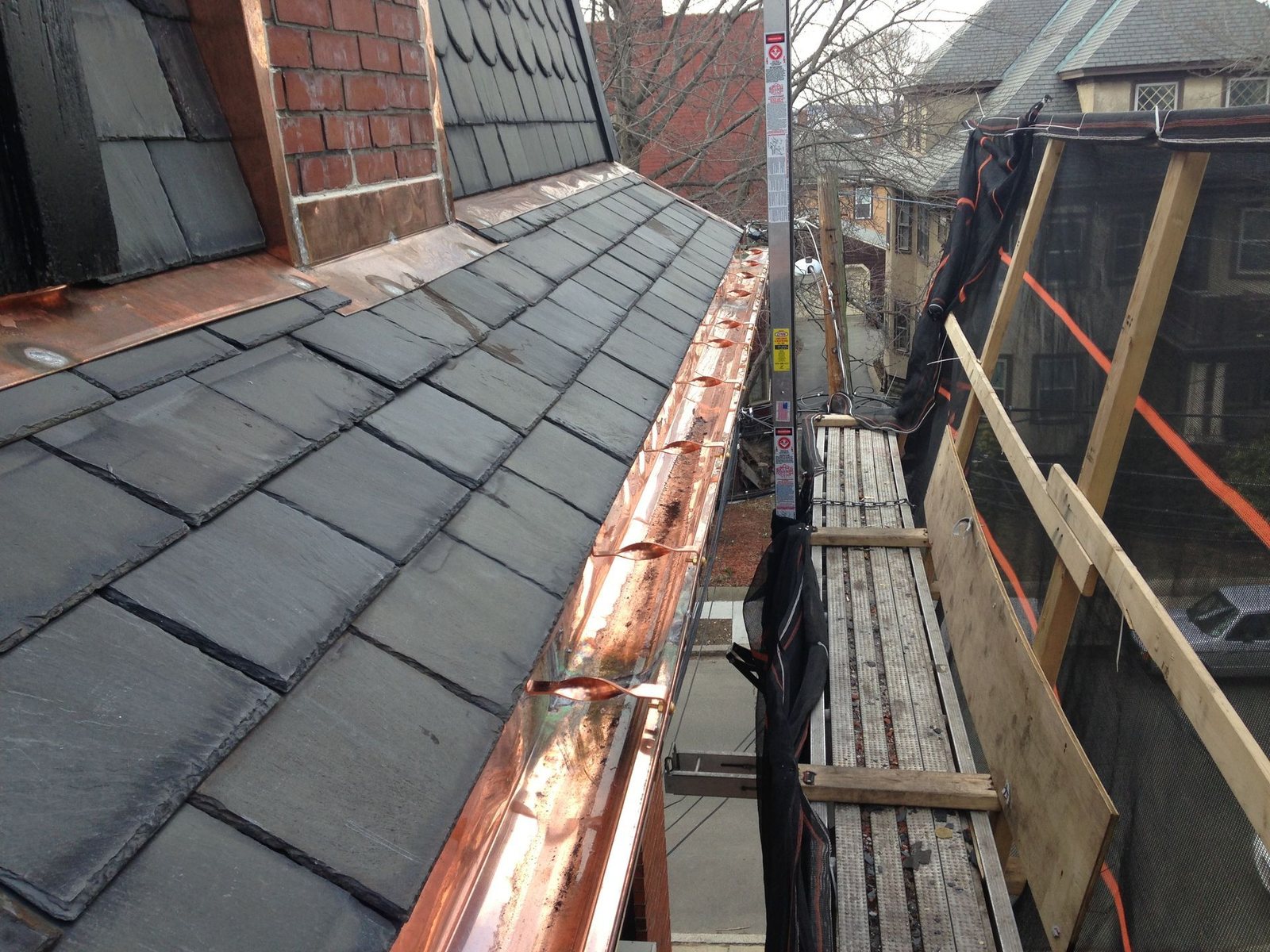
Half Round gutters require periodic inspection and cleaning. Spring and late fall are sensible checkpoints in Greater Boston, with another look after severe wind, rain, snow, or ice. Tree-heavy properties may need more frequent work.
Regular inspection of seals and joints is important to maintain half-round gutters. Check the slope, outlets, caps, miters, solder, sealant, and every exposed support. Staining behind the run, standing water, loose brackets, or a washed-out area below a downspout can identify a problem before an interior leak appears.
Half Round gutters may require fewer repairs due to their design, according to some sales descriptions, but that is not a dependable promise. Their smooth shape has fewer corners and can be easier to clean. Repairs still depend on material, joint quality, impact damage, corrosion, snow load, and maintenance.
The National Park Service advises removing leaves and debris, flushing troughs and downspouts, correcting misalignment, and sealing leaks as part of cyclical care. Use non-abrasive tools where a finish or natural copper patina should remain exposed.
what Art Slate can verify before work begins
Art Slate Roofing’s current service page confirms repair and replacement work for copper and aluminum gutters, including half-round and K-style systems, cleaning, fascia repair, and hanger work. It also says the drainage assessment checks existing pitch, downspout placement, and fascia condition.
That is the limit of the company claim here. This article does not claim that Art Slate manufactures on site, stocks every profile, installs a named guard product, or uses one fabrication method for every home. Those details have to be confirmed for the specific project.
Frequently asked questions
Are half round gutters better for historic homes?
They are often a good visual match, but the right choice depends on the building. Check old photographs, surviving hardware, local historic-district guidance, roof geometry, and drainage needs before selecting a profile. A pre-1950 construction date by itself does not prove that half round gutters were original.
Do half round gutters clog less than K-style gutters?
Their curved interior has fewer corners where debris can settle, so cleaning can be easier. They are not clog-proof. Leaves, needles, roof grit, and ice can still block the gutter or outlet, and guards do not remove the need for inspection and cleaning.
Can half round gutters be seamless?
Yes, some metal and profile combinations can be formed in long continuous runs. Corners, outlets, and some transitions still create joints. Fewer straight-run joints may reduce potential leak points, but the word seamless does not guarantee a longer service life or a leak-free system.
What size half round gutter does a house need?
Five- and six-inch sizes are common on houses, but size should not be chosen from a rule of thumb alone. Roof area, pitch, local rainfall intensity, valleys, run length, outlet size, and downspout placement all affect capacity. Large or steep roof sections may need a larger gutter, more outlets, or both.
How often should half round gutters be cleaned?
Inspect and clean them in spring and after the leaves fall, then check again after severe storms. A tree-heavy property may need more frequent service. Use cleaning methods that suit the metal and finish, and inspect joints, outlets, brackets, and seals while the gutter is clear.
How long do half round gutters last?
There is no single lifespan for the shape. Material, metal thickness, finish, fasteners, joint work, drainage, salt exposure, ice, and maintenance all matter. HUD planning tables estimate 50 years for copper gutters and downspouts and 20 years for aluminum, but those figures are planning estimates, not warranties for a particular installation.
Talk to the owner
A half round system should start with a real inspection, not a map or square-foot estimate. The roof edge, fascia, outlets, downspout route, and existing metal all affect the final scope.
Every gutter project Art Slate quotes gets walked by Arturo before a number goes on paper. Read about our slate and copper roofing service or schedule a free assessment when you are ready to review the roof and drainage together.