Gutter Guard Installation: A Step-by-Step Guide for Boston Homes
Gutter guard installation in 6 steps: how to pick mesh, micro mesh, brush, foam, or reverse curve guards, what DIY takes, and where slate roofs change the job.
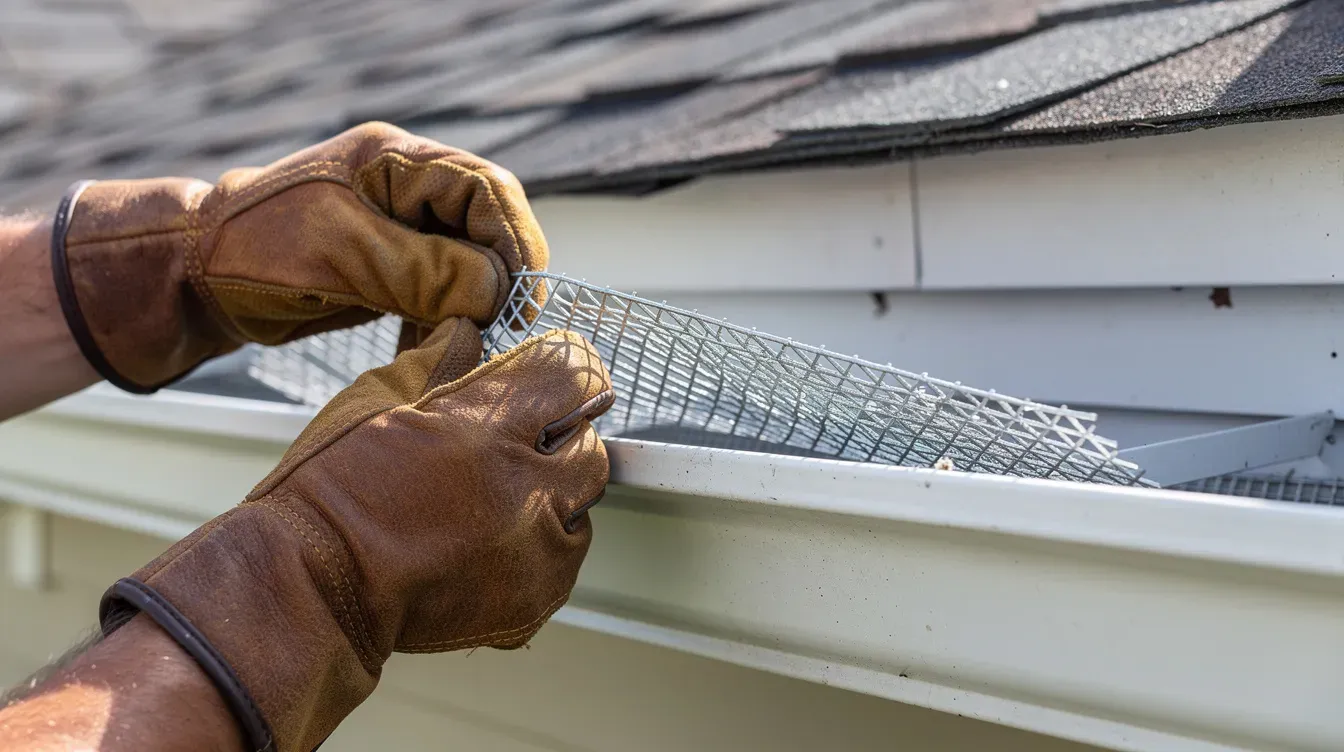
TL;DR: Gutter guard installation is a six step job: clean and repair the gutters, measure, dry fit, set the first section, overlap sections and close the corners, then fasten and test with a hose. Pick the guard by the trees overhead. Metal micro mesh handles pine needles and grit, coarse screens handle big leaves. Guards cut cleaning but never end it. On slate roofs, nothing slides under the slate.
Gutters · 14 min read
Gutter guard installation looks like a Saturday job on the box. Snap a panel onto the gutter, move the ladder, repeat. Sometimes it is that simple. On a lot of Boston houses it isn’t, because the gutter is copper, the roof is slate, or the eave is three stories up over a brick walk.
This guide walks through the six steps, the guard types and what each one is good at, and the common mistakes that turn a cheap fix into a leak. Where we cite numbers, they come from published sources we name in the text: This Old House, FEMA, IBHS, the CDC, OSHA, GAF, and the Copper Development Association. They are not Art Slate Roofing figures.
What gutter guards do, and what they don’t
Gutter guards are covers or inserts that sit over or inside the gutter system. The job is simple: block leaves and large debris while allowing rainwater to reach the downspouts. When they work, you get fewer clogged gutters, less overflow, and less water dumped against the foundation. Twigs, seed pods, shingle grit, and other debris stay on top instead of in the trough.
That last part matters more than people think. A packed gutter spills at the low spot every storm. The water lands in the same bed, soaks the same corner of the basement wall, and over years that is how foundation issues start. Guards help prevent that kind of water damage by keeping the trough open.
There are a few smaller benefits too, and they need careful wording:
- Mosquitoes. The CDC lists gutters and downspouts among the places mosquitoes lay eggs when they hold standing water. A guard that keeps the gutter from clogging means less standing water, so fewer breeding spots. It won’t do anything about a gutter that holds water because it was hung flat.
- Wildfire embers. Dry leaves and needles in a gutter can catch embers. The IBHS Wildfire Prepared Home research points to gutter debris as an ignition path, and its program calls for noncombustible gutter covers. FEMA’s guidance says the same and notes that plastic can melt. So metal guards can help. Plastic and foam guards don’t count here. Wildfire risk around Boston is low, but brush fires do happen in dry springs.
- Debris buildup. Less organic debris sitting in the trough means less weight on the hangers and less wet muck against the metal.
What they don’t do: make the gutter maintenance free. Most gutter guards still collect something on top, and some types fail in ways a plain open gutter wouldn’t. No gutter guard solution replaces gutter cleaning. It just spaces the cleanings out.
Types of gutter guards and how each one handles debris
Each type of gutter guard has strengths and weaknesses, and most gutter guards fall into one of five designs. The design decides how water gets in, what gets stopped, and what gets through. Here is how the main designs compare.
Screen and mesh gutter guards
Screen gutter guards are perforated or expanded metal panels with fairly large holes. They stop maple and oak leaves, and water passes through fast. Small debris, seeds, and roof grit fall right through. Mesh gutter guards use a finer weave. The mesh filters more debris while still allowing water through, so water flow stays close to an open gutter in normal rain. Metal mesh guards are the middle ground on price and performance.
Material matters here. Stainless steel resists rust and outlasts plastic by a wide margin. Plastic mesh rolls, the kind sold by the coil, are flimsy. Load one with a wet mat of leaves or a foot of snow and it sags into the trough, and then it traps debris instead of shedding it.
Micro mesh guards for fine debris
Fine debris calls for micro mesh. Micro mesh guards use a very fine stainless steel screen stretched over a rigid frame. This Old House notes that micro mesh with 30 or 50 holes per linear inch filters out pine needles and shingle granules. That is the type to look at under white pines and hemlocks, which drop needles all year. Micro mesh guards cost more than screens, and on a needle-heavy lot they earn it.
The catch is the surface. Needles and pollen still collect on top and have to be brushed or rinsed off, and FEMA’s wildfire fact sheet makes the same point about mesh leaf guards. Micro mesh gutter guards are also fussier to install, since it usually has to be trimmed with tin snips around corners and hangers.
Surface tension gutter guards (reverse curve)
Surface tension gutter guards, also called reverse curve or hood guards, cover the whole gutter with a solid metal hood. Rain follows the rounded front edge and drops into a narrow slot, while leaves slide off the front. They redirect water into the gutter and push debris off the top. Surface tension guards work well under big leaves.
In heavy rainfall they have a known weak spot. Fast water can shoot past the curve and over the gutter. They are also bulky, sit out in front of the fascia, and are hard to lift for cleaning. On a historic cornice they are usually the wrong look.
Brush gutter guards
Brush gutter guards are long bristle cylinders that sit in the trough. Leaves land on the bristles, and water flows beneath them to the outlet. Brush gutter guards trap debris on top rather than keeping it out, which works on lightly treed lots. Under a heavy canopy the bristles trap debris faster than rain can clear it. They mat with wet leaves and needles, and you end up pulling the whole brush out to clean it. They are easy to install, which is most of their appeal. Brush gutter guards also lift out in one piece.
Foam inserts
Foam guards are porous blocks cut to fill the gutter channel. They block debris, but they need cleaning at least once a year, or seeds sprout and roots grow into the foam. They also hold moisture. A soaked foam gutter guard underneath a mat of leaves stays wet for days, and in a New England freeze that water turns to ice right at the eave.

How to pick the right gutter guard
Choosing the right gutter guard starts with the trees, not the brand. Walk the yard and look up. The right gutter guard for a house under oaks is not the right one under pines.
- What drops on the roof? Big maple and oak leaves are easy for almost any metal screen. Pine needles, hemlock needles, and maple seeds need micro mesh. Assessing the surrounding foliage tells you more than any product sheet.
- How heavy is the canopy? A house under mature street trees in Newton or Cambridge is worth a heavier, higher quality guard. A house on an open lot may not need guards at all.
- What is the climate? Water flow matters as much as filtering. Boston gets heavy snow, freeze and thaw cycles, and summer downpours. Guards have to carry snow load without collapsing, and they have to take hard rain without overshooting. Choice depends on climate and rainfall as much as on leaves.
- What gutter do you have? Measure it. Guards come in 4, 5, and 6 inch widths, and 5 and 6 inch are the common residential sizes. Half round, K style, and built-in box gutters each need a guard made for that shape.
- What is the roof? Asphalt shingles, slate, and copper each change how the guard can attach. More on that below.
Should you install gutter guards yourself?
DIY installation can save money compared with hiring a pro. Plenty of gutter guards are sold as easy to install, and on the right house they are. DIY installation still takes a full day of ladder moves on a big house.
DIY is reasonable when:
- the run is one story, straight, and easy to reach
- the gutters are sound 5 or 6 inch aluminum
- you are comfortable on a ladder and own basic tools
- you will wear gloves and safety glasses the whole time, because cut mesh and gutter edges are sharp
Professional installation makes more sense when:
- the roof is slate, clay tile, or copper
- the gutters are copper half round or built-in box troughs
- the walls are two or three stories, or you have steep rooflines you can’t stand on
- the house has an ice dam history, or the gutters leak, sag, or overflow already
Slate, copper, and three story work require professional installation. That’s not a sales line. Roof work at height on brittle materials is where homeowners get hurt and roofs get broken.
Warranties are part of this. The installation method can affect a roofing warranty. GAF’s technical bulletin on gutter covers says most professionally installed covers don’t affect its shingle warranty, but it warns against products that need fasteners through the shingle, removal of shingles or drip edge, or installation under the underlayment. It also says its warranty doesn’t cover the guard or damage caused by installing it. Read your roof warranty before anything goes under a shingle. Professional installation doesn’t make that question go away, so ask the installer how the guard attaches.
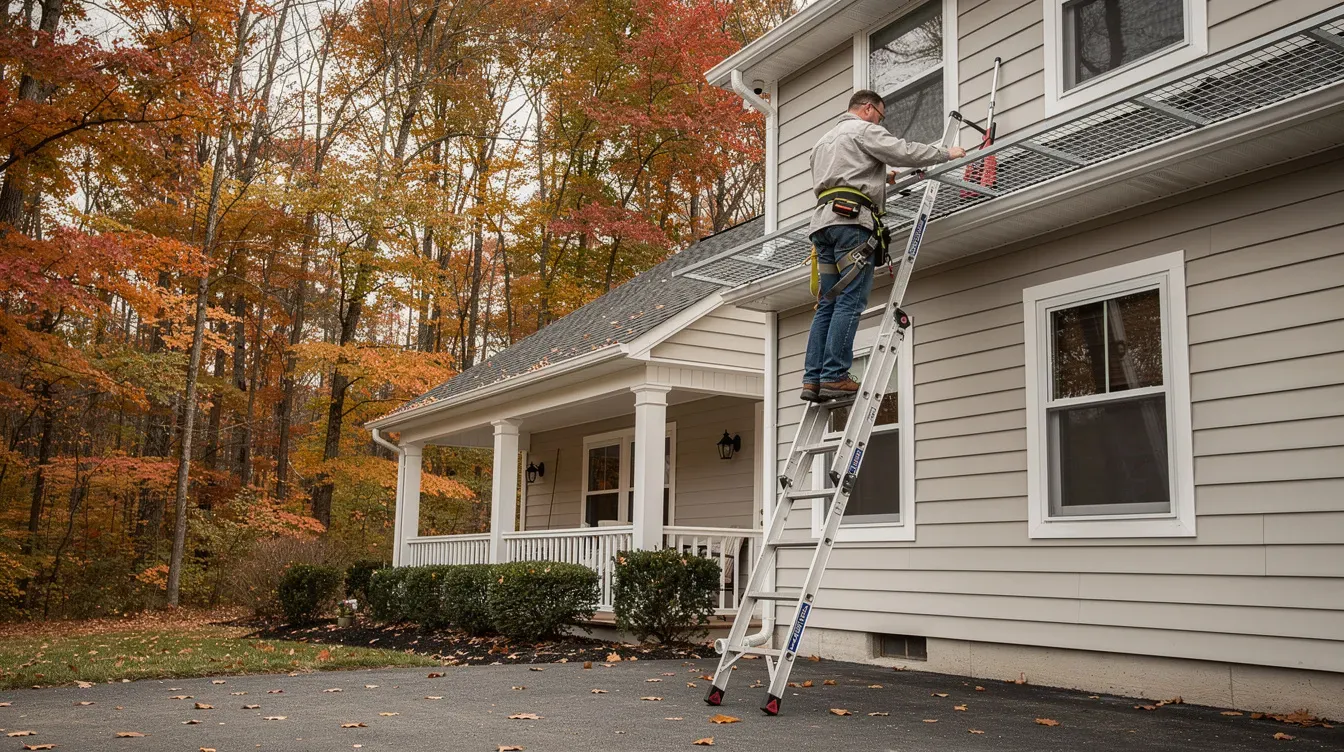
Ladder safety is the other half. OSHA’s extension ladder fact sheet sets the base out 1 foot for every 4 feet of working height and has the ladder extend 3 feet above a landing. Keep three points of contact. Don’t carry panels up in your hands. Falls tend to happen when someone leans out past the rails, so move the ladder instead. Most homeowners can handle a one story run safely if they respect that rule.
Gutter guard installation in 6 steps
These steps cover the snap-in and screw-down metal gutter guards sold for 5 and 6 inch gutters. Many common sections run about 3 feet (36 inches). Some come in 4 or 5 foot lengths. The job takes anywhere from a couple of hours to a couple of days. Read the manufacturer’s installation instructions first, because they override anything general, including this list.
Step 1: Clean the gutters and repair what’s broken
Scoop out every leaf, twig, and clump of grit with a gutter scoop. Wear gloves. Then flush the run with a hose and watch the downspouts. If water backs up, clear the downspout from the top before you go further.
Now look hard at the gutter system itself. Check for sags, loose hangers, pinholes, and failed seams. Repair the existing gutters before you install anything. A guard on a broken gutter just hides the problem for another year.
Step 2: Measure and gather the tools
Measure the total length of every run and confirm the gutter width. Count inside corners, outside corners, and outlets. Buy a little extra to cover cuts and mistakes.
You need basic tools:
- extension ladder with a stabilizer, so it doesn’t bear on the gutter
- work gloves and safety glasses
- tin snips for metal guards
- cordless drill and the screws the kit calls for
- tape measure, marker, and pliers
Step 3: Dry fit and plan the layout
Lay out the sections before fastening anything. Mark where each one starts and ends, where it meets a corner, and where it crosses a downspout outlet. Check the roof’s pitch too. A low slope roof drains slowly, and a steep one throws water fast in a storm, which matters for reverse curve and flat guards.
Step 4: Install the first gutter guard section
Start at one end of the easiest run. The first gutter guard sets the line for the rest, so take your time with it.
The front edge usually hooks, clips, or screws to the gutter lip. Some guards have a locking edge that snaps over the front lip. If the lip is bent from years of ladders leaning on it, straighten it with pliers so the guard sits flat.
The back edge goes one of three ways, depending on the product: tucked under the first course of roof shingles, clipped to the back of the gutter, or fastened to the fascia. If the product tucks under shingles, slide it in gently on top of the drip edge. Don’t pry. Older asphalt shingles crack when bent.
On slate, skip the tuck completely. Slate doesn’t flex. Prying at the bottom course cracks it, and a nail or screw through slate is a leak. Use a guard that attaches to the gutter or the fascia only.
Step 5: Overlap sections and close the corners
Overlap sections by the amount the instructions call for. Overlap sections in the direction the water runs, so the upstream piece sits on top. Some panels have a tab on one end that slides under the next one. Trim the locking edge on the overlap with tin snips if needed, so the layers sit tight and flat.
At corners, cut each piece at about 45 degrees so the two meet without gaps. Close the open ends of each run with the end pieces the kit supplies, or fold a flap down into the gutter. Every gap at a seam, corner, or outlet is where small debris gets in and gutter clogs start. Overlap sections that are too short pull apart the first winter.
Step 6: Fasten, inspect, and test
Put in every screw the instructions show. In wind and snow country, snap fit alone isn’t enough. On copper gutters, use copper, brass, bronze, or stainless steel fasteners. The Copper Development Association lists those as compatible with copper, and mixing in aluminum or galvanized parts invites corrosion.
Walk the house from the ground and sight down each run. Look for dips, lifts, and gaps. Then run a garden hose on the roof edge. Water should drop through the guard, run to the outlet, and leave the downspout freely. If it sheets over the front and causes overflow, adjust the guard before the next storm. Good water flow through the guard is the whole point: keeping debris out while allowing water in. Check it again after the first big rain.
Common mistakes during gutter guard installation
Most failures come from a short list. To avoid common mistakes, check these before the ladder comes down:
- Skipping the cleaning. A guard over a packed or sagging gutter hides the damage and guarantees overflow.
- Leaving gaps. Loose seams, open corners, and gaps at the outlet let needles in. Pine needles can still clog gutters with guards on if the seams are loose.
- Buying flimsy materials. Mesh guards made of plastic are the usual culprit. Plastic mesh sags under debris and snow. Foam holds water. Metal materials hold up.
- Damaging the roof. Bent shingles, cracked slate, screws through the roof, or a disturbed drip edge. Each one is a new leak point.
- Forgetting ice. A guard that traps snow at the eave can add weight and ice where you least want it.
- Rushing the ladder. Overreaching, working alone, or setting the ladder on the gutter itself.
If a guard is installed correctly, none of these show up. If several apply to your house, that is a sign the job needs a pro. Homeowners who avoid common mistakes the first time rarely have to redo the job.
Gutter cleaning and maintenance after the guards go on
Gutter guards reduce cleaning frequency. They don’t replace gutter cleaning or regular maintenance checks, and no guard is maintenance free. Think of periodic maintenance as the price of fewer ladder trips.
- Inspect regularly. Twice a year in New England: in fall after the leaves are down, and in spring after the thaw. Add a check after major storms.
- Clear the top. Brush, blow, or rinse off leaves, needles, and debris sitting on the guard. Micro mesh openings fill with pollen and grit.
- Clean foam every year. Pull it, rinse it, and look for sprouting seeds.
- Lift metal guards now and then. Metal guards may need a full cleaning underneath every few years.
- Check the fasteners. Wind shifts sections and ice lifts them.
To save time, pair the guard check with your own roof walk from the ground: look for slipped slate, lifted flashing, and staining under the eave. Those combined checks head off maintenance headaches while they are still small repairs. They protect the house from the water damage a missed clog causes.
Proper installation and the right material selection help gutters last longer, and they protect the fascia behind them. The sloppy install, not the guard itself, is usually what shortens a gutter’s life.
Slate roofs, ice dams, and New England winters
Gutter guards may not prevent ice dams in cold climates. An ice dam starts on the roof, not in the gutter. Heat from the house melts snow on the upper roof, the water runs down to the cold eave, and it refreezes. A clogged gutter makes it worse, but a clean one doesn’t stop it. Our ice dam guide covers the fix order, starting with air sealing the attic.
In winter, check that guards aren’t holding ice against the eave. Foam is the worst for this. Solid hoods can also let snow pile up and slide off in one sheet. If you have heat cable, a guard must not cover or pinch it. We cover cable layouts on our ice melt systems page.
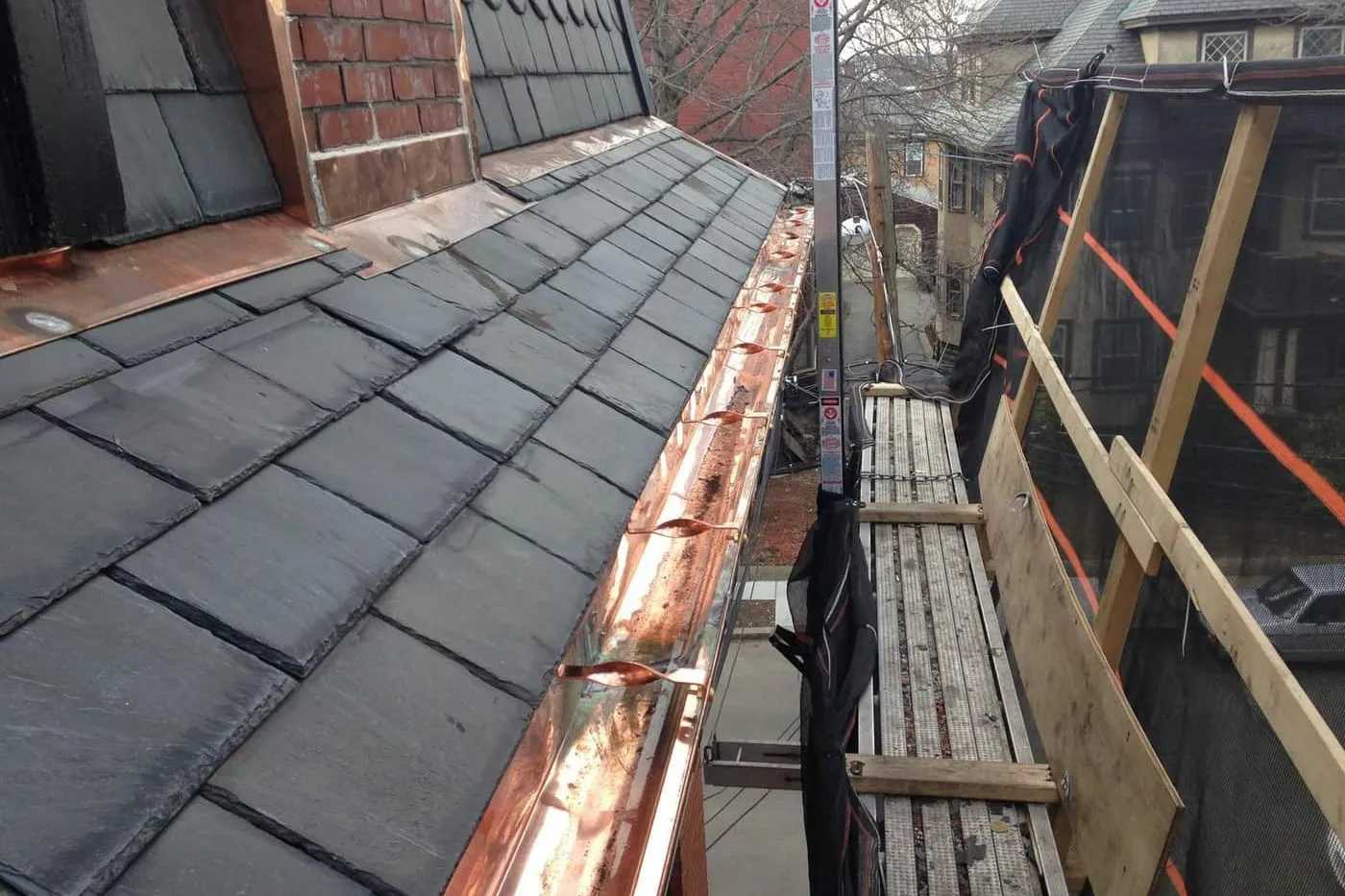
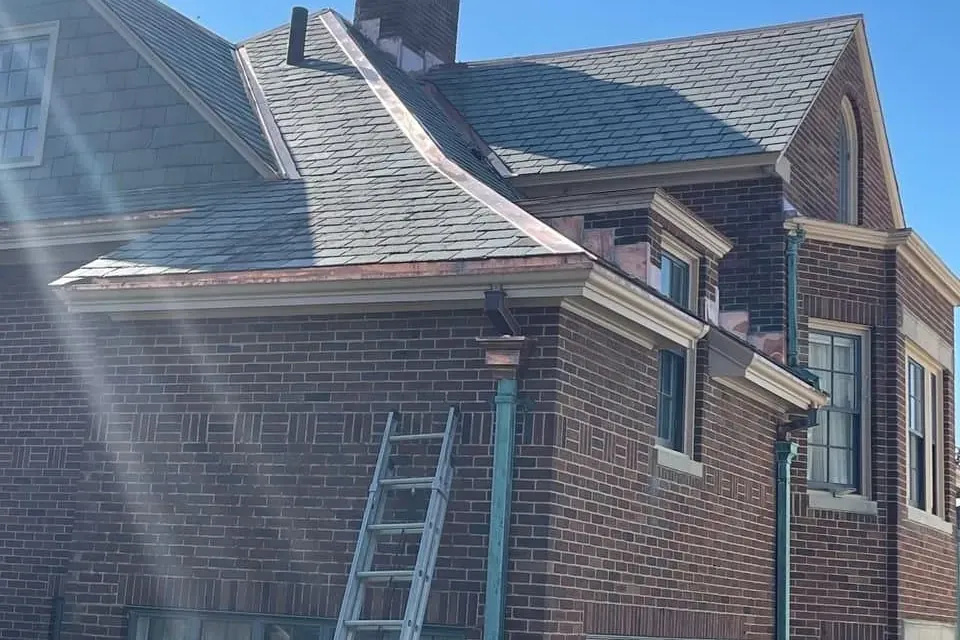
Slate and copper houses need one more rule: nothing goes under the slate, and nothing is nailed through it. Guards that clip to the gutter or mount to the fascia leave the roof alone and protect the slate you already paid for. For copper gutters, stick to copper, brass, or stainless guards and fasteners. Our copper gutter guards guide and half round gutters guide go deeper on fitting those profiles.
Where we stand on gutter guards
We don’t install gutter guards as a default. As our gutter repair page says, they are a solution to a problem that proper gutter installation often prevents. We quote them when a homeowner asks. On most houses we recommend gutter cleaning twice a year instead: once in fall after the leaves are down, once in spring after the thaw. Falling leaves in October and November are the main load on Boston gutters.
If your gutters are leaking, sagging, or pulling off the fascia, fix that first. Our gutter replacement cost guide lays out what repair and replacement run, and the gutter repair video shows the work start to finish.
Frequently asked questions
Can I install gutter guards myself?
On a one story run with sound 5 or 6 inch gutters, often yes. You need a steady ladder, gloves, safety glasses, tin snips, and a drill, and a couple of hours to a weekend depending on the house. Two and three story walls, slate or copper roofs, and old box gutters are a different job. Those require professional installation.
Do gutter guards mean I never have to clean my gutters?
No. Guards cut how often you clean, not whether you clean. In a 2026 This Old House survey of 1,000 homeowners who bought gutter guards, about 17% said they no longer clean their gutters at all, 41% clean once a year, and 43% still clean twice a year or more. Plan on a fall and spring check, and a look after big storms.
What is the right gutter guard for pine needles?
Fine metal micro mesh. Coarse screens and brush inserts let needles through or catch them in the bristles. Even micro mesh collects needles on top, and FEMA’s wildfire guidance makes the same point about mesh leaf guards, so budget time to brush or rinse the surface.
Do gutter guards go under the shingles?
Some do. Many micro mesh and reverse curve products tuck their back edge under the first course of asphalt shingles. GAF’s technical bulletin on gutter covers says to avoid products that need fasteners through the shingle, removal of shingles or drip edge, or installation under the underlayment. On a slate roof, don’t slide anything under the slate. Use a guard that clips to the gutter or the fascia.
Will gutter guards stop ice dams?
No. Ice dams start when heat from the house melts snow on the upper roof and the water refreezes at the cold eave. A guard can keep the gutter from packing with leaves, which helps drainage, but it can also hold snow and ice at the edge. Air sealing, insulation, and ventilation address the cause.
How long does gutter guard installation take?
A single story ranch with straight eaves can take a couple of hours. A large house with many corners, downspouts, and ladder moves can take a couple of days. Repairs found during the cleaning step add time.
Talk to the owner
Whether a guard makes sense depends on the gutter under it: the metal, the profile, the hangers, the roof edge, and the trees overhead. That’s hard to judge from the ground.
Every gutter project Art Slate quotes gets walked by Arturo before a number goes on paper, and that walk is free. See what we install and repair on our gutter repair page, schedule a free assessment, or call 617-913-1130. You get an honest answer on whether the work is needed now, in a few years, or not at all.