Aluminum Gutters on Older Boston Homes: K Style Sizes, Colors, Upkeep and Cost
Aluminum gutters on older Boston houses: K style vs half round, 5 to 8 inch sizes, .027 vs .032 gauge, colors, seamless runs, copper contact, upkeep and cost.
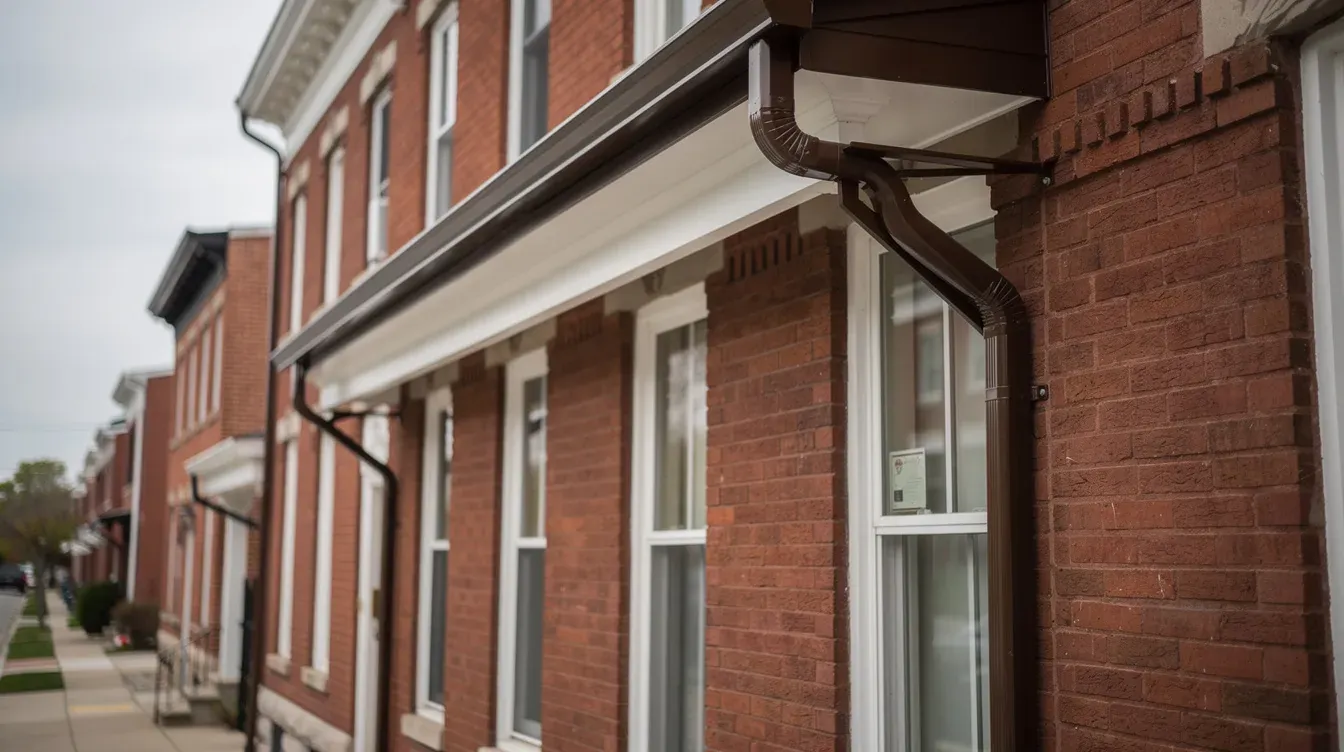
TL;DR: Aluminum gutters are light and they don't rust, and they cost far less than copper. K style is the common shape on houses, and 5 or 6 inch covers most homes. Go with .032 inch metal if snow sits on your roof, because the thinner .027 dents. Aluminum moves a lot with heat and cold, so long runs need room to slide. Never let it touch copper. Clean them twice a year and expect 20 years or more. Angi gives about 25.
Gutters · 13 min read
Most of the gutters on houses around Boston are aluminum. That’s true on 1980s colonials and on plenty of triple-deckers too, and you’ll even see it hung under a slate roof that deserved better. It’s cheap and easy to work with. Hung right, it lasts a long time.
Hung wrong, it sags in the first winter.
I’ll start with the shapes. Sizes and gauges come next. After that I get to colors and installation, and I finish with cost and upkeep. Size and color facts come from maker and seller catalogs. I checked Gutter Supply, K&M Sheet Metal and Senox, and named them in the text. Metal movement figures are from NRCA. Lifespans come from Angi and HUD. One note before anything else. Our gutter repair page says half round copper with hidden hangers is our standard on older Boston homes, and it calls K style aluminum the practical choice when copper isn’t in the budget. So this post is about the practical choice, and I’ll be honest about where it falls short.
What Aluminum Gutters Do Well, and Where They Fall Short
A gutter catches what comes off the roof edges and hands it to a downspout. Then the water goes somewhere away from the foundation. On an old house that matters more than people think. Water that spills over the front soaks the siding and stains the brick. Over the years it gets into the fascia too, and a fieldstone foundation doesn’t love it either. Bad drainage at the eave is behind a lot of the damp basements I get called about.
Aluminum does that job well for the money. It’s lightweight, so it doesn’t pull hard on old wood. Unlike steel, it won’t rust, and it shrugs off ordinary corrosion from rain and snow. It bends and cuts easily, which makes it flexible to work with, and it’s easy to customize. Corners and odd little returns around a bay window come out of the same coil. That’s a big part of why it’s among the most popular choices on houses.
The weak spots are real. A falling limb or a ladder set against it will dent it. Ice sliding off a steep roof does the same. The seams on sectional gutter can start to drip after some years. And aluminum grows and shrinks with temperature more than most roofing metals, so a sloppy install shows up fast.
It’s also sustainable. The Aluminum Association says nearly 75 percent of all aluminum ever produced is still in use, because the metal recycles over and over.
How Long They Last
Angi gives aluminum gutters about 25 years. HUD’s planning table uses 20. It’s durable stuff. With regular maintenance you should see better than 20. Neglect them and you won’t. For comparison, copper gutters run 50 to 100 years by the same Angi numbers. Our copper vs aluminum gutters post does the long math on that.
K Style Aluminum Gutters and the Other Profiles
Gutter profile means the shape of the trough when you look at it from the end. Aluminum comes in two main ones.
The K Style Gutter
Angi calls K style the most common type on homes built in the last 50 years. A K style gutter combines a flat back and a flat bottom with a front face shaped a little like crown molding. Some sellers call it an ogee gutter. K&M Sheet Metal does. The flat back sits tight against a flat fascia board, and hidden hangers inside the trough screw through into the wood.
“K style” names the shape. It isn’t a brand. You’ll find it in widths from 5 inch up to 8 inch. The two smaller sizes are what you see on houses.
K style holds a lot of water for its width. Those inside corners in the front face also hold leaves and roof grit, so cleaning matters.
Half Round Profiles and the Bead
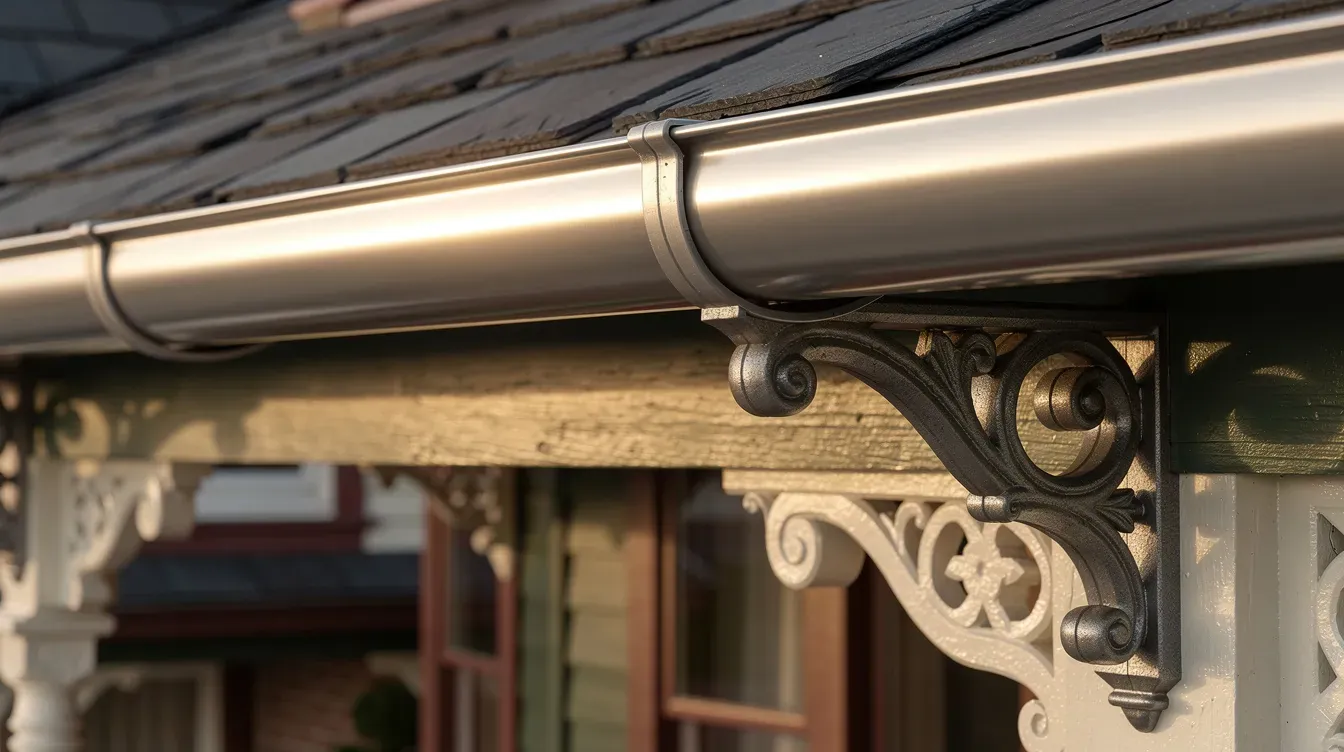
Half round is a plain half circle. It’s the traditional look on Victorians and brick rowhouses. Aluminum half round exists, and Gutter Supply sells two versions. Traditional Single Bead Half Round has its front bead rolled outward, and that’s the older look. It usually hangs on brackets or straps that support it from below. Reverse Bead Half Round has the bead rolled inward, toward the inside of the trough. That inward bead lets it take hidden hangers the way K style does. The parts aren’t interchangeable. The end caps have to match the bead. So do the hangers and miters.
On a historic house I’d still steer people toward copper half round. That’s what our half round gutter guide covers.
Sizes, Thicknesses and Section Lengths
Five and 6 inch are the common residential sizes. Seven and 8 inch exist, mostly for commercial roofs and churches. That’s how eGutter, a parts seller, describes its own lineup. Pick the size from the roof. Its area matters, and so does the pitch. Local rainfall conditions count too. Don’t just copy whatever was there.
A rough guide from the roof:
- 5 inch handles most single family houses with average roof planes.
- 6 inch is for big roof planes, steep slate that sheds water fast, and long runs that feed a single downspout.
- 7 and 8 inch are for commercial and other large roofs.
Thicknesses vary by size. The common residential gauges are .027 and .032 inch. Larger sizes run heavier, and Gutter Supply lists its 8 inch K style in .040. Thicker gutters resist dents and bending better. This Old House recommends the .032 where snow loads run heavy, and that’s us. It’s priced higher, and I’d still pay it. I’d take .032 on any house with branches hanging over it. Same if ice comes off a steep roof, or if ladders get leaned on the gutters.
Sections or One Piece
K style can be ordered in fixed 10 or 20 foot sections, and that’s how K&M and eGutter both list it sold. Those pieces get shipped to the house and joined with sealed laps. Long pieces kink with rough handling, so it takes two people to carry them. K&M notes that its 7 and 8 inch gutters are formed by hand. That caps them at 20 feet. Its 5 and 6 inch are roll formed from coil and can run any practical length.
That’s how seamless gutters get made. A contractor brings a forming machine on a truck, feeds coil through it and cuts each run to length right there on site, creating long sections with joints only at corners and outlets. Fewer joints means fewer places for leaks. Professional installation is often required for one piece runs, because nobody owns that machine but a gutter crew. Our gutter replacement cost guide cites HomeGuide on one piece runs costing about $3 to $5 more per foot than sectional.
Colors and Finishes
Pre-painted aluminum comes in a lot of colors. Gutter Supply says more than 20 factory-applied colors across its aluminum line. Senox lists 26 traditional colors in its 2026 catalog. White and dark bronze are the ones I see most, then black and the browns.
Not all colors are available in every size, though. Gutter Supply says so outright. A color that’s stocked in 5 inch K style can be a special order in 6 inch half round, or missing from the matching downspout. Check that before checkout, and check the quantity of every accessory in that color too. Waiting on delivery of two end caps can hold up a whole project.
Factory paint keeps its appearance a lot longer than paint brushed on afterward. eGutter’s standard .027 coil is baked enamel, and it lists Kynar 500 on its heavier .032 commercial coil. On a historic house, match the gutter to the trim and it mostly disappears along the roofline. Contrast it and it becomes one of the architectural features. Either is fine. Just decide on purpose.
Parts That Have to Match a K Style System
A gutter is a system. The trough is one piece of it. Each run also needs hangers and end caps. Corners take inside or outside miters. Then there are the outlets, the aluminum downspouts and their elbows. Every accessory has to fit the same size and gutter profile.
K style usually takes rectangular downspouts in 2x3 or 3x4 inch. InterNACHI’s moisture intrusion guide calls a 5 inch K style with 2x3 downspouts the common setup. It also suggests about one downspout for every 50 feet of gutter. Bigger downspouts carry more and clog less. That’s handy under trees.
Mixing brands is where fit goes wrong. Two parts both called 5 inch K style can differ enough to leak at the joint, and the colors rarely match side by side. Buy the parts from one line when you can. Our gutter hangers guide goes deep on hanger types.
Installing Aluminum Gutters on an Older House
On a new house you screw gutters to new fascia. On a 1900 house you find out what’s behind the old gutter first. Rot at the fascia and soffit is common after decades of overflow. It gets fixed before any new hanger goes in.
Then comes slope. This Old House gives 1/4 inch of drop per 10 feet, snapped as a chalk line from the high end. Hangers hold whatever line you give them. They don’t create it. Once a run is complete, put a hose in the high end and watch where the water goes.
Hanger spacing comes next. Industry guidance puts hangers no more than 36 inches apart and 18 inches where snow and ice sit for weeks. Some hidden hanger makers list 24 inches as standard. Gutterall, for one, drops to 16 for heavy snow. On our estimates hanger spacing is its own line item. Our gutter page also says the hidden hangers go into rafter ends, not just the sheathing.
The flashing at the eave matters too. Drip edge and the ice and water membrane have to lap so water can’t sneak behind the gutter. Our roof flashing repair post covers those details.
Heat, Cold and Expansion Joints
Aluminum moves. NRCA lists its expansion rate at 0.0000129 inch per inch per degree Fahrenheit. That’s about twice steel’s. A 40 foot run that goes through a 100 degree swing changes length by about 5/8 inch. Boston does that every year, from a January night to a sunny July afternoon.
If the run can’t move, something gives. Seams pull apart, or fasteners work loose. Sometimes the gutter buckles. Proper installation prevents sagging and leaks. Long straight runs get an expansion joint. ACM, a coil supplier, recommends one for every 40 feet of continuous gutter. The hangers should let the trough slide a little instead of pinning it.
Keep Copper Away From Aluminum
This one matters on slate and copper roofs. Aluminum doesn’t rust, but it can corrode when it touches a less active metal with water around. Copper is the big one. The Copper Development Association warns that runoff from copper can corrode aluminum below it, even where the two never touch. So aluminum gutters under a copper roof or copper valley are a bad pairing. Where the two have to be near each other, put a nonabsorptive gasket between them.
GAF has a technical bulletin on a related problem. Copper granules from algae resistant shingles can collect in aluminum gutters and corrode them. GAF calls the cases isolated. They mostly involve standing water and piled up granules, so keep gutters draining.
Fasteners count too. Use the aluminum or stainless fasteners the hanger maker supplies. A plain steel screw in an aluminum gutter is asking for trouble.
What Aluminum Gutters Cost
These are the numbers our own cost guide uses for what aluminum gutters cost. The installed figures cover materials and labor. None of these are Art Slate prices.
| Item | Source | Figure |
|---|---|---|
| Aluminum, installed, national | Angi | $3 to $15 per linear foot |
| Aluminum, installed, Boston | Angi | $8 to $13 per linear foot |
| One piece aluminum, average home | HomeGuide | $900 to $2,400 installed |
| One piece vs sectional | HomeGuide | about $3 to $5 more per foot |
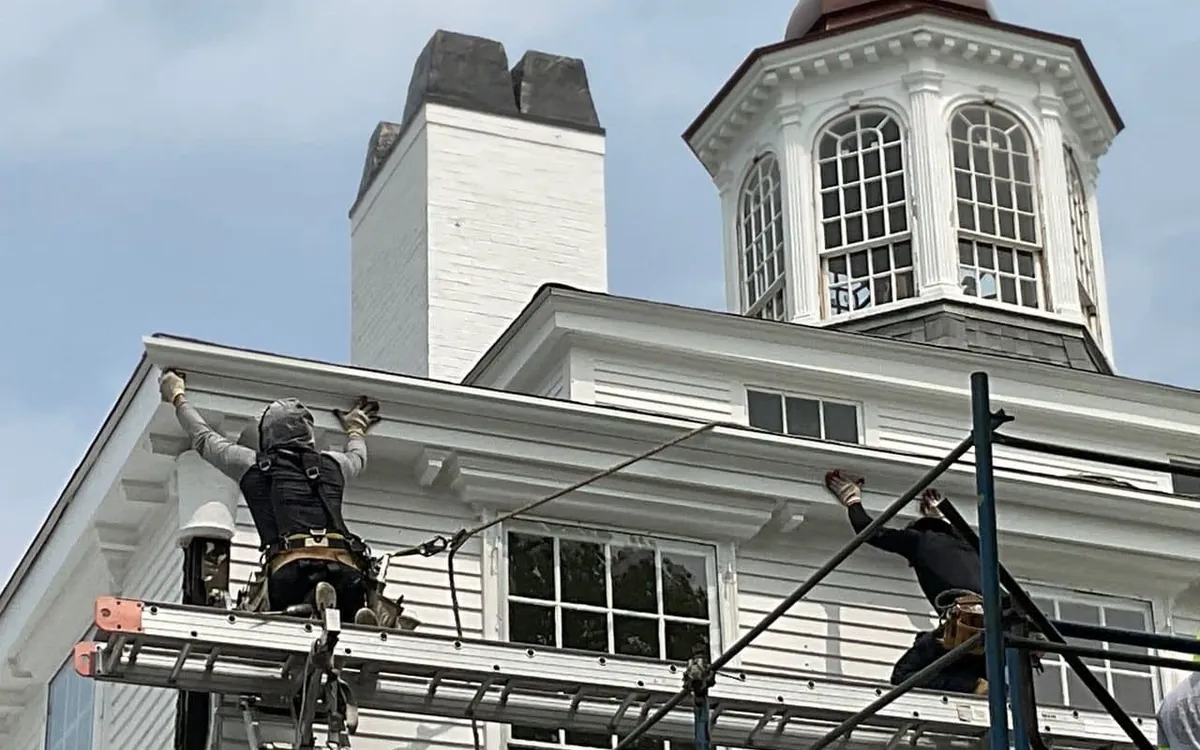
Height adds cost. So does rotten fascia, and so do extra downspouts. On a tall house, access is a real share of the bill. Somebody has to put up staging or bring a lift. Get every quote itemized. Then you can line up the gauge and size on each one, and the hanger spacing and downspout count too.
Cleaning, Ice and Gutter Guards
Aluminum gutters are low maintenance. That isn’t no maintenance. They need regular cleaning to prevent blockages and overflow. Our gutter page says twice a year, once in fall after the leaves are down and again in spring after the thaw. Painted gutters need periodic inspections for debris even when they look fine from the ground.
When you’re up there, look for these:
- Drips at seams, end caps and outlets
- Low spots still holding water a day after rain
- Sections pulling off the fascia
- Dents from ladders or branches
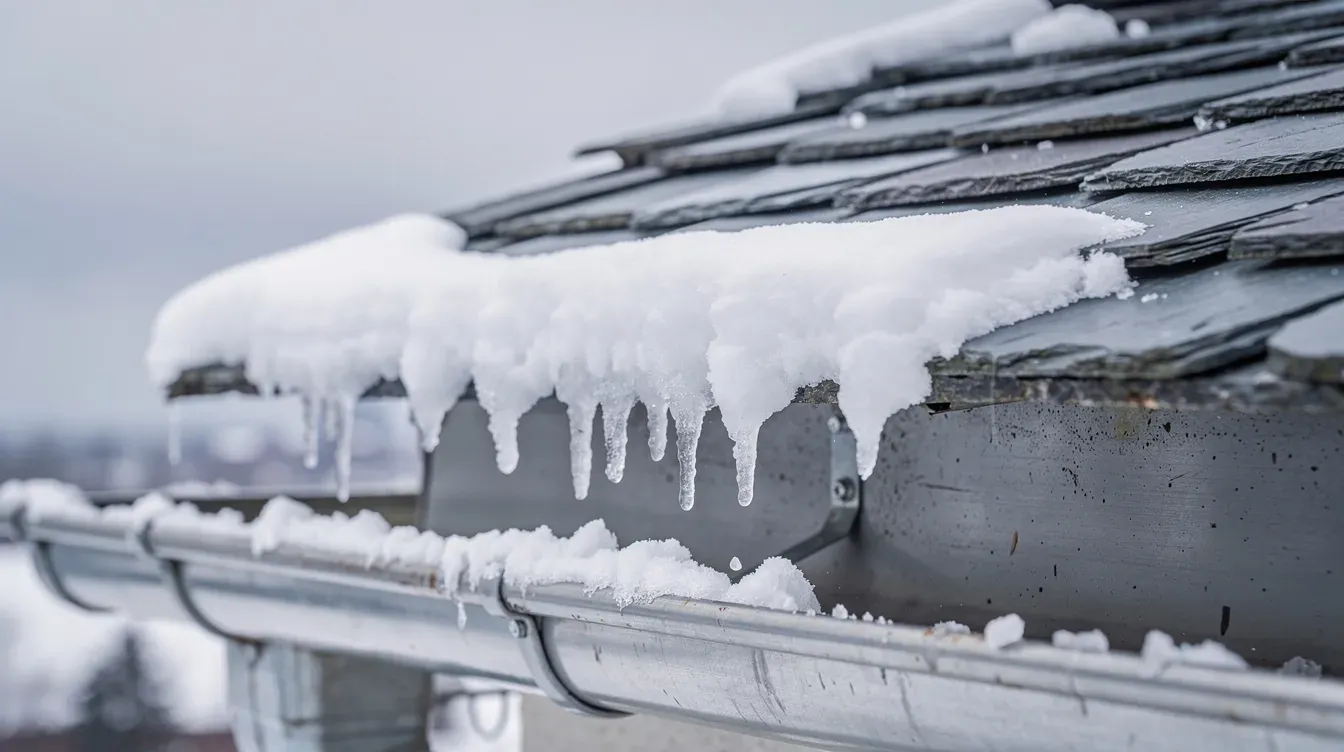
Clogs feed ice dams. Water backs up behind leaves and freezes. Then the next melt has nowhere to go but under the roofing. Boston saw all of it in 2014 and 2015, when the National Weather Service recorded a record 110.6 inches of snow for the season. Ice in a gutter is also heavy. That’s one more reason for .032 metal and tight hanger spacing. Our ice melt systems page covers the heat cable side of it.
Gutter guards cut cleaning but don’t end it. Under big maples and oaks you’ll still be lifting them now and then. Our gutter guard installation guide covers the types. Our gutter page also says we don’t install guards by default and usually recommend cleaning twice a year instead.
Repair or Replace
Plenty of aluminum gutter can be fixed. A loose run gets new hangers. Leaky end caps and corners get cleaned and resealed. One crushed 10 foot section gets swapped. If that’s all it needs, our gutter page says we’ll tell you so.
Replacement makes more sense when:
- Seams and corners keep leaking after you reseal them
- Thin .027 gutter has dents along most of its length
- The run pulls off the fascia every winter
- Water runs behind the gutter and has rotted the wood
Cost comes into it too. Our cost guide’s rule of thumb is to replace once damage spreads across several runs or a single year of repairs hits $500 to $700. If a re-roof is coming, do the gutters with it. The roof edge work overlaps, and the staging only goes up once.
Frequently Asked Questions
How Long Do Aluminum Gutters Last?
Twenty years and up if somebody cleans them. Angi says about 25, and HUD’s planning table uses 20. What gives out first is rarely the metal. It’s the sealant at the seams and corners, or a hanger screwed into soft fascia.
What Size K Style Gutter Do I Need?
Most houses take a 5 or 6 inch. I lean to 6 inch on big roof planes and steep slate, since that water arrives fast. Seven and 8 inch are mostly commercial. Downspouts matter just as much, so count those before you upsize the gutter.
Do Aluminum Gutters Rust?
No. It can corrode, though. Around here copper is usually why.
Are One Piece Gutters Better Than Sectional?
For leaks, yes. A one piece run is formed on site from a coil of aluminum and cut to the exact length of the wall, so the only joints left are at the corners and the outlets. Sectional gutter comes in 10 or 20 foot pieces, and every splice is a sealed lap that can open up after a few winters of the metal moving. The catch is that you need a crew with a forming machine on a truck. HomeGuide puts the difference at about $3 to $5 more per foot.
How Much Do Aluminum Gutters Cost?
Angi puts aluminum at $3 to $15 a linear foot nationally and $8 to $13 in Boston. Those are Angi’s figures, not ours. Rotten fascia moves the total more than people expect. Height does too.
Can Aluminum Gutters Go Under a Copper Roof?
I wouldn’t. Rain off copper carries a little dissolved copper with it, and the Copper Development Association warns that this water attacks aluminum below. Under copper, use copper gutters.
Talk to the Owner
Aluminum or copper, the gutter is only as good as the wood behind it and the slope it’s hung on. I’d want to see your roof before telling you which one fits.
I walk every roof myself before a quote goes out. Our gutter work is half round copper and K style aluminum, plus box gutters on older cornices. If yours only need a repair, I’ll tell you. The estimate is free. See our gutter repair page, request a free estimate, or call 617-913-1130.