Storm Damage Roof Repair in Greater Boston: Slate, Copper, and the Insurance Claim
Storm damage roof repair for Greater Boston slate and copper roofs: what nor'easters and wind actually break, what a specialist inspects, repair vs replacement, cost, and the insurance claim path.
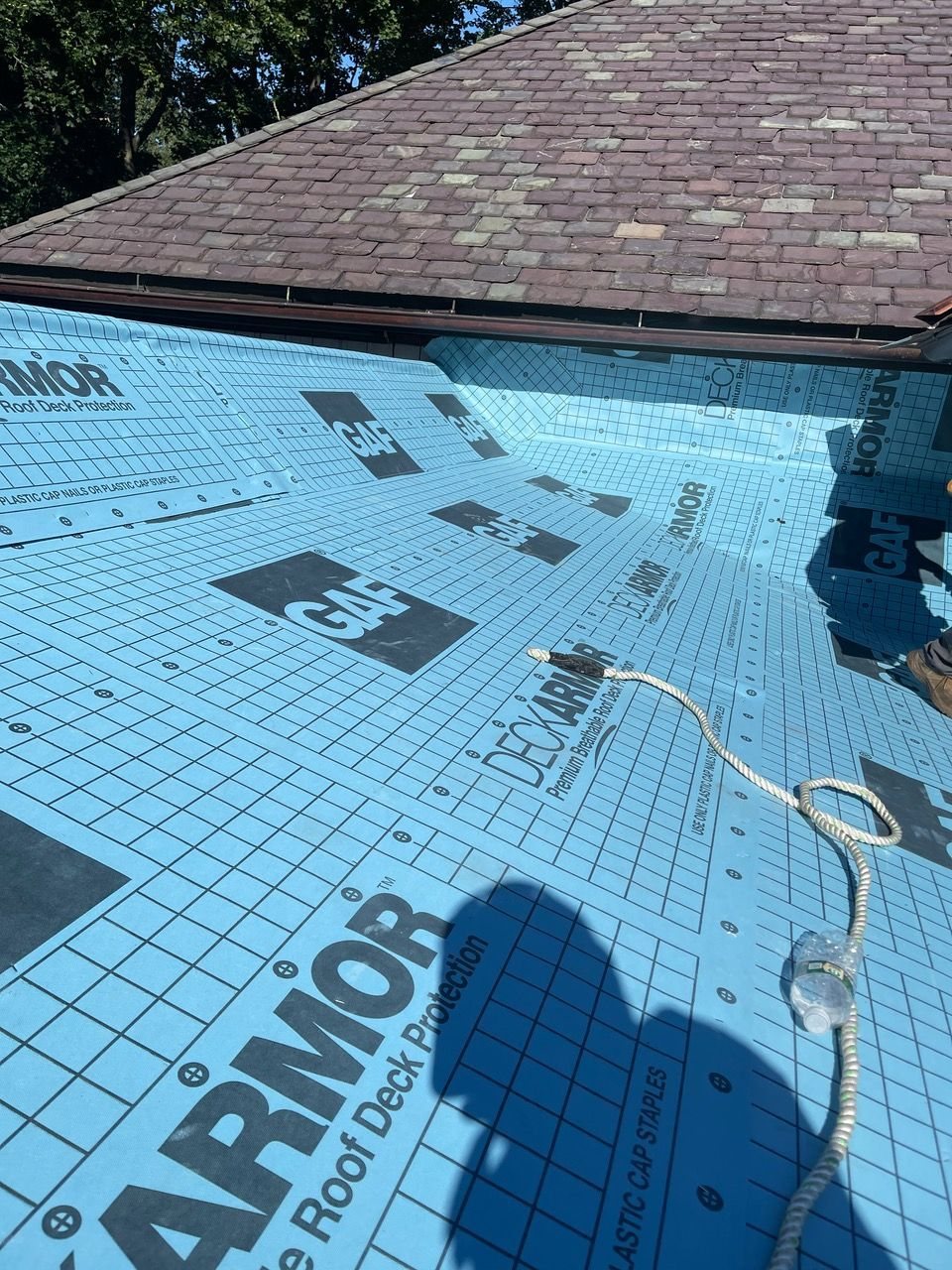
TL;DR: Storm damage roof repair in Greater Boston is its own problem, because nor'easter wind, driven rain, and ice hit slate and copper differently than they hit asphalt. Wind lifts and slides slate, strips ridge and hip caps, and peels copper flashing at the seams. After a storm, get a real inspection from someone who works in slate, document everything with dated photos, and open the insurance claim before you commit to a scope. Most storm damage is a targeted repair, not a full replacement. Replace only when a whole slope is broken or the deck is soaked.
Repair · 13 min read
Storm damage roof repair is one of the most common calls we get after a Greater Boston nor’easter, and most of the advice online was written for an asphalt shingle roof somewhere else in the country. Slate and copper do not fail the way three-tab shingles fail.
The wind lifts and slides stone instead of tearing it off in sheets. The copper peels at the seams. The real damage often hides at the ridge, in the valleys, and behind the flashing rather than out in the open field where a homeowner would spot it.
This post is the New England version. It covers what our storms actually do to slate and copper roofs, what a specialist looks for when the wind stops, how to tell a repair from a replacement, what the work tends to cost, and how to document the damage so your insurance claim holds up. The insurance piece matters here because storm claims are where a lot of Boston homeowners lose money they were owed.
I install and repair slate and copper for a living, so I will be plain about one thing up front. On these roofs the tile is rarely the expensive part. The copper and the flashing details are the roof, and after a storm they are usually what needs the work.
What storm damage roof repair looks like in Greater Boston
Storm damage roof repair on a slate or copper roof is mostly detail work, not a big tear off. A nor’easter does not usually take the whole roof. It finds the weak points and works them open, and those weak points are predictable on an old Boston house.
The common list after a storm looks like this: a handful of slates cracked or slid out of line, ridge or hip caps lifted, a copper valley dented or lifted at a seam, flashing pulled back at a chimney, and gutters torn loose at the fascia. Any one of these lets water past the surface and onto the deck.
The trap is that most of this is invisible from the street. A homeowner sees no missing shingles and assumes the roof is fine, while a lifted flashing quietly leaks into the wall for a month. That gap between what shows and what leaks is why a real inspection matters more on slate than on asphalt.
The first move after the storm
If water is actively coming in, the first job is to stop the interior damage without making the roof worse. On slate that means a safe temporary cover over the opening, set by someone who will not walk and crack more stone getting to it, not a rushed patch that has to be undone later.
Do not send anyone up to walk a wet slate roof to look for damage. It is slick, it breaks underfoot, and a homeowner or a general handyman on a slope after a storm usually adds broken slate to the bill. Read the roof from a ladder and read the ceilings and attic from inside instead.
Then slow down. Once the leak is contained, there is no prize for signing a contract in the first 24 hours. The good storm damage roofing decisions get made after a proper inspection, not in the parking lot with a door knocker.
Nor’easters and wind damage to roof systems here
New England storms are their own category. A nor’easter drives rain sideways for hours, sometimes days, with sustained wind that a summer thunderstorm never matches. The National Weather Service explains how these nor’easter storms form and behave along the coast, and Boston sits right in their path.
Sideways rain is the part that gets people. On a calm day, water runs down the slate and off the roof the way the roof was designed to shed it. In a nor’easter, wind pushes water uphill, under the slate, and sideways into flashing joints that were never meant to take pressure from that angle. A roof that is watertight in an ordinary rain can leak in a nor’easter.
Wind damage to roof systems in this climate also comes with the storm surge of debris. Branches, and sometimes whole limbs, come down on roofs across Greater Boston in every big blow. A branch strike cracks slate on impact and can punch through the deck if it is heavy enough.
Wind uplift on slate and copper
Wind does not usually rip slate off the way it strips shingles. It works by uplift and prying. Gusts get under the exposed edge of a slate, flex it against its nails, and either crack the stone or work the nails loose until the slate slides. The Insurance Institute for Business and Home Safety documents how wind loads attack roof edges and coverings, and edges are exactly where slate and copper are most exposed.
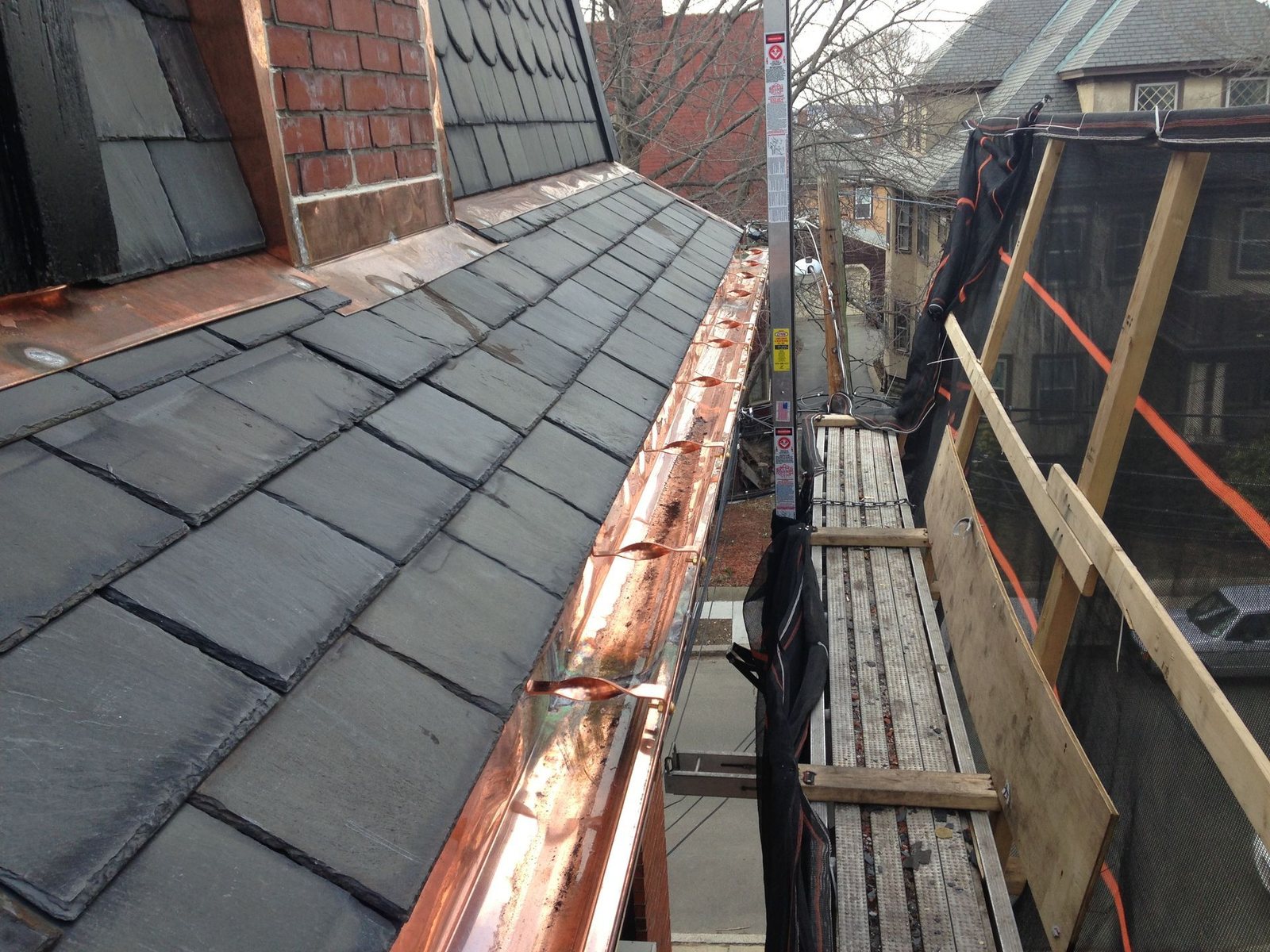
Copper takes wind differently. Standing seam and copper flashing are folded and locked at the seams, so a strong enough gust can pry a seam open or peel a flashing leg back off the wall. Once a copper seam lifts, wind driven rain has a straight path underneath it. This is why wind damage repair on a copper roof is often seam and flashing work, not panel replacement.
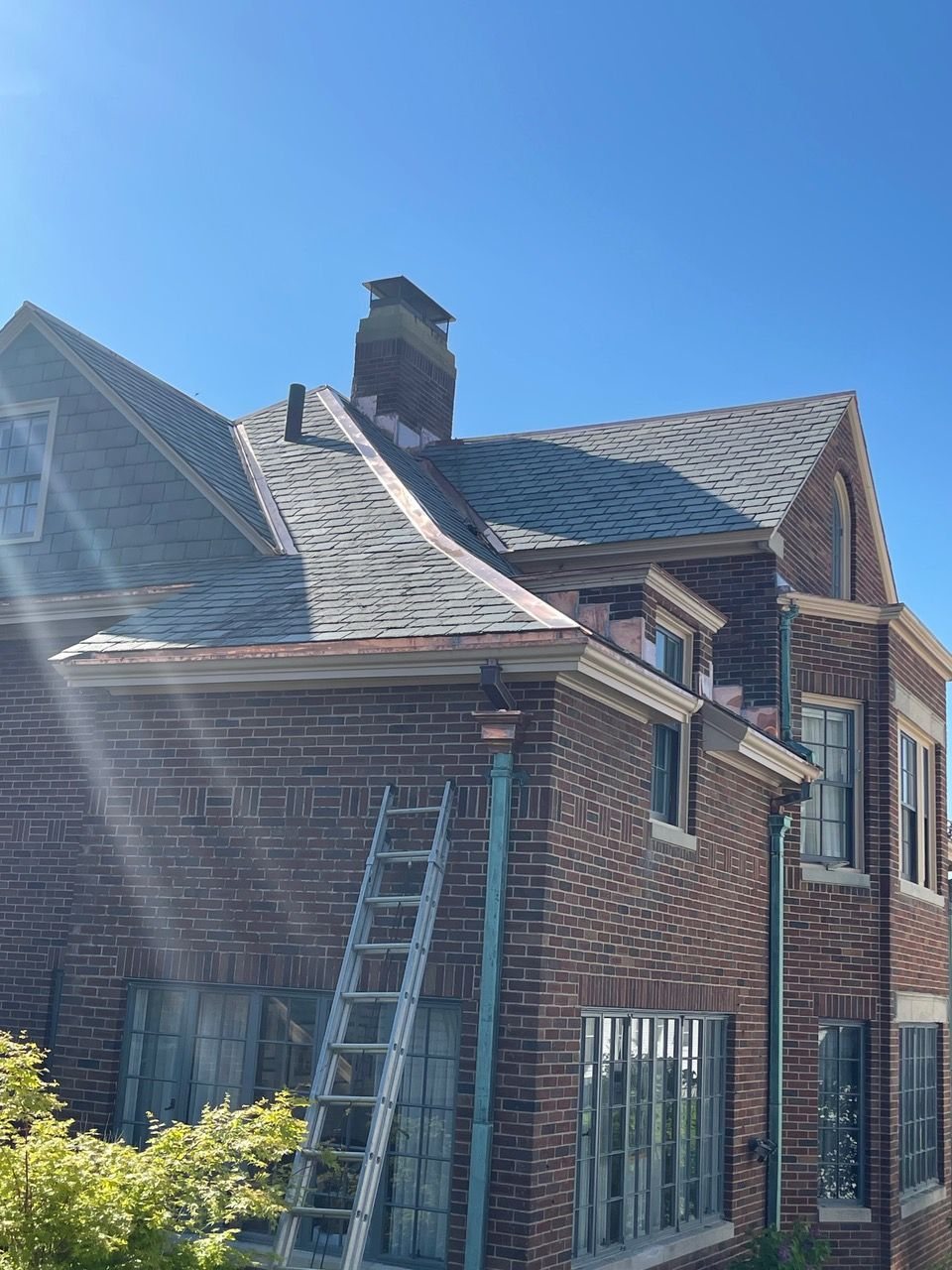
Ridge and hip caps are the other classic uplift casualty. They sit at the highest, most exposed lines on the roof, and a nor’easter will find any cap that was under nailed or bedded in tired mortar. A run of lifted ridge is one of the most common things we reset after a storm.
Hail damage roof repair: less common here, still real
Hail is a bigger roofing problem in the Plains and the Southeast than it is in Massachusetts, but we do get it, and hail damage roof repair on slate is a different animal than on asphalt. Hail bruises and cracks asphalt shingles, knocking granules loose. On slate, a large enough stone chips the exposed edge or cracks the tile outright.
The IBHS research on hail impacts and roof performance is written mostly around shingles and impact ratings, but the underlying point holds for stone: a hard hit finds the weakest tiles first. On a slate roof, that usually means older, softer, or already delaminating slates crack while sound stone shrugs the same hit off.
The tricky part with hail is that the damage can be subtle and scattered. A few cracked slates spread across a slope are easy to miss from the ground and easy for a rushed adjuster to overlook. That is another reason roof storm damage repair on slate rewards a careful, close inspection over a quick look.
Ice-dam-driven storm damage
Not all storm damage in Boston arrives as wind. Some of it arrives as ice. A heavy snow followed by a cold snap builds ice dams at the eaves, and that ice pushes meltwater back up under the slate, where it freezes, expands, and lifts the stone from below.
This is storm damage that shows up days after the storm, once the melt and refreeze cycle has done its work. It cracks slate at the eaves, works flashing loose, and soaks the deck along the bottom courses. We walk through why these form and how to stop them in our guide to ice dam prevention in New England.
The repair here is rarely just replacing a few slates. If ice got under the eaves, the ice and water membrane and the flashing at the edge usually need attention too, or the same thing happens next winter. Fixing the slate without fixing the edge detail is a repair that does not last.
What a slate and copper specialist checks: the storm damage roof inspection
A good storm damage roof inspection on a slate roof is done from a ladder and from inside the attic, not by walking the slope. Slate cracks under a boot and turns slick when wet, so a roofer who walks your slate to inspect it is causing damage, not finding it. Most of what matters can be read from the edge and from below.
Here is the roof storm damage assessment we run after a Boston storm:
- The field: cracked, slipped, or missing slates, read with binoculars from the ground and up close from the ladder.
- Ridge and hip: lifted or displaced caps, opened mortar, exposed nails.
- Valleys: dents, lifted copper, debris dams, and torn seams where water concentrates.
- Flashing: chimneys, sidewalls, and step flashing pulled back or punctured.
- Gutters and eaves: copper or aluminum torn from the fascia, and ice damage at the bottom courses.
- The attic: daylight through the deck, damp sheathing, and fresh water staining that tells you where the roof is actually leaking.
The attic is the honest witness. From inside you can see whether water reached the deck and where, which turns a guess about hidden damage into a fact. Our post on the early warning signs a slate roof needs work covers the same read in more depth.
Storm damage roof repair vs storm damage roof replacement
Most storms end in a repair, not a replacement. The question is where the line sits, and it is not about the number of broken slates alone. It is about how much of the roof is compromised and what shape it was in before the storm.
Repair is the right call when the damage is localized and the deck under it is dry. A dozen broken slates, a lifted ridge, and a torn valley are all repairs, even when they add up to a real bill. Slate is built for single piece repair, and a matched stone in a sound roof is a clean, lasting fix.
Storm damage roof replacement earns its place when a whole slope is stripped, when the sheathing is soaked across a wide area, or when the roof was already worn out and the storm was the last straw. Age is the deciding factor as often as the storm is.
On a Boston roof wearing its original nails from the early 1900s, a big blow sometimes tips a tired roof over the edge, and patching it is throwing good money after bad. Our guide to how long a slate roof lasts helps you judge where your roof sits on that curve before you decide.
The decision should be driven by the roof, not by the contractor’s preference. A crew that only wants to sell you a full replacement after a repairable storm is a crew to walk away from.
How to estimate storm damage roof repair costs
The honest way to estimate storm damage roof repair costs is to count the damage, not to multiply a per square foot rate. Storm repairs are itemized work: so many slates, so many feet of flashing, this much copper, this much staging. A blanket square foot number does not describe a patch job.
As a rough frame for Boston slate work, a small repair of a few broken slates and a resealed flashing often lands in the few hundred to low four figures. A stripped ridge line, a torn copper valley, or a section of blown off slate runs higher, because the copper and the skilled labor are where the money goes, not the stone itself.
Two things swing the number more than anything else. Access, meaning how much staging or lift it takes to reach the damage safely, and copper, because copper is expensive and copper work is slow. A repair at a two story eave and a repair at a fourth story chimney on a mansard are not the same job even if the slate count is identical. For related copper pricing, our copper roofing repair service page lays out what that work involves.
Documenting damage and working with your adjuster
The high insurance value of a storm claim is exactly why this step is worth doing right. Sudden storm damage from wind, hail, or a fallen tree is usually covered, subject to your deductible, while wear and old leaks are not. Your job is to prove the damage is storm caused and recent.
Document before anyone touches the roof. Take dated photos of the exterior damage from every safe angle, the interior water stains, and any soaked insulation, and note the storm date. The Insurance Information Institute walks through how to file a homeowners claim and what carriers expect to see.
Open the claim before you commit to a final scope, and get your own written assessment from a local roofer to compare against the adjuster’s. On steep slate roofs, adjusters often cannot safely reach the damage and miss it on the first walk, so a specialist’s documented findings give you the grounds to request a re-inspection. Our post on the first 48 hours after storm damage lays out the full claim sequence step by step.
How to find a licensed roofer for storm damage repair
The day after a big storm, out of state crews fan into damaged Boston neighborhoods offering to handle everything and asking for a signature. Some are fine. Many take a deposit, do rushed work, and are gone before the warranty is ever tested. Knowing how to find a licensed roofer for storm damage repair protects you from both the storm and the storm chasers.
Check the credentials first. In Massachusetts that means a Construction Supervisor License and Home Improvement Contractor registration, plus current liability insurance you can verify. Then check the fit: storm damage repair contractors who only do asphalt are the wrong crew for a slate and copper roof, no matter how good their price is.
Ask for slate and copper references you can actually drive past, a written and itemized scope, and a deposit that stays modest rather than half the job up front. A local roofer with a real slate track record is worth waiting a few extra days for. If your damage is a broader slate problem, our slate roof repair in Boston guide covers what quality repair work looks like, and chimney leaks are covered in our chimney flashing repair post.
Frequently asked questions
How do I estimate storm damage roof repair costs?
Start with the count, not a per square foot rule. Small storm damage roof repair on a Boston slate roof, meaning a few broken slates and a resealed flashing, often lands in the few hundred to low four figures. A stripped ridge, a torn copper valley, or a blown off section runs higher, because the copper and the labor are the real cost, not the stone. The honest number comes from a roofer counting damage on a ladder.
When should I replace the roof entirely instead of repairing storm damage?
Repair is the default when the damage is localized and the deck under it is dry. Lean toward storm damage roof replacement when a whole slope has lost its slate, when the sheathing is soaked across a wide area, or when the roof was already near the end of its life and the storm finished it. On an old Boston roof wearing its first nails, a big storm can tip a tired roof from repair into replacement.
How do I find a licensed roofer for storm damage repair in Boston?
Check for a Massachusetts Construction Supervisor License and Home Improvement Contractor registration, ask for proof of insurance, and confirm the crew actually works in slate and copper, not just asphalt. Be wary of out of state door knockers who appear the day after a storm and offer to handle your insurance. A local roofer with a slate track record and references you can drive past is worth more than the fastest quote.
How do I get a storm damage roof repair estimate I can trust?
Ask for a written scope that lists what will be repaired, what materials go back on, and what stays. A trustworthy storm damage roof repair estimate names the copper gauge for flashing, whether slate is salvaged or matched, and what the crew found in the attic. If an estimate is a single lump sum with no detail, you cannot compare it to the adjuster’s number, and comparing those two numbers is how you protect the claim.
Does homeowners insurance cover storm damage roof repair?
Usually yes for sudden storm damage from wind, hail, or a fallen tree, subject to your deductible and policy terms. Insurance rarely pays for wear, rot, or deferred maintenance, so an adjuster will look for whether the damage is storm caused or age caused. Document the storm date, take dated photos, and keep your receipts. On a steep slate roof, adjusters sometimes miss damage they cannot safely reach, which is why a specialist’s assessment matters.
Is a few missing slates after a storm an emergency?
A couple of broken or missing slates is not a crisis, but it is an open door for water, so it should be handled within days, not months. If water is actively entering the house, that is an emergency: get a safe temporary cover on it, then book a real repair. In our freeze and thaw climate, a small opening left through winter turns into a wet deck and a bigger bill by spring.
Talk to the owner
The useful first step after a storm is not a phone quote or a number off a satellite photo. It is one person up on a ladder and in the attic, reading what the storm actually did to your slate, your copper, and your deck, and telling you whether it is a repair or something bigger.
Every storm damage repair Art Slate quotes gets walked by Arturo before a number goes on paper. See our slate and copper roofing service or schedule a free assessment, and Arturo will tell you what your roof needs and help you document it for the claim.