Snow Guards for a Slate Roof: Types and Layout, Plus Installation
A plain guide to snow guards on a slate roof: pad style and rail systems, copper, layout by snow load and pitch, and how to install them without cracking the slate.
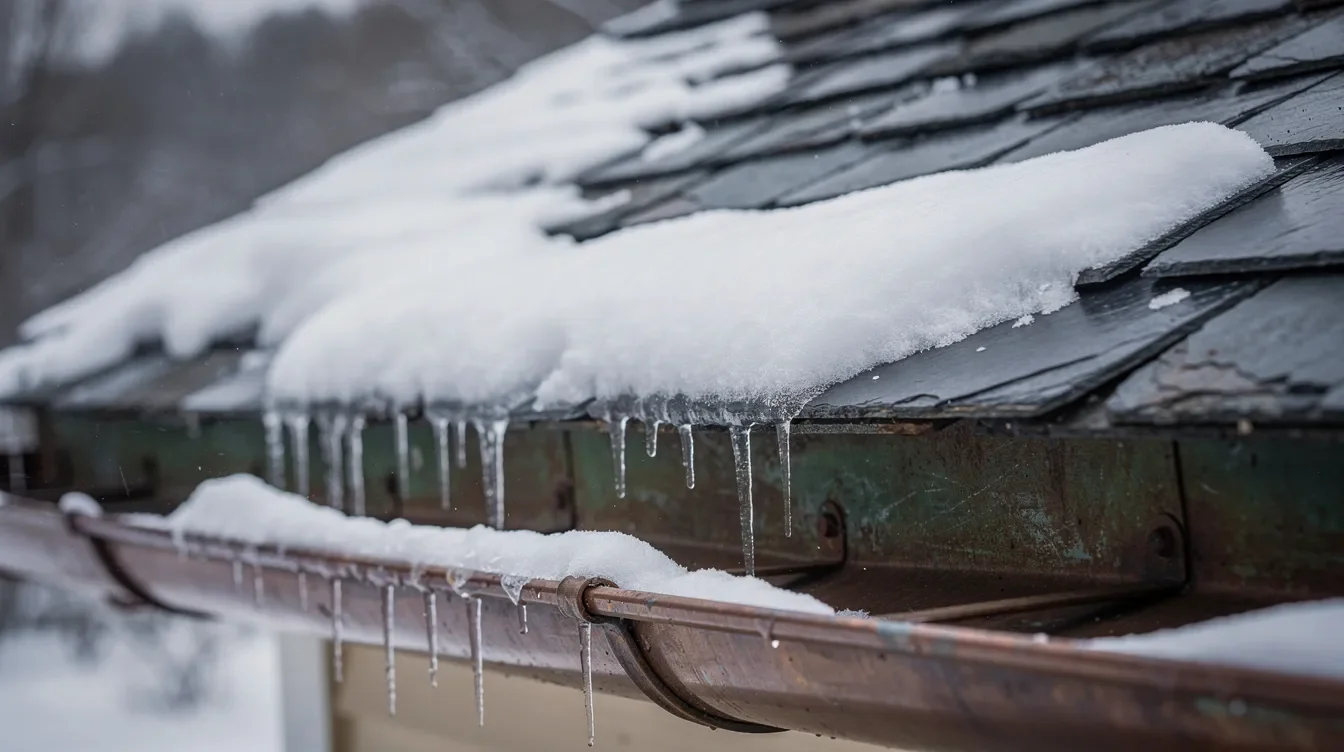
TL;DR: Snow guards hold snow on a slate roof so it melts slowly instead of coming off in one slide. Pad style snow guards are the cheaper choice. Rail and bar systems hold a heavier snow load and make a continuous line at the eave. Copper is the material that belongs with slate and with copper gutters. Layout follows the roof pitch and the snow load for your town. Don't drill through a slate face. Guards don't stop ice dams.
Slate · 11 min read
A steep slate roof will hold a few feet of snow after a January storm. Then a mild afternoon hits and the underside loosens, so the whole pack lets go at once. That slide can tear the gutters off. It can bury a walk, or land on a car or on someone standing at the door. Snow guards hold that snow in place until it melts gradually, instead of letting it run in one sheet.
How snow guards work depends on the roof pitch and the snow load. What sits under the eave matters just as much. The notes below cover the two main types, how a layout is set, and how the guards get installed on new slate and on a roof that’s already up. They also cover what the guards do not do.
Why Snow Guards Matter on Slate Roofs
Slate is a smooth stone. Compared with textured roofing materials like an asphalt shingle, it has almost no grip, so snow slides off it once a melt layer forms underneath. Many of the older houses around Boston have a roof pitch of 8:12 or steeper. Dark slate also warms in the sun, even on a cold day, which starts that melt.
Without snow guards, slate roofs can shed a dangerous avalanche of snow and ice. The pack doesn’t trickle off. It comes down as a slab. Walkways and doors take that hit, and so do lower roofs and parked cars. Gutters take it too. A copper half-round that’s hung correctly still isn’t built to catch a few tons of sliding snow.
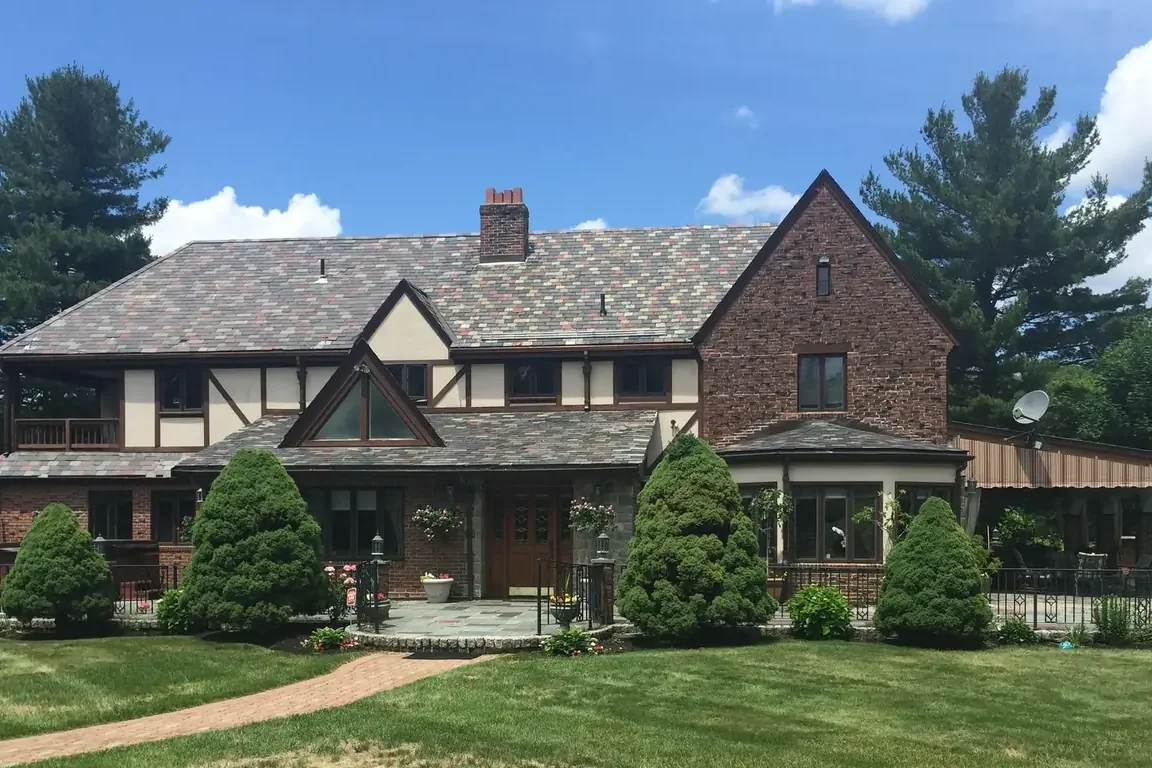
A slate roof lasts 75 to 150 years, and the copper on it often lasts 80 to 100 years or more. That longevity is what a single winter slide can undo at the eave. That’s the safety case for snow retention, and it’s also the case for the roof itself.
Sliding Snow and Snow Load on a Steep Slate Roof
New England winter conditions stack wet coastal storms on freeze thaw cycles. Rain on snow makes a dense pack too. The number people quote for Boston is often a range, like 30 to 40 pounds per square foot. That’s mixing two different figures.
Massachusetts publishes a ground snow load for every city and town in 780 CMR 51.00, Table R301.2(2). For Boston that number is 40 pounds per square foot. Cambridge uses the same figure, and so do Newton and Malden. The 30 psf figure in the same table is the minimum flat roof snow load, not a second guess at the ground load. Towns farther west and uphill run higher, some of them up to 60 psf. The table is in the state residential code chapter on building planning.
Ground snow load is an input for design, not the weight sitting on your roof on a given morning. Exposure, heat from the house, and roof pitch all change what the rafters actually carry. For snow guards the point is simpler. The expected snow load and the roof pitch are the factors that determine the layout. A long, steep slope lets sliding snow pick up speed. A lower slope still needs guards if people or a driveway sit under the eave.
Snow retention is not a way to make a weak roof carry more. The structure has to already be able to hold the design load, because the guards keep that snow in place while the snow melts. If you’re unsure about the framing, that’s a question for an engineer, not a catalog.
Copper valleys and other metal flashings are slicker than the slate around them, and a solar array can leave a smooth path on the slope below it. Those lines should be considered in the layout, not only the eave.
Pad Style Snow Guards and Snow Retention Systems
Snow guards come in two main categories. There are pad style snow guards, and there are continuous rail systems. The type you choose should be suited to the slope and the snow load. How the roof is used at ground level belongs in that decision too.
Pad Style Snow Guards
Pad style snow guards are small individual units, usually on a strap, set in staggered rows across the field. They create friction so the snowpack can’t move as one sheet. On residential slate they are the most economical option for snow retention, and they are the look most people expect on an old house.
Alpine SnowGuards makes a pad style unit called the Snow Bird, often listed as Snow Birds, for slate as well as shingle and tile roofs. The pad sits on a long strap that fastens to the deck, and you can add rods later if you want a stronger line. The usual finishes are galvanized steel and copper-plated stainless, not solid copper. On a slate roof that already has copper valleys and gutters, a solid copper pad is the better material match.
Rail and Bar Systems
Rail systems provide a continuous barrier across the eaves, which is useful for heavy snow and for long, unbroken slopes. Bar-style snow guards are engineered for strength and durability, and the bar itself is a durable piece. Bar systems hold heavier snow loads than pad style guards. Pipe-style systems do a similar job with a pipe on brackets, again a continuous barrier along the roofline.
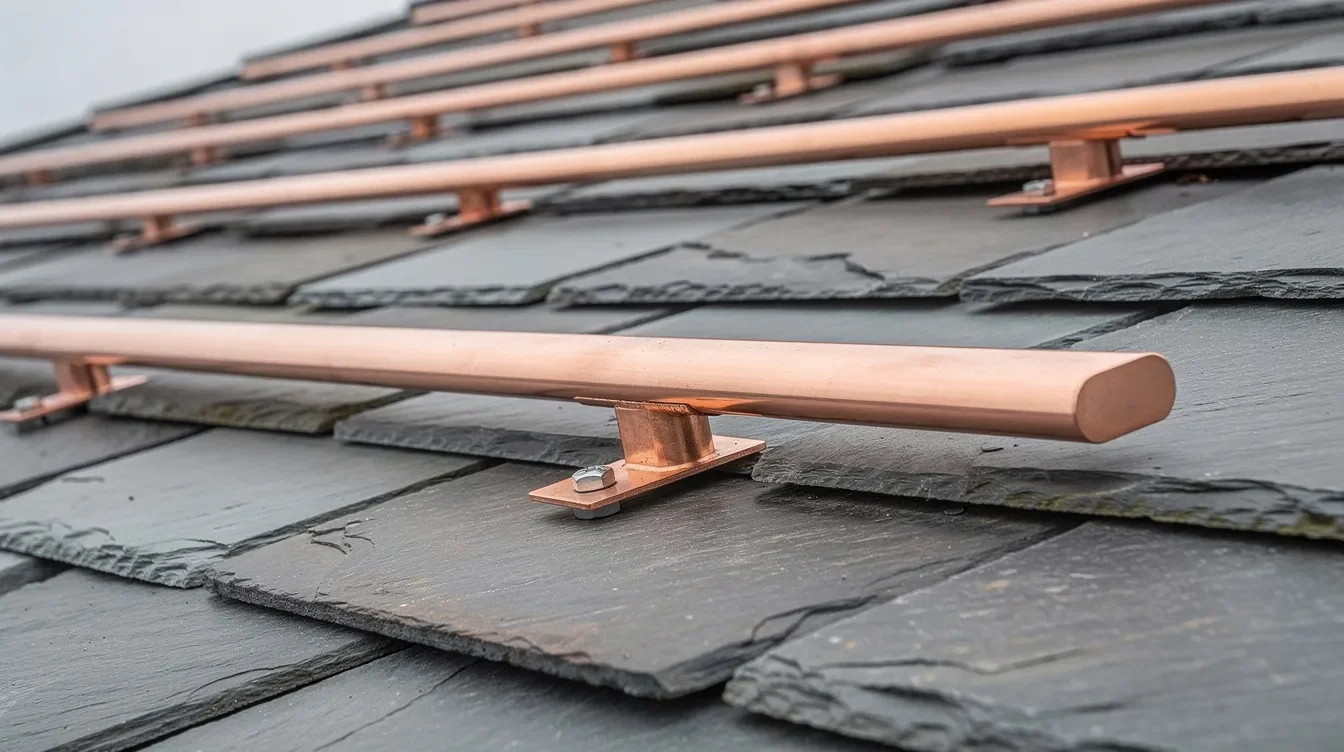
A lot of roofs use both. Pads cover the field. A rail or a bar sits just above the eave, or above a walk, where a miss would cost more.
Best Snow Guards for a Slate Roof, Including Copper
What to buy for a given house isn’t a single product. Guard designs have to fit the properties of slate. The stone is brittle and smooth, and the fastening has to go under the tile or into the deck, not through the face.
Copper snow guards are highly recommended for slate roofs, especially where the valleys and gutters are already copper. Copper blends with the stone as it weathers, and it doesn’t react with slate. Material compatibility still matters around the other metals on the roof. Never put copper tight against aluminum or galvanized steel without a separator, or you get galvanic corrosion. Fasteners should match the guard. More on metals and coatings, plus layout charts, is in the copper snow guards post.
Color comes with the metal. Bare copper goes brown, then green. If you want a gray that stays closer to the slate, some makers offer coated copper. The guard still has to be a type that can be installed without breaking the slate. Those options, plus the layout, are what you’re actually choosing.
Snow Guards Slate Roof Layout by Pitch and Load
Snow should be held in staggered rows so the weight is distributed and there isn’t a clear path down the slope. A common starting pattern from one manufacturer is three rows near the eave, with the middle row shifted so the pads don’t line up. Longer rafters and heavier snow add rows higher up. Don’t invent a spacing. A gap in the pattern is how a slide starts to run.
Identify the areas under the roof where people walk or park. Doors and lower roofs in the drop zone count too. Those are the lines that can’t be left open. Then work from the eave up, following the manufacturer’s layout for your roof pitch and snow load. You can receive a layout from the manufacturer once they have the pitch and the rafter length, along with the snow load for your town.
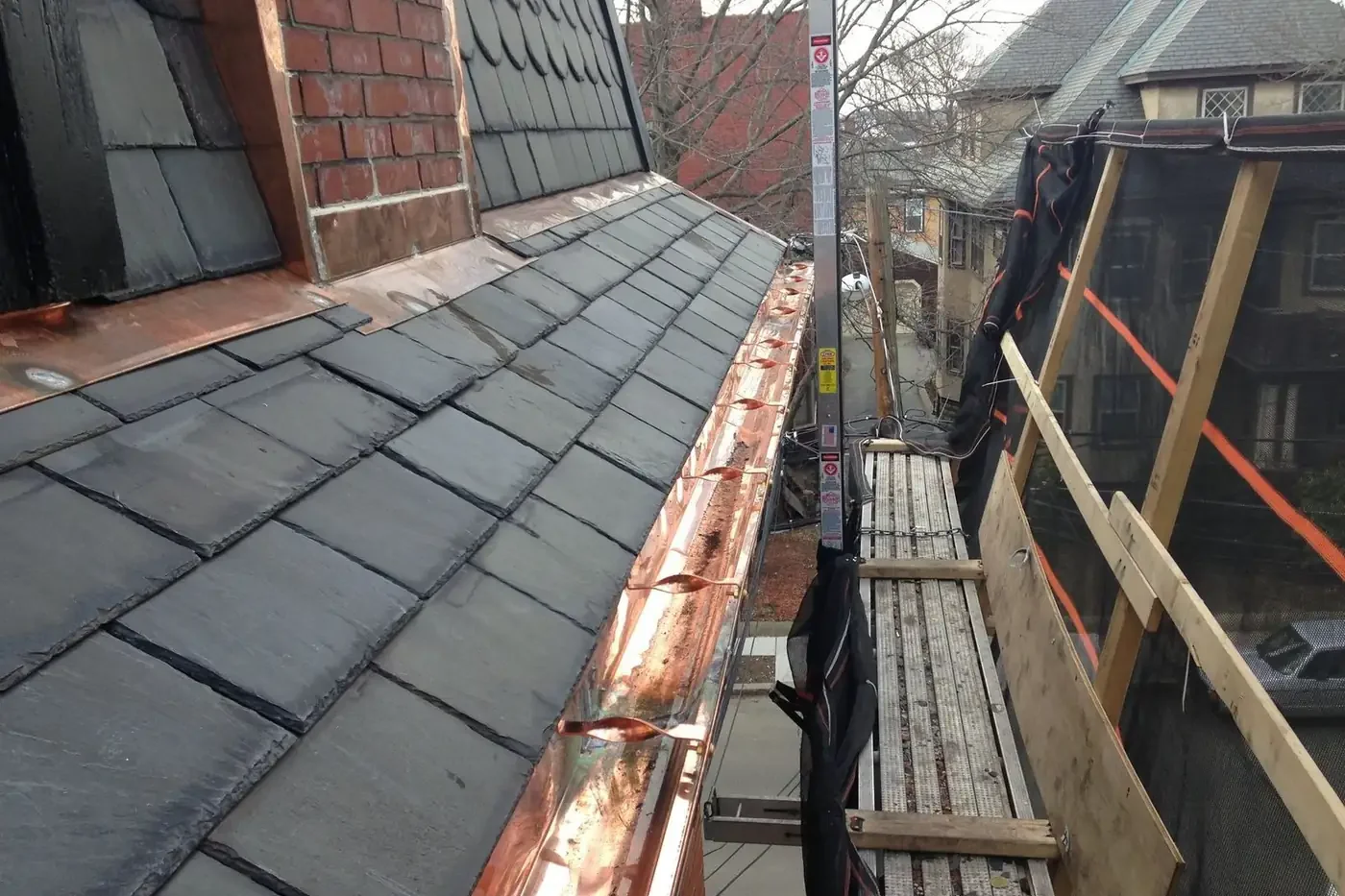
Guards help spread snow weight across the roofing system by keeping the pack in place on the field, instead of letting it all fetch up at the eave or come off in one run. They do not add strength to the rafters.
How to Install Snow Guards on New and Existing Slate
The install is what decides whether a guard holds or a slate ends up cracked. You cannot drill a screw through the face of a slate and expect it to last. The tile will crack, often not on the day you do it, and then it leaks.
On a new roof the straps or hooks go in as the slate is laid, fastened to the deck with copper or bronze copper roofing nails that match the rest of the roof. Straps have to fit the thickness of the slate so the course above lies flat.
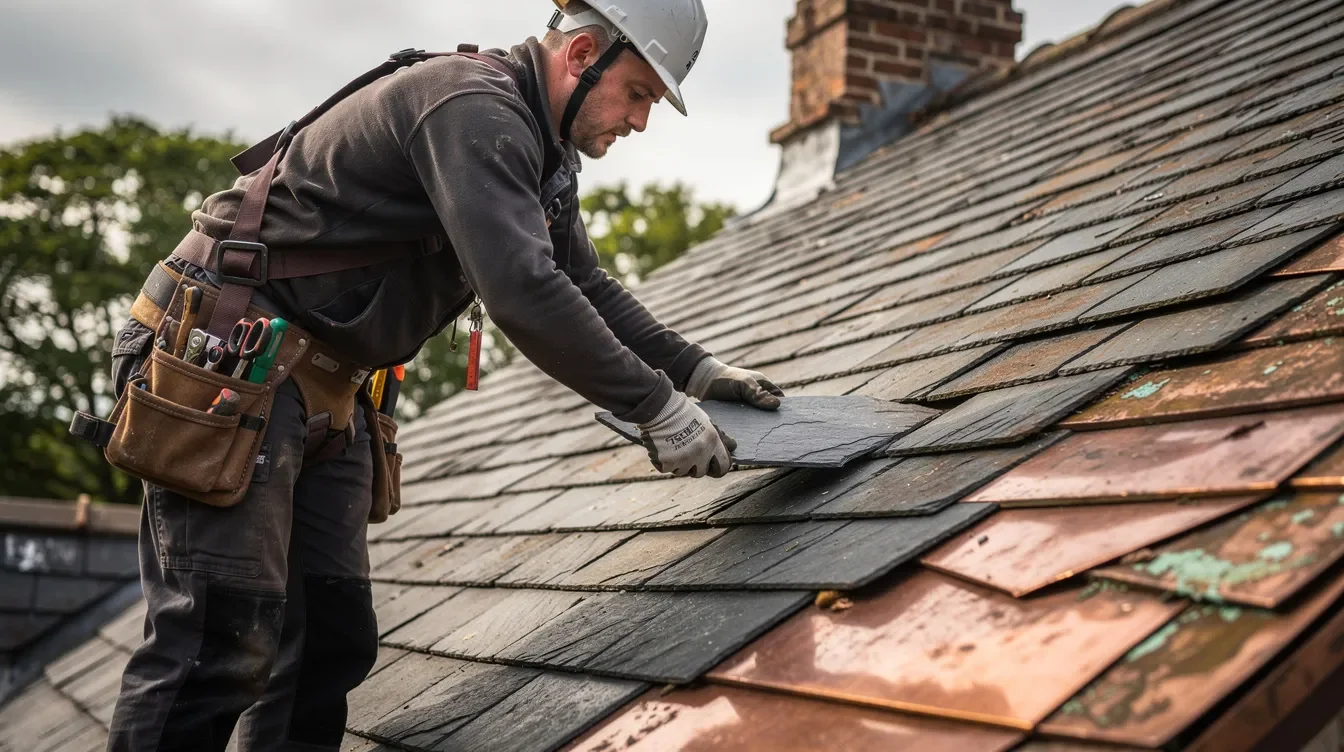
On an existing roof the methods vary, but the idea is the same. Get the strap under the course above without nailing through the face. Some guards slide in or strap under the slate and hook on a nail. That retrofit is doable, and it isn’t easy. The slate is brittle. A contractor who works in slate will lift individual tiles, slip the strap in, and have matching replacement pieces ready if one breaks. Lifting old slate without breaking it takes experience. Clamp-on hardware is for adjacent metal roofs, not for natural slate.
These are the mistakes that show up most:
- Screws through the face of the slate
- Dissimilar metals that start galvanic corrosion
- Spacing that’s too wide, which leaves a path for a slide
- Guards set only at the eave on a long, steep slope
These systems are designed to hold snow, not to make up for a thin deck. Once the guards are installed, check them after a heavy winter. Look for a bent or missing piece, or a slate that’s slipped next to one.
What Snow Retention Does Not Do
A warning belongs here. Snow guards do not prevent ice dams, and they do not increase the roof’s load capacity. They manage how snow and ice leave the roof. They don’t change whether meltwater freezes at a cold eave. If you get heavy icicles, the cause is usually heat escaping into a cold eave. An ice melt system is a separate fix. The same is true of ice dam prevention work at the eaves.
They also don’t remove the need to keep gutters and downspouts clear. Retained snow that can melt slowly still has to drain. If the outlet is clogged, that water sits at the eave.
What they do is protect people and property from a sudden slide. The job is to hold the snow. That stops a roof avalanche, and it keeps a winter thaw from sending snow slides onto the walk. Keep that in mind in the spring, when it’s safer to get on the roof and look. There’s some peace in knowing the walk is clear, but only if the layout was honest in the first place.
Talk to the Owner
Snow guards are a small part of a roof, but they decide where a few tons of snow end up. Whether you need them, and which type, depends on the roof and what’s under the eaves of the home. Homeowners usually ask after the first slide comes close to a walk or a car.
Our work is slate and copper roofing in Greater Boston. See our slate and copper roofing page. Snow guards aren’t listed as their own service, so ask about your roof directly. The estimate is free. Request a free estimate or call 617-913-1130.
We’re Art Slate Roofing, LLC, at 22 Clarendon St #2, Malden, MA 02148. Licensed and insured, MHIC #176393, rated 4.8 across 24 Google reviews.
Frequently Asked Questions
Do I Need Snow Guards on a Slate Roof?
A steep slate roof with a walk under the eave is the usual case for them. A driveway or a door under that same eave is too. The stone is smooth, and once a melt layer forms under the pack, the snow can come off in one slab. That slide is what tears gutters loose and what puts people at risk on the sidewalk. A lower pitch still deserves a look if anything valuable sits in the drop zone, or if a lower roof would take the hit. The roof pitch and the snow load for your town drive how many rows you need, and whether pads are enough or a rail belongs at the eave. A short eave over a garden bed is a different problem than a three-story wall over a sidewalk.
How Do Snow Guards Work on a Slate Roof?
They don’t melt the snow. They hold it so the pack stays on the field and the snow melts a little at a time. Pad style snow guards create friction in staggered rows, which breaks the pack into smaller areas that can’t run as one sheet. A rail or a bar makes a continuous barrier, usually near the eave, and a pipe system does the same job. That line is what you want where the load is heavy or the slope is long. None of this increases the load the rafters can carry. The roof has to already be able to hold the design snow load, because the guards keep that weight in place until it drains.
Can You Install Snow Guards on an Existing Slate Roof?
Work on an existing roof is a retrofit, and the method has to protect the slate. You don’t drill through the face of a tile. The usual approach is a strap or hook that slides under the course above and fastens to the deck, or hooks on a nail, without a hole in the exposed face. On a new roof the same strap goes in as the slate is laid, which is simpler. On an old roof, individual slates have to be lifted, and some of them will be brittle enough to break, so matching pieces should be on hand. It isn’t a weekend project for someone who hasn’t worked in slate. Ask a slate contractor to look at the thickness and the nailing, and to check the condition, before anyone starts.
Do Snow Guards Prevent Ice Dams?
Ice dams form when heat from the house melts snow on the upper roof and the water refreezes at a cold eave. Snow guards don’t change that. They can actually keep more snow on the roof, which is the opposite of clearing the eave. If you have heavy icicles, look at insulation, ventilation, and, where it’s warranted, an ice melt system along the problem eaves and valleys. Guards still have a job in that picture. They keep a sudden slide from ripping the gutter or the heat cable on the way down. Treat the two problems separately. One is retention. The other is meltwater that has nowhere to go but into the roof edge.
When Are Rail or Bar Systems the Right Choice?
Rail and bar systems are the usual pick where the snow load is heavy or the rafters are long, and where a miss would land on a walk or a driveway. A continuous barrier at the eave holds a larger sheet than a row of pads, which is why bar systems are used for heavier loads than pad style guards. Pads can still cover the field above that line, and many roofs end up with both. Pipe-style systems do the same job with a pipe on brackets. That choice should come from the manufacturer’s layout for your pitch and load, not from a photo of a pretty rail. On most older residential slate around Boston, pads do the wide coverage and a bar is added only where the risk is highest.
Why Are Copper Snow Guards Recommended for Slate?
Copper is already on most of these roofs. It shows up in the valleys and the flashings, and often in the gutters. A copper guard weathers with that metal, from brown to green, and it doesn’t react with the slate itself. Copper snow guards are highly recommended for slate roofs for that reason. The catch is compatibility with everything else. Copper against aluminum or galvanized steel will set up galvanic corrosion. The fasteners and any adjacent metal have to match, or they need a separator. Galvanized pads cost less and can stain the slate with rust. See the copper snow guards guide on this site for the metals and the coatings. Specific models are in that post too.