Gutter End Cap Guide: Which Type to Buy and How to Seal It
Gutter end cap basics for homeowners. How left and right K style caps differ, why gutter metals shouldn't mix, and how a cap gets riveted and sealed.
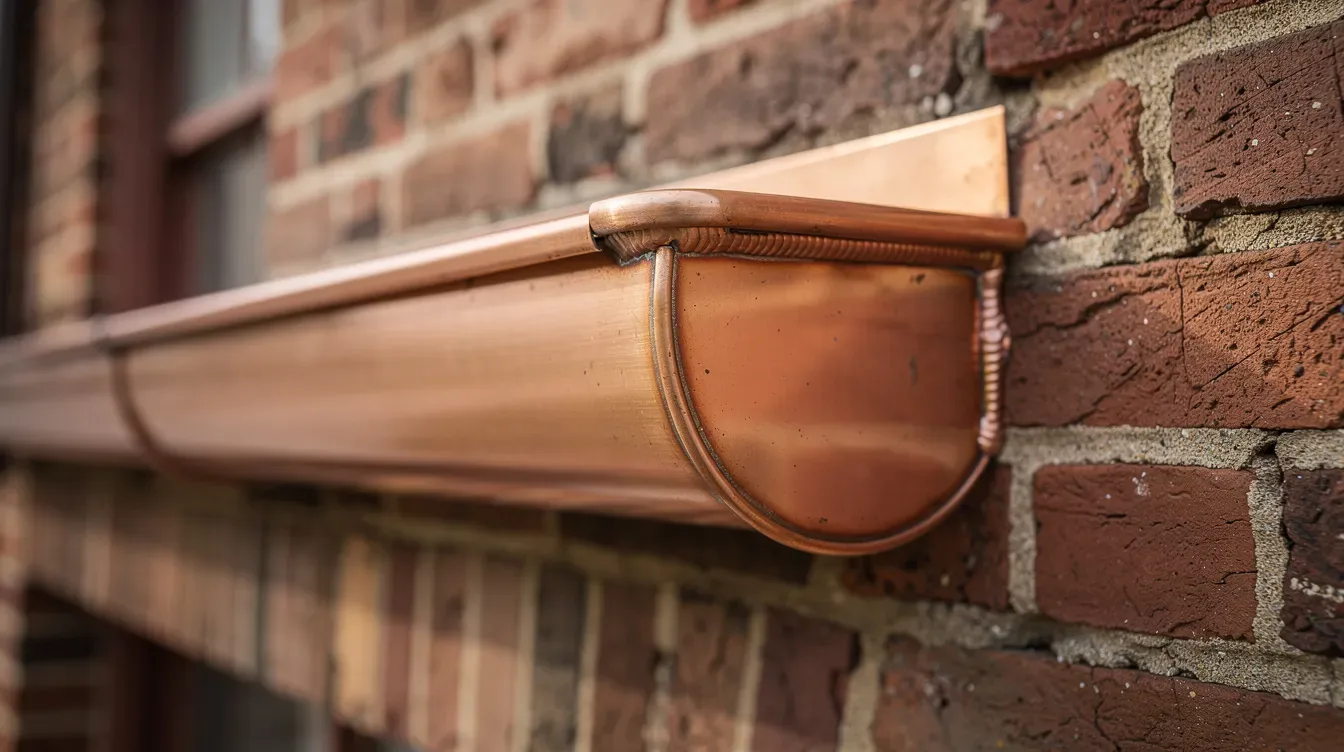
TL;DR: A gutter end cap closes the open end of a gutter run so water stays in the trough until it reaches the downspout. It has to match the gutter's profile, size and metal, and on K style gutters the hand, left or right. Rivets or screws hold it on and gutter sealant on the inside seam keeps water in. Copper caps are soldered. Check the ends of each run after storms.
Gutters · 9 min read
Rain comes off the roof, drops into the gutter, and runs toward the downspout. At the far end of the run there’s nothing to stop it going sideways, except the gutter end cap. When that little piece fails, the water goes down the fascia instead of the downspout.
Search results for the term also mix in electrical parts. Those are wireway end caps, which close the end of a metal raceway indoors, nowhere near rain. This post covers only the gutter kind.
What a Gutter End Cap Does on a Boston Roof
Most houses have a few. Any run that stops at a porch or a bay, or at a blank stretch of eave, needs one. Corners and outlets get their own fittings, so the caps only go on the plain dead ends.
When a gutter end cap leaks, the evidence is usually below it. Look for a drip line on the fascia, a thin dark stripe running straight down from the end of the gutter. On brick or siding there’s a black or green mildew streak in the same spot, because that wall stays damp after every rain. If the cap or its rivets are steel, a rust bloom shows up at the seam, an orange stain bleeding downward.
Painted wood goes next. The paint blisters and the fascia goes soft, and after enough winters the board rots. In January the drip freezes into an ice patch on the step below.
The sealant on a gutter end cap gives out first. It cracks and pulls away from the metal. Our gutter leaking into house post covers the other ways water gets out of a gutter system.
Gutter End Cap Types and the Gutters They Fit
K style has a flat back and a shaped front, usually an ogee curve. It’s the profile on most newer houses. Its caps are formed to match and come in aluminum or steel, in painted colors.
Half round is a plain half circle, the kind you see on Victorians and brick rowhouses. It takes half round caps. Our half round gutters post covers the profile.
Vinyl gutters use molded caps sized to one maker’s system, so they don’t swap with another maker’s.
Box gutters sit inside the cornice, lined with metal (often copper), and the ends are cut for the building. Nothing in a catalog fits most of them. Someone cuts a piece and joins it to the liner the same way the rest of the liner is joined, which our box gutters post goes into.
How to Match a Gutter End Cap to the Gutter
Profile and Size of a Gutter End Cap
Profile first. A K style cap won’t close a half round gutter, even when both say 5 inch on the box. Residential gutters are mostly 5 inch or 6 inch wide, and 5 inch K style is the one you see most. Put a 5 inch cap in a 6 inch gutter and there’s an inch of gap for sealant to fill, which it won’t do for long. Older and bigger buildings can have other widths, so put a tape measure on the gutter itself. Don’t guess.
Left and Right Hand on a Gutter End Cap
K style isn’t the same front to back, with a flat wall on one side and a shaped face on the other. That makes the cap for the left end a different piece from the cap for the right end. Gutter Supply says most metal K style caps are sold as separate left and right pieces, and that you should match the cap to the end of the installed gutter, not to which side you’re standing on. Flip a left cap over and it still isn’t a right one. It won’t seat.
Ordering a Gutter End Cap Online
The reviews on a product listing rarely say which hand the gutter end cap is. Before the items go in the cart, check profile and size, then metal, then hand, against the gutter on the house. Any customer ordering from a supply house should have those answers ready, and a photo of the old cap helps. A stock cap that nearly fits is how you end up with a gap. Other gutter accessories, like hangers and outlets, are sold by profile too.
Gutter End Cap Materials and Galvanic Corrosion
Aluminum and Steel as Gutter End Cap Metals
Aluminum is the usual metal for a K style gutter end cap. It’s light, and it doesn’t rust the way steel does, though it can still corrode. It also moves with temperature. Our galvanized gutters post works out the numbers: over a 100 degree swing, a 30 foot aluminum run grows about half an inch, and steel about a quarter inch. That movement lands on the joints, and a cap is a joint. Heavier gauge caps resist denting better than thin ones. Crimping alone doesn’t make an aluminum cap watertight.
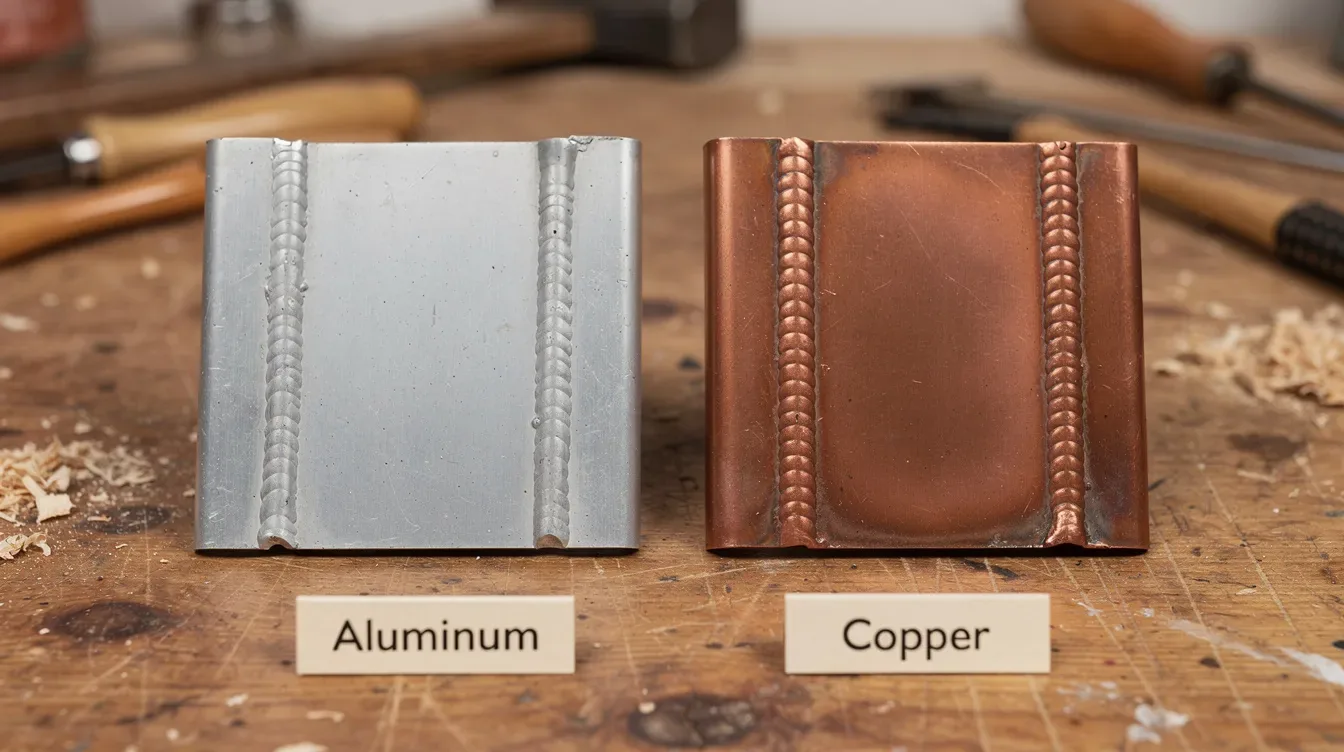
Galvanic corrosion starts when two different metals touch while water sits on them. The less noble one loses. The Copper Development Association Inc. ranks aluminum at the low end of its list and copper at the high end, so on a copper gutter the aluminum cap is what gets eaten. Copper wash running onto bare aluminum can speed that up, since traces of copper salts are in it.
Steel is a smaller problem. The handbook says iron and steel are generally fine against copper unless the steel is similar in mass or smaller, and a steel rivet or a small steel cap is exactly that. So a steel gutter gets a steel cap. A copper gutter gets a copper cap and copper or compatible fasteners. Where two metals have to meet, the handbook describes gaskets or tape, or a compatible primer.
Copper Gutter End Cap Joints
Copper gutters are traditionally joined with lapped seams that get riveted and then soldered. The solder is what makes the joint watertight. Rivets hold the metal but don’t seal it. Angi puts copper gutter life at 50 to 100 years, and that range assumes the joints are made properly.
How a Gutter End Cap Gets Fastened and Sealed
Fasteners and Sealant on a Gutter End Cap
Fasteners hold the cap on and sealant keeps the water in. They’re two jobs. Gutter Supply is blunt about it: sealant doesn’t replace the fasteners or the solder. A rivet or screw alone doesn’t seal the joint either. Caulk by itself eventually lets go, because it’s trying to hold a joint that moves.
For an aluminum K style cap the order goes like this:
- Scrape off any failed sealant, then wipe the gutter end clean and dry.
- Dry-fit the cap. Check the hand, and check that the whole cap seats against the gutter.
- Run gutter sealant along the inside seam.
- Press the cap on and hold it square.
- Rivet or screw through the back and the side returns. Skip the trough floor, since a hole there sits in standing water, and skip the visible front.
- Smooth the squeezed-out sealant into the seam, cover the rivet heads inside the gutter, let it cure, then run a hose in from the far end.
Look for a snug fit with enough flange left to crimp or screw. If the sealant has to bridge a gap, the cap is wrong or the gutter end is bent. Don’t use a cap to pull a twisted gutter back into line. Pick a sealant sold for gutters and compatible with both metals. This Old House recommends butyl gutter caulk on a clean, dry seam.
Pitch and Soldering Near a Gutter End Cap
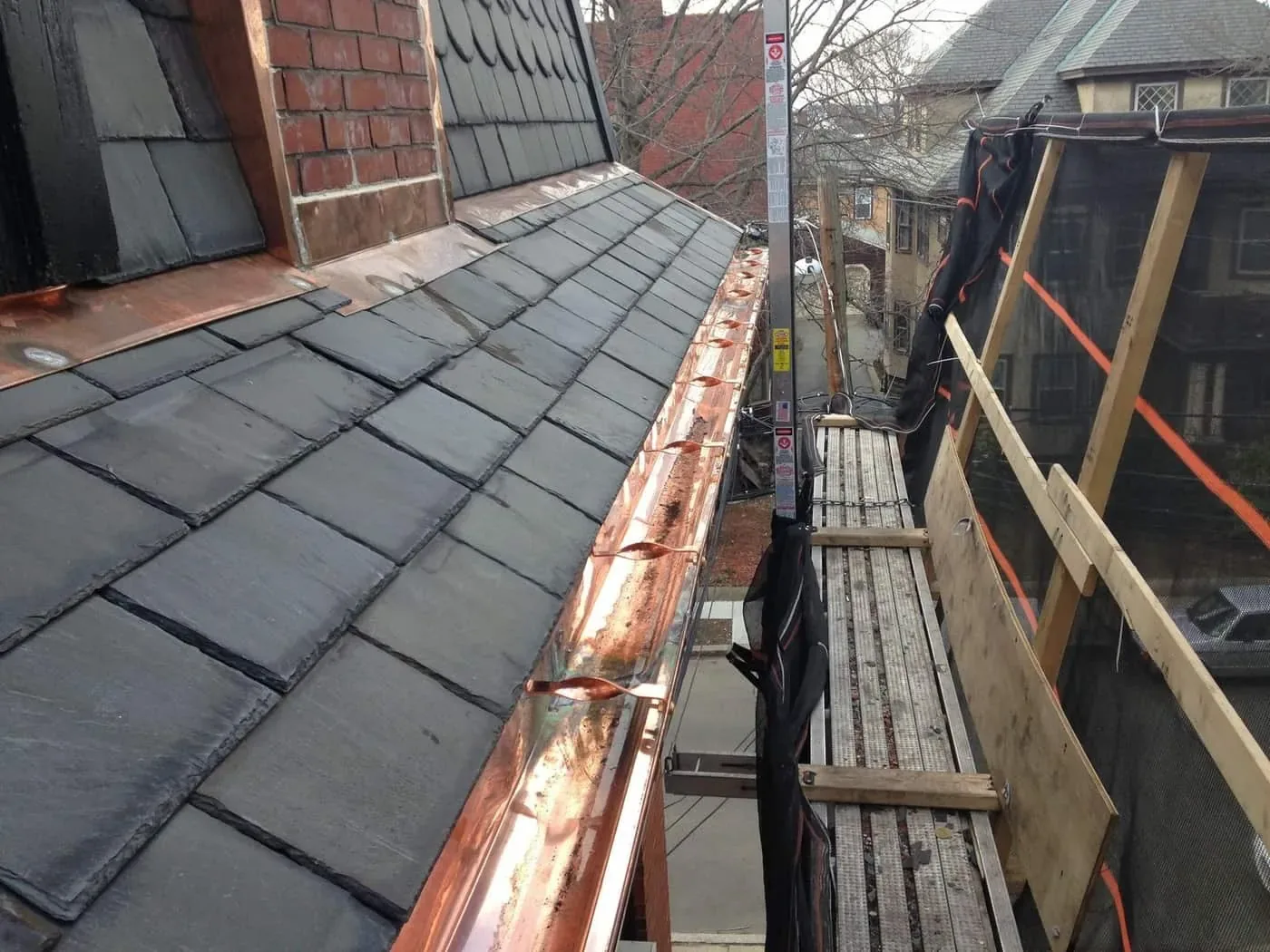
On copper the cap gets soldered. Both surfaces are cleaned and fluxed, and the solder flows into the seam. Too much heat scorches nearby trim or cracks a slate, so it’s slow work at a roof edge.
The end of a run shouldn’t hold water. Gutters should fall about 1/4 inch per 10 feet toward the outlet, the figure This Old House gives. On a 30 foot run that’s 3/4 inch of drop. Pitch it the wrong way and the water leans on the cap and its seam.
Gutter End Cap Problems and Warning Signs
What goes wrong, mostly:
- Sealant that has cracked or pulled away from the inside seam
- A cap knocked loose by ice, a snow slide off a metal or slate roof, or a ladder leaned on the gutter
- A universal cap forced onto the wrong profile, leaking at the corners
- An aluminum cap or a steel rivet on a copper gutter, with corrosion around the joint
- Caulk used where a rivet or solder should have been
From the ground, check the end of each run during a rain. Water coming off the very end means the cap isn’t holding. After the rain, look for the drip line on the fascia, the mildew streak on the wall, and a rust bloom on steel parts. On aluminum next to copper, look for a white chalky crust. Soft paint or moss at the corner of the eave is another sign, and so is ice on the steps below a gutter end in February.
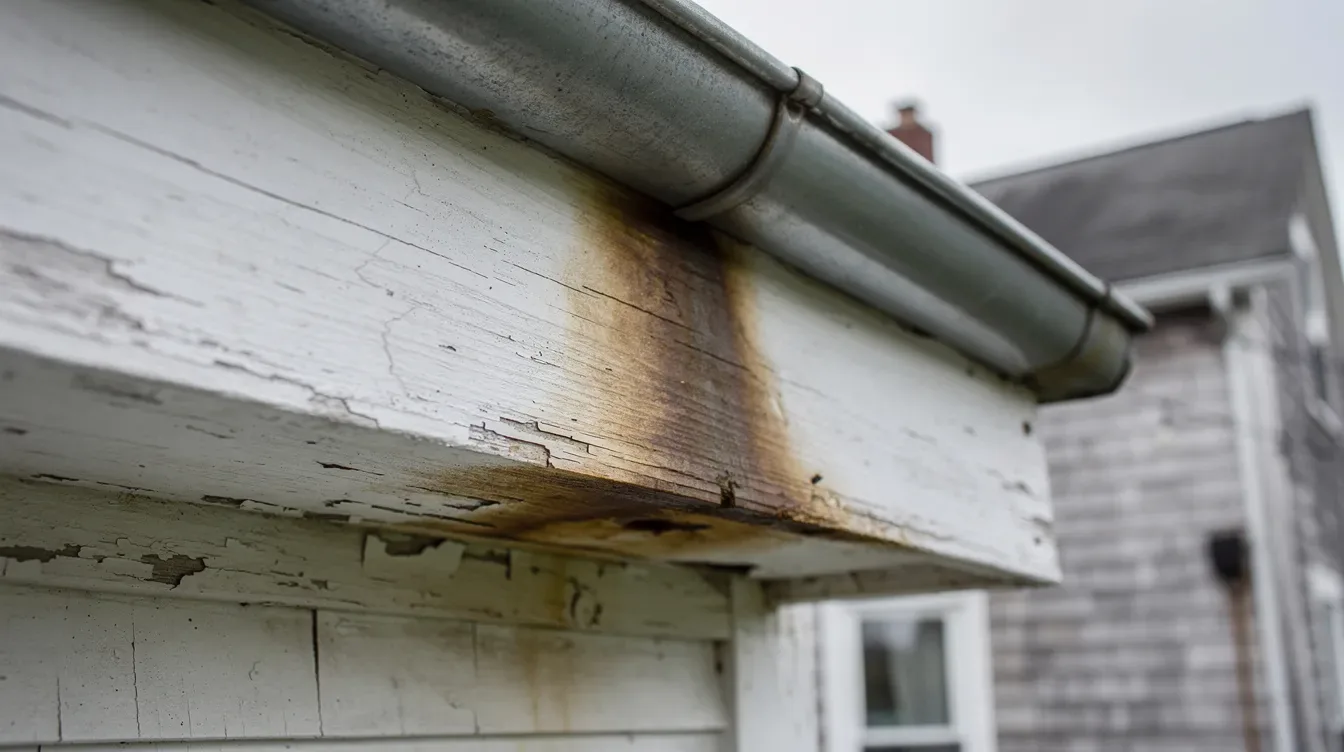
A leak at a cap starts as a stain outside. Then the fascia gets wet and the soffit follows. In bad cases the water follows the wall into the house. Resealing or replacing a gutter end cap is a small repair. Replacing rotted boards is a bigger one. Our gutter repair page explains what that work involves.
Maintaining a Gutter End Cap and When to Hire It Out
After a big storm, look at the ends of the runs from the ground for drips, a cap that has shifted, or a gutter pulled out of line. Look again in fall once the leaves are down and before the first freeze, since the gutters need cleaning then anyway and the ends of the runs can be checked in the same pass. On aluminum, reseal a cap when the sealant cracks, because the inside seam is where it fails. Copper solder joints rarely need work.
Swapping a gutter end cap at a porch roof, from a sturdy ladder, with a rivet tool and a tube of sealant, is a job plenty of homeowners do themselves. Up at a second story eave it’s different. So is a slate roof, where a boot can break a slate, and so is soldering a copper gutter next to wood trim, where the torch is a fire risk.
On an older house the cap also has to look right. On an aged copper gutter, a bright aluminum cap shows from the street. Matching the profile and the metal is what keeps the original look of a historic house, and roofers who work on them tend to carry fittings made for specific profiles and use rivets and sealant matched to the metal.
Talk to the Owner
If water is getting out at the end of a gutter, or a run is pulling off the fascia, it’s often easier to look at it in the yard than to sort it out over the phone.
If you have questions about the gutters or the roof on your house, start at our gutter repair page or contact us. You can also call 617-913-1130.
We’re Art Slate Roofing, LLC, at 22 Clarendon St #2, Malden, MA 02148. Licensed and insured, MHIC #176393, rated 4.8 across 24 Google reviews.
Frequently Asked Questions
What Does a Gutter End Cap Do?
It plugs the open end of a gutter run. Without one, water reaches the end of the trough and pours out the side and down the fascia. Corners use miters and outlets use their own fittings, so end caps cover only the plain dead ends, like where a run stops at a porch roof. A failed one leaves a drip line on the fascia and a mildew streak on the wall under it, and in January it can leave ice on the steps below.
How Do I Pick the Right Gutter End Cap?
Start with what’s on the house. Measure the gutter width, which is usually 5 inch or 6 inch, and see whether the profile is K style or half round. Check the metal too, since copper shouldn’t touch aluminum. On K style, hold the cap’s flat edge against the gutter’s flat back to get the hand right. A 5 inch K style cap won’t close a 6 inch gutter or a half round one, and sealant can’t make up the difference. Photograph the old cap before you toss it, and bring the photo when you shop.
Are Gutter End Caps Left and Right?
On K style gutters, usually. The flat back and the shaped front sit on opposite sides, so a cap made for one end of a run doesn’t fit the other end. Most metal K style caps are sold as separate left and right pieces. Flipping a left cap over won’t turn it into a right one. Gutter Supply says to match the cap to the end of the installed gutter and not to whichever side you happen to be standing on, which trips up a lot of people at the ladder. Dry-fit before sealing, so a wrong hand shows up while the sealant is still in the tube. The cap’s flat edge goes against the gutter’s flat back and its shaped face goes to the front, and when both line up the cap seats without forcing. Check the listing for hand before ordering.
Can I Seal a Gutter End Cap With Caulk Alone?
You can, but it tends to leak sooner or later. Gutters move with every hot afternoon and cold night, and caulk alone is holding a joint that moves. Rivets or screws hold the cap on, and gutter sealant on the inside seam keeps the water in. Gutter Supply says sealant doesn’t replace the fasteners or the solder, and that a rivet or screw alone doesn’t seal the joint either. On a K style cap the rivets go through the back and the side returns, after the sealant has been run along the inside seam.
Can I Put an Aluminum Gutter End Cap on a Copper Gutter?
Better not to. Where the two metals touch and water is present, the aluminum is what corrodes, and the early sign is a white chalky crust at the joint. Copper Development Association Inc. also says water running off copper shouldn’t drain onto bare aluminum, since traces of copper salts can speed up the damage. A copper gutter should get a soldered copper cap with copper fasteners. If a mix can’t be avoided, the group’s handbook describes gaskets or tape, or a compatible primer, between the metals.
Is an Electrical Wireway End Cap the Same as a Gutter End Cap?
The names match and the parts don’t. A wireway end cap closes the open end of an electrical raceway indoors, where it never meets rain. Gutter end caps close a trough that carries roof water outdoors, so they deal with ice and a wide temperature swing too. Sizes listed for electrical parts, or for vinyl gutter parts, don’t carry over to a metal K style gutter. Make sure a listing says gutter, and that it names the profile and the size before anything goes in the cart.