Galvanized Gutters on Older Boston Homes: Sizes, Profiles, Costs and Care
Galvanized gutters explained: what G90 zinc does, K style vs half round, 5 to 8 inch sizes, gauge, 2026 costs per foot, installation, painting and lifespan.
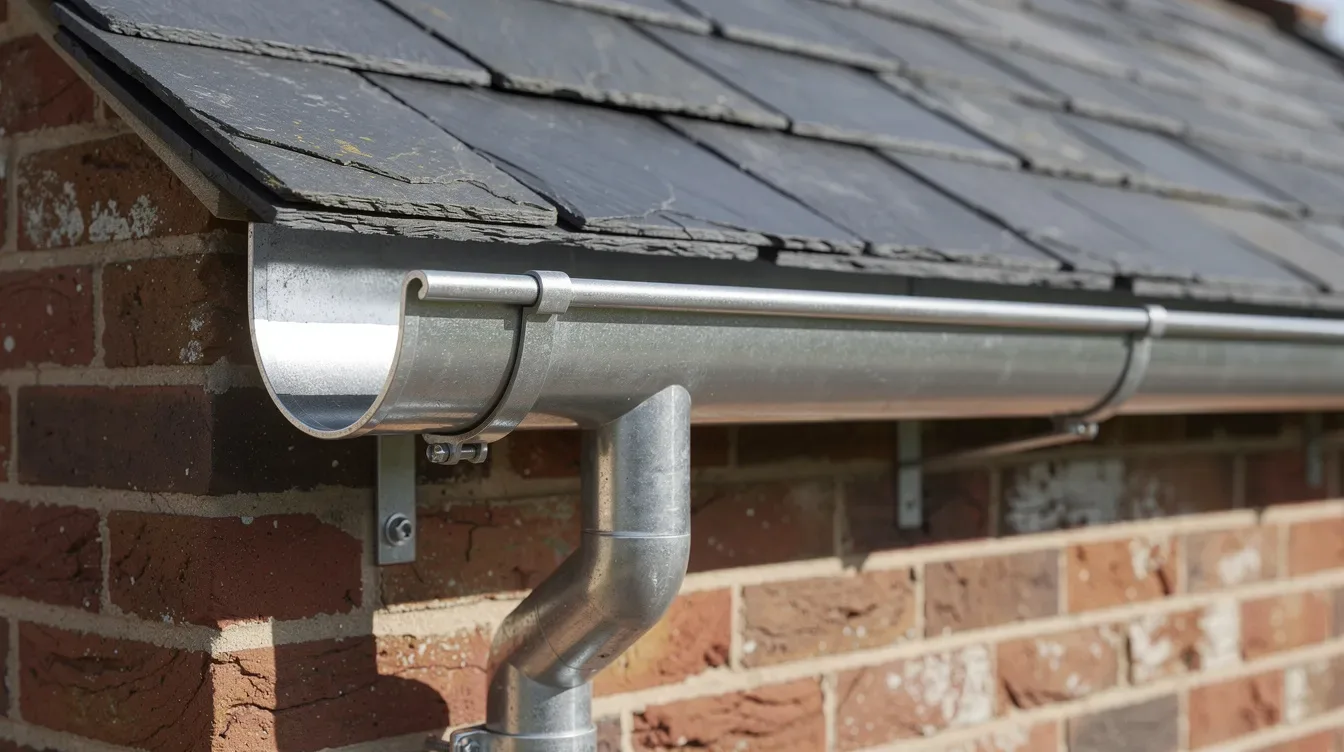
TL;DR: Galvanized gutters are steel troughs coated in zinc. The zinc corrodes first to protect the steel, then weathers to a dull gray. Steel is stiffer than aluminum and takes ice and knocks better, but it rusts once the zinc wears through. NAHB gives galvanized steel gutters about 20 years and Angi says 15 to 20. Angi's May 2026 figures put materials at $3 to $8 a foot and labor at $2 to $6. K style is the common profile and half round the traditional one. Either way the pitch, the hangers and the cleaning decide how long they last.
Gutters · 14 min read
Galvanized steel is the gutter metal nobody talks about. Copper gets the attention on old Boston houses. Aluminum is what most crews hang because it’s light and cheap. Steel sits between them, costs a little more than aluminum and a lot less than copper, and it’s tougher than people give it credit for.
It fails in predictable ways. The zinc wears off. Then the steel rusts.
First comes what the coating does, then the two gutter profiles. After that I get into sizes and gauge. Installation and 2026 pricing follow, and upkeep is last. The cost figures are Angi’s. What the zinc does comes from the American Galvanizers Association (AGA), and the lifespan numbers lean on the NAHB life expectancy study. InterNACHI and This Old House fill in the installation details, and gutter makers like Berger publish the catalogs I checked sizes against. One more thing before we start. Our own gutter page says half round copper is our standard on older homes, with K style aluminum as the practical fallback. Galvanized isn’t on that list, so take this as a plain explainer and not a pitch for steel.
What galvanized gutters are made of
Start with plain carbon steel sheet. It runs through a bath of molten zinc, comes out coated on both faces, and gets roll formed into a gutter. Most gutter steel is sold as G90. That means 0.90 ounce of zinc per square foot of sheet, with both sides counted together. I’ve seen it described as 0.90 ounce per side. It isn’t.
The zinc protects the steel in two ways. It’s a skin that keeps water off the metal. And zinc is more reactive than steel, so when both get wet the zinc corrodes in place of the steel. The AGA calls this sacrificial or cathodic protection. A small scratch doesn’t rust right away because the zinc around it covers for it. The AGA says a bare spot up to about a quarter inch across stays protected until the zinc around it is used up. That figure is for thick hot dip coatings on structural steel, though. Gutter sheet carries far less zinc, so I wouldn’t count on that much margin.
Shiny doesn’t last. Out in the weather the zinc builds a thin film. Oxides form first, then a tight carbonate layer that slows further corrosion. According to the AGA, galvanized steel weathers to a uniform matte gray, usually within six months to two years depending on exposure. If you like the bright metal look, enjoy that first season.
Why steel gutters hold up in a Boston winter
Steel is stiff. A falling branch or a slide of ice off a slate roof will dent aluminum where steel often just shrugs it off. Load matters too. A run packed with slush is heavy, and our gutter cost guide points out that steel takes ice load better than aluminum. That same capacity helps in heavy rainfall, as long as the hangers are screwed into sound wood and spaced for the weight, because a strong trough on weak hangers just fails at the hangers instead.
It moves less with temperature. For the same swing, steel expands roughly half as much as aluminum. Over a 100 degree change, from a January night to a July afternoon in full sun, a 30 foot steel run grows about a quarter inch. Aluminum grows about half an inch. Less movement means less strain on joints and end caps every year. Vinyl is the weak one in the cold, since This Old House notes that plastic turns brittle in extreme cold.
People oversell the fire point. Steel doesn’t burn, and it won’t sag and drip in a house fire the way vinyl does. The zinc is another matter. It melts at about 787°F, so a real fire will cook the coating off, and you’d be replacing that gutter anyway.
The downsides are simple. Steel is heavy, so it needs solid fascia and good hangers. Once the zinc is gone it rusts, and the rust spreads from cut ends and screw holes.
How long galvanized steel gutters last
The NAHB life expectancy study gives galvanized steel gutters 20 years. Angi’s gutter guide says 15 to 20, the range on our cost guide. You’ll also see 20 to 30 quoted, including on Angi’s page about one piece gutters. Treat that as the top of the range, the number you get from steel that’s cleaned every spring and fall, touched up the first time bare metal shows, and kept painted if it was painted to begin with. Location matters too. Salt air near the harbor pulls it the other way.
For comparison, Angi gives aluminum about 25 years and copper 50 to 100. Which metal you choose comes down to climate and budget. Your taste counts too.
Gutter profiles on galvanized steel
Two shapes cover nearly every house.
K style gutters
A K style gutter has a flat back against the fascia and a flat bottom. The front is shaped a bit like crown molding. Angi calls it the most common type. In galvanized it’s also the cheaper one, about $5 to $8 a foot installed against $8 to $12 for half round in Angi’s 2026 galvanized guide. Hidden hangers inside the trough screw it to the fascia.
Those inside corners in the shape catch leaves and roof grit. Plan on cleaning.
Half round gutters and the bead
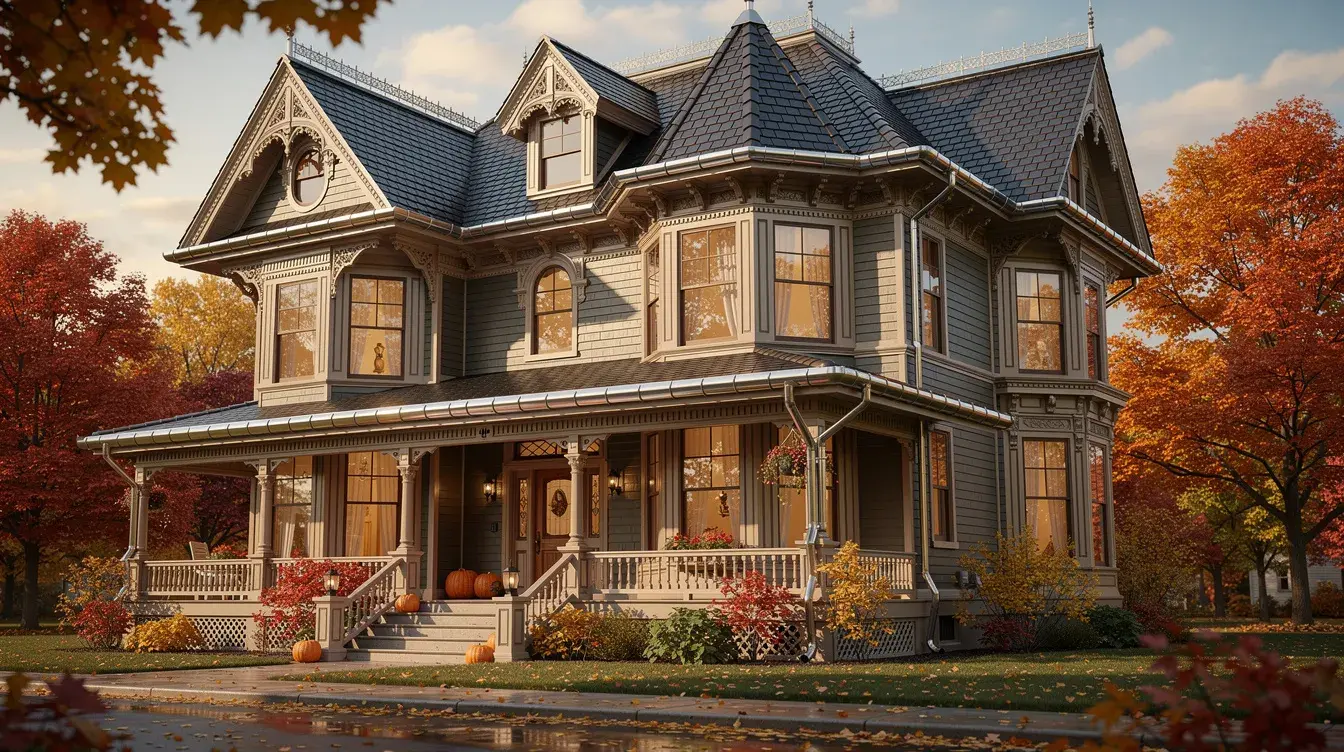
Half round gutters are a plain half circle hung on brackets or hidden hangers. They’re the period look on Victorians and brick rowhouses, and on anything with slate. In a historic district the commission may want to review any change you can see from the street, so check before you order. Our half round gutter guide goes deeper on that.
The rolled lip along the edge is called the bead. You’ll read that galvanized half round has a single bead on the outer edge. Plenty does. Not all of it, though. Berger’s catalog lists half round in single bead and double bead. It also lists reverse bead. Those bead options matter, because the brackets and end caps have to match whichever you pick. Gauge varies too. Berger makes its galvanized half round in 26 gauge, and its catalog lists steel gutter in 24 and 28 gauge as well. Lower numbers are thicker. In areas where the runs are long and the snow sits, 24 gauge is the stiffer pick.
Sizes, gauge and section lengths
Galvanized gutters come in 5, 6, 7 and 8 inch widths, and Berger lists its galvanized half round in all four. Five and six inch cover most houses. The bigger two are for large roofs, steep slopes that throw a lot of water and commercial buildings. Size it from the roof itself. Area and pitch matter, and so does local rainfall. Habit shouldn’t. Angi prices oversized gutters at $10 to $15 a foot.
Sectional steel comes in 10 or 20 foot lengths. Berger’s standard galvanized half round is 10 feet, and sellers like Gutter Supply offer that same line in 10 and 20 foot pieces. Longer sections mean fewer field joints, and every joint you skip is one less place to leak. There’s one piece steel too, formed on site to the full length of each run. Angi lists the gutter itself at $8 to $10 a foot that way, with labor on top.
Round downspouts or rectangular
Downspout selection follows the profile. K style takes rectangular downspouts in 2x3 or 3x4 inch sizes. Half round takes round downspouts, which are usually 3 inch or 4 inch across. InterNACHI’s moisture intrusion guide calls a 5 inch K style with 2x3 downspouts the common setup, and suggests one downspout serve no more than about 50 feet of gutter. Bigger roofs need more outlets or bigger downspouts. At the bottom, InterNACHI wants water carried 4 to 6 feet from the foundation. Plan extensions that won’t wash out the landscaping.
Galvanized steel gutter installation, step by step
Slope comes first. Then downspout size, then how well the thing is fastened. Get those right and the metal matters less than you’d think.
On an older house the order goes like this, and the first step is the one people skip because it means looking behind the old gutter before anything new gets bought.
- Check the fascia and the roof edge. Remove any rotted wood and replace it before placing a single hanger. Steel is heavy, and a hanger in soft wood pulls out.
- Measure each run and plan the outlets. Count the inside and outside corners, since a miter is needed at each one.
- Set the pitch before the hangers go up. This Old House gives 1/4 inch of drop per 10 feet, snapped as a chalk line from the high end. InterNACHI allows 1/4 inch per 5 to 10 feet. Hangers hold whatever line you give them. They don’t create slope.
- Hang it. Industry guidance puts hangers no more than 36 inches apart, and 18 inches where snow and ice sit for weeks. Our gutter hanger guide has the detail. Screw into solid wood, rafter ends if you can reach them.
- Seal every spot where two pieces join and connect the outlets and downspouts. Once the run is complete, put a hose in the high end and watch where the water goes.
Doing it yourself
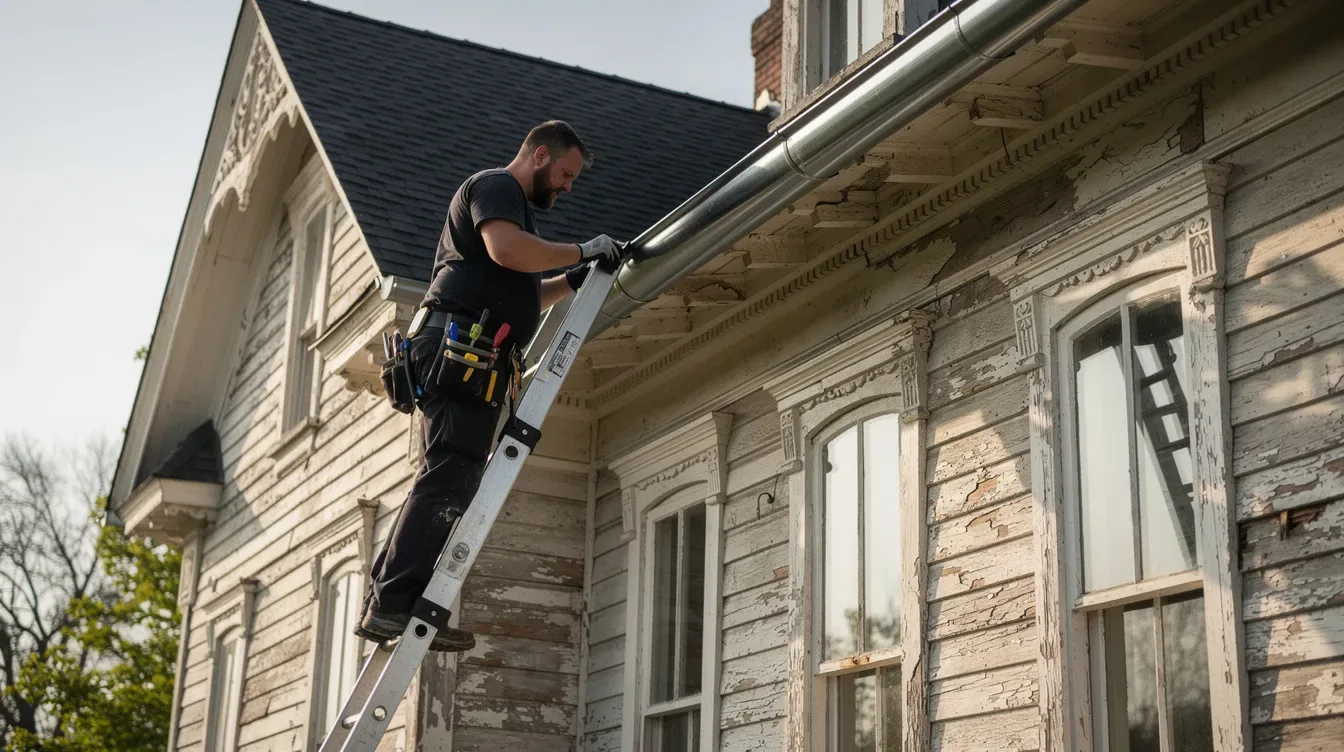
It can be done on a one story ranch. Angi’s DIY list starts with ladders, saws and fasteners. Safety gear goes on top of that. Sealant goes on the list as well. So do the hangers and connectors, and Angi puts materials at $3 to $8 a foot. Steel is harder to cut than aluminum and the cut edges are sharp, so wear gloves. A second person helps a lot with 20 foot pieces. On a three story house with slate, I’d leave it to a crew with staging. Being responsible about height costs less than a fall.
Never lean a ladder on a gutter. Never grab one to steady yourself either. A gutter isn’t built to take a person’s weight, so it bends, the hangers let go and you go with them.
What galvanized gutters cost in 2026
Angi updated its galvanized steel numbers on May 30, 2026.
| Item | Angi, 2026 |
|---|---|
| Materials | $3 to $8 per linear foot |
| Labor | $2 to $6 per linear foot, or $50 to $100 an hour |
| Installed, typical | $5 to $12 per linear foot |
| Permits, where required | $50 to $200 |
| Gutter guards | $4 to $12 per linear foot |
| Removal, delivery and cleanup | $100 to $500 |
A whole house runs about $1,000 to $2,500, with the average near $1,500. Multi story homes cost more. They need longer downspouts and more safety setup, and Angi puts a 220 to 300 foot multi story job at $2,000 to $5,000. Custom profiles and decorative finishes push it up further. Some towns require a permit, and Angi puts those fees at $50 to $200.
Angi’s broader gutter guide gives galvanized $5 to $20 a foot nationally, and our cost guide lists Angi’s Boston figure at $8.50 to $9.50. Expect Boston pricing toward the top of most ranges, since tight lots and staging add labor here and rotten fascia turns up behind old gutters often enough that it’s worth pricing in before anyone climbs a ladder.
Buying gutter parts online
You can order most galvanized parts from a supplier’s website, and for a small repair that’s often the easy way. Check a few things before anything goes in your cart.
- Match the profile, bead and size to what’s on the house. A 5 inch K style end cap won’t close a 6 inch half round.
- Check the thickness. If the listing gives a gauge, 26 is common on residential gutters and 24 is heavier.
- Read reviews shared publicly by other buyers, and look for complaints about pieces bent in shipping. Long sections dent easily.
- Some trade suppliers only show stock and pricing after you log in to a dealer account.
- Before checkout, add up the small parts. Hangers, miters, outlets, end caps and sealant are where a parts list runs short.
We don’t sell gutter parts and there’s no store on our site. If you’d rather have someone look first, that part’s free.
Keeping galvanized gutters going
Steel asks for more attention than copper. Not a lot more.
Clean them at least twice a year, in the fall after the leaves are down and again in spring. That’s the schedule on our gutter page. Angi points out that regular cleaning helps prevent clogs and rust. With steel the rust is the real reason, because a mat of wet leaves sitting in the bottom of a trough keeps the zinc damp for weeks, and the AGA says the protective film forms through wet and dry cycles.
While someone’s up there, a quick inspection should cover these:
- Drips at seams, end caps and outlets
- Rust spots, especially at cut ends, screw heads and inside corners
- Low spots still holding water a day after rain, a sign the pitch has gone
- Gutters pulling away from the fascia
If any of those are present, deal with them before winter.
Fix small things early, with products made for galvanized steel. ASTM A780, the repair standard the AGA points to, allows three repairs over damaged galvanizing. Zinc rich paint is one. Zinc based solder and sprayed zinc are the others. For a homeowner that means a zinc rich touch-up paint. Apply it to clean, dry metal over the bare spots. Loose joints get cleaned and resealed with a gutter sealant rated for metal.
Keep a simple maintenance log. Write down the date and what got cleaned. Note what got fixed too, and snap a photo. Over time that record tells you whether a rust spot is new or has been growing for three years.
Painting galvanized steel
You can paint it, just not straight off the truck. New galvanized carries oils and a slick zinc surface that paint won’t grip. Gutter Supply’s listing for galvanized half round says to let it weather a season first. The other route is a good cleaning and a primer whose label says it’s made for galvanized metal.
Watch the paint type. The AGA says oil based coatings such as alkyds need a tie coat over galvanizing to avoid saponification, a reaction with the zinc that makes paint let go. And skip the sander. A painter quoted by This Old House warns that a sander will damage the zinc coating. Painted steel can match the appearance of your trim colors, and the paint adds one more layer to protect the metal. This Old House puts repainting at every 5 to 10 years.
Keep copper away from galvanized steel
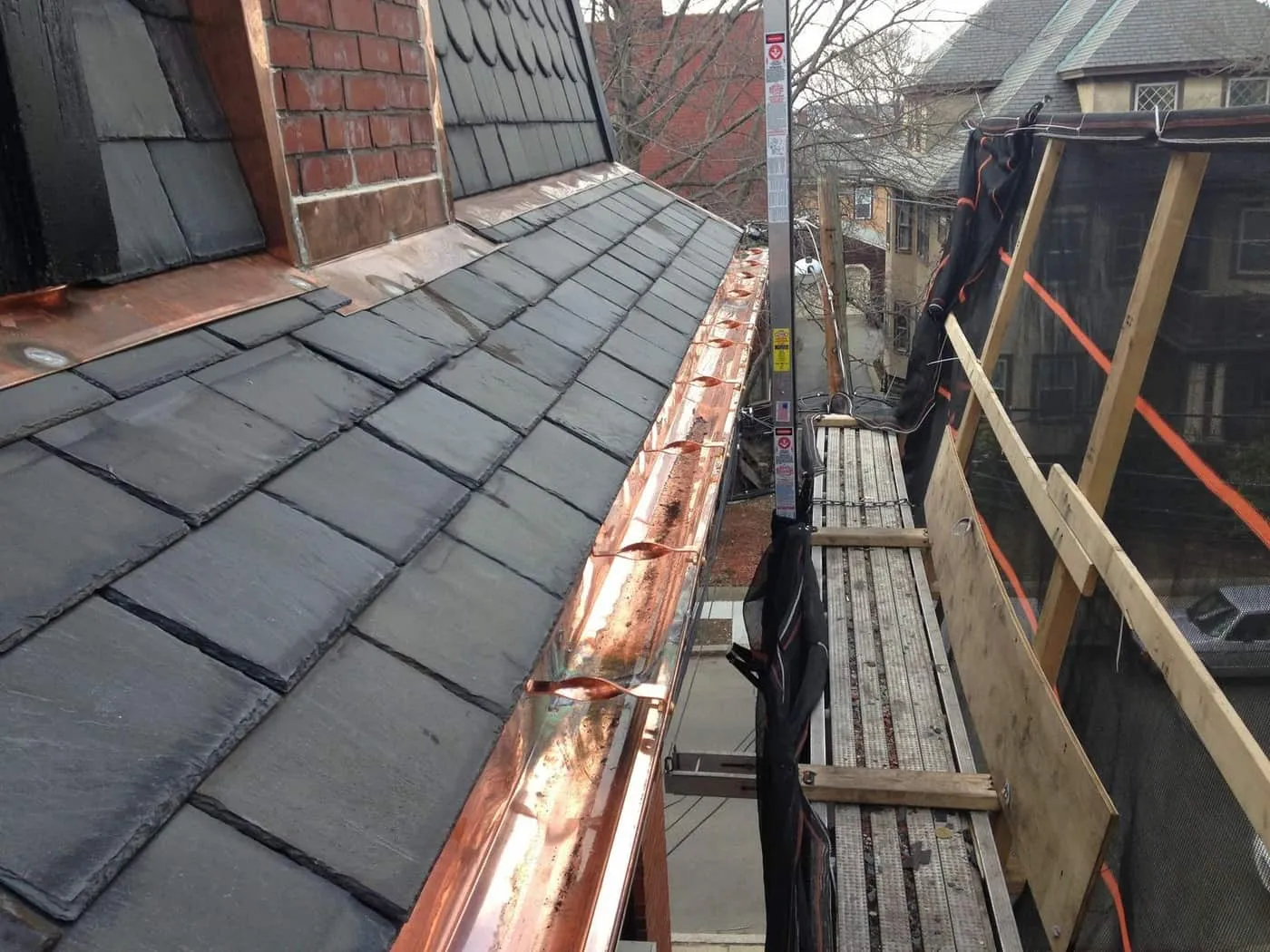
This one bites people with slate and copper roofing above the gutter. Copper and zinc touching with water between them form a galvanic cell, and the zinc loses. The Copper Development Association names aluminum and zinc as the main metals to keep from touching copper. Galvanized steel is zinc coated, so a copper valley or a run of copper flashing that sits right on a steel gutter will eat through the coating at that spot long before the rest of the gutter shows wear. Where the two have to meet, put a nonabsorptive tape or gasket between them. Our copper flashing guide covers it in more depth.
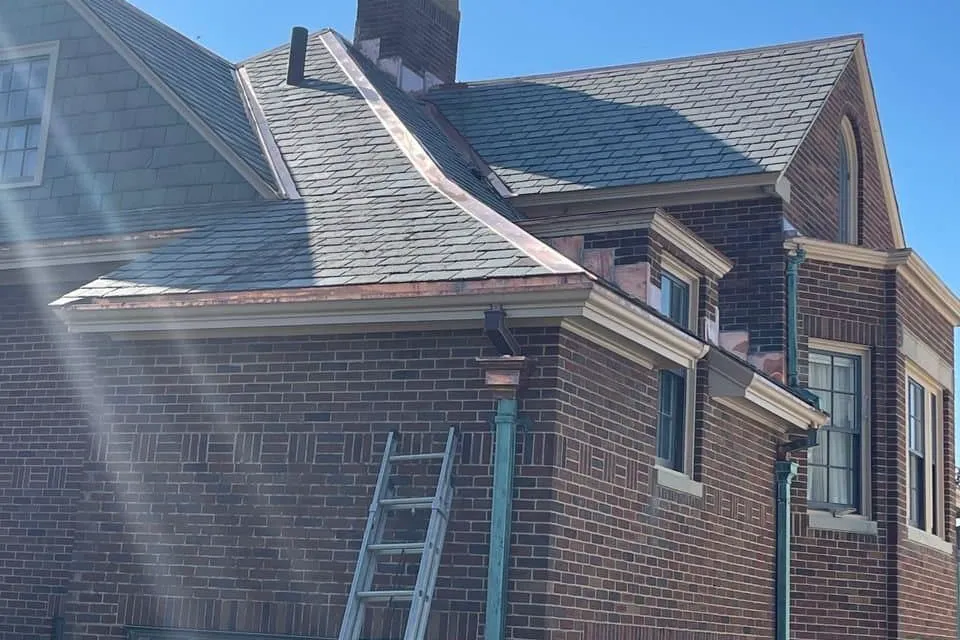
Repair or replace
Angi says minor leaks and loose sections can often be repaired for $5 to $10 a foot, and so can small rust spots. Once rust runs along several sections, or a repair costs more than half the price of a new system, replacement usually makes more sense. Holes rusted through the bottom are the clearest sign. Patching those buys a season or two.
Replacement is also the time to rethink the system. If the old gutter overflowed every storm, the fix is likely a bigger size or an extra downspout. Fresh zinc won’t solve that. If a re-roof is coming in the next few years, do the gutters with it, since the eave work overlaps and the staging only goes up once.
Frequently asked questions
How long do galvanized gutters last?
Figure on about 20 years. The NAHB life expectancy study says 20 and Angi’s gutter guide says 15 to 20. You’ll see 20 to 30 quoted too, Angi’s page on one piece gutters among them, and that’s what you get from steel that’s cleaned every spring and fall, touched up the first time bare metal shows and kept painted if it was painted to begin with. Salt air near the harbor shortens it.
Are galvanized steel gutters better than aluminum?
Stronger, yes. Steel dents less when a branch comes down or ice slides off the roof, and it carries a load of wet snow without bowing between hangers the way thin aluminum can. It’s heavier, though, so the fascia behind it has to be sound. It also rusts once the zinc is gone. Aluminum never does. Angi gives aluminum about 25 years and galvanized 15 to 20, so the stronger metal isn’t the longer lasting one. Under big trees and heavy snow I’d lean steel. If you never want to think about rust, look at copper.
Do galvanized gutters rust?
Eventually, yes. The zinc goes first. Bare steel rusts after that, so cover bare spots early with zinc rich touch-up paint.
Can you paint galvanized gutters?
Yes, with the right prep. Brand new galvanized is too slick and oily to hold paint. Let it weather a season. Or clean it well and use a primer labeled for galvanized metal. The American Galvanizers Association says oil based paints like alkyds need a tie coat over zinc. Don’t sand it. That strips the zinc.
What size galvanized gutter do I need?
Most houses take 5 or 6 inch. Seven and 8 inch are for big or steep roofs and commercial work. Roof area and pitch decide it, along with local rainfall.
How much do galvanized gutters cost?
Angi’s May 2026 guide says $5 to $12 per linear foot installed. A whole house usually lands between $1,000 and $2,500.
Talk to the owner
What your gutters need depends on the house. The roof above them, the wood behind them, where the water goes once it hits the ground. I can’t tell that from a photo.
Our gutter work is half round copper and K style aluminum, plus box gutters on older cornices. If what you’ve got only needs a repair, I’ll say so. The estimate is free. Have a look at our gutter repair page, request a free estimate, or call 617-913-1130.