Downspout Extension Guide: Picking One and Installing It
A plain guide to the downspout extension: how far it should reach, what fits which downspout, flexible versus buried pipe, and how to install one.

TL;DR: A downspout extension carries roof water away from the foundation. Four feet is the usual minimum. Flat yards and wet soil call for 6 feet or more. Measure the downspout first, since sizes differ. Then choose a flexible extender or buried pipe, or a hinged piece if you mow up to the wall. Pitch it about 1/4 inch per foot, secure it with two screws, and check it with a hose. Inspect it twice a year for clogs.
Gutters · 10 min read
An inch of rain on 1,000 square feet of roof is about 620 gallons. If the downspout drops all of that right at the wall, the soil beside the foundation takes it every time it rains, and that’s how a damp basement starts. A downspout extension is the cheap fix. It’s a length of pipe or a tray that carries the water a few feet out into the yard.
The distances people quote don’t agree, and some of the usual advice about burying pipe doesn’t fit Massachusetts. Both get sorted out below.
What a Downspout Extension Does for Your Foundation
Most gutter downspouts end in an elbow a few inches off the ground, pointing at the wall or just past it. Everything the roof collects comes out there. A downspout extension is there to direct water away from the house, so the rainwater lands somewhere it can drain off. Extending the discharge point even a few feet changes where the soil gets wet.
Without one, the soil along the wall stays wet. On a house with a stone or brick foundation, which describes a lot of older Boston houses, wet soil pushes moisture into the masonry and freeze and thaw works on the mortar. That’s water damage in the basement over time, and in bad cases a crack. Drainage that carries water away from the home’s foundation prevents basement flooding and foundation cracks, and that’s the whole argument for the part.
It can’t fix a gutter that overflows or a seam that leaks. Those are separate problems. Our gutter leaking into house post covers them.
Types of Gutter Downspout Extensions
Above-Ground Gutter Downspout Extensions
These sit on the lawn or the mulch. Bob Vila’s 2026 roundup says gutter downspout extensions of this kind range from 2 to 5 feet, and most can be linked together for more length. The common kinds:
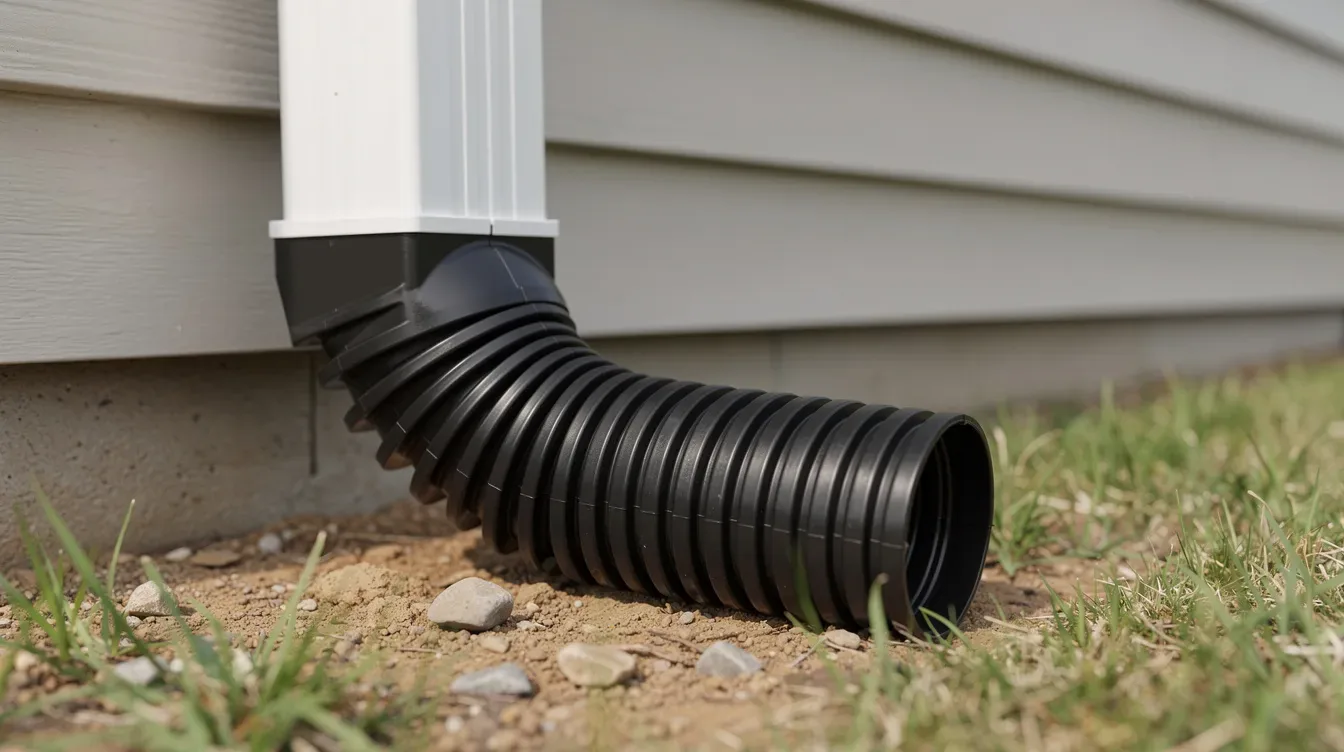
- Flexible tubes that stretch to length and bend around obstacles like steps and shrubs
- Rigid vinyl or aluminum pieces, either straight or on a hinge
- Hinged extensions that swing up so the mower can get by, which suit a yard with grass running up to the wall
- Roll-out sleeves that fill with water, unroll during a storm and roll back up when the flow stops
Low-profile extensions lie flat on the ground and can be tucked under mulch or landscaping so they’re hardly visible.
A splash block is a different thing. It’s a short tray under the elbow that keeps the water from digging a hole in the soil right at the outlet. That’s all it does. The tray is short, so on its own it’s rarely enough.
Underground Gutter Downspout Extensions
Buried versions run solid pipe from the downspout to a daylight outlet or a dry well. They’re out of sight, nothing to mow around, and once they’re in they’re permanent. They’re also the most work. It takes a trench and a continuous slope, plus an outlet that makes sense for the lot.
Flexible Downspout Extenders: Lengths and Real Products
Flexible downspout extenders are what most people buy first. Flexibility is the selling point. They’re cheap, they bend around a step, and the plain ones fit the common sizes. In Bob Vila’s 2026 test of five products the prices ran $5 to $20.
Lengths vary more than you’d guess. The table in that roundup lists the Amerimax Flex-A-Spout at 21 to 55 inches, so a little over 4 feet at full stretch. The Gutterlix is listed at 21 to 67 inches, which is 5 feet 7 inches at the most, and its listing shows two adapters and eight screws in the box. Look at features like that on any flexible piece. Bob Vila called it the longest tube in the test, and rated it 5 out of 5 for effectiveness and for value. It also held only about 10 pounds of weight before it caved in. A boot will flatten it.
So “nearly 5 feet” undersells the longest ones and oversells the shortest ones.
Flexible plastic has other limits. It can sag in the middle and collect debris, and the ribs can crack after enough winters and sun. Thicker polyethylene keeps its shape better than thin, but nobody sells any of it as crush proof.
The Amerimax Dripper Flipper is a different animal. It’s a hinged vinyl tray, listed at 30 inches long and made for 2x3 downspouts. Bob Vila rounds that to about 2 feet. It flips up for mowing and the open tray is easy to clear of leaves. It was effective at directing water away from the house in that test, but it only goes straight and only goes that far.
Downspout Sizes and How to Measure for an Extension
Rectangular downspouts on houses are mostly 2x3 or 3x4 inches. Round ones are usually 3 or 4 inches across, and you see them under half round gutters on older houses. The 2x3 size usually goes with a 5 inch K style gutter, and 3x4 turns up more often on 6 inch gutters and bigger roofs.
Measure the outside of the downspout at the bottom. Get the narrow side and the wide side, or the diameter of a round one. Look at what the elbow is made of. Then check the listing for downspout sizes before you look at anything else, and before you purchase. Some extenders fit one size only. The Dripper Flipper is listed for 2x3. The Gutterlix listing says its two adapters fit 2x3 and 3x4 downspouts as well as 3x3.
Fit is crucial here. A mismatch is the usual problem, and it’s why a connection leaks or pops loose under a heavy rain, and forcing it only breaks the piece. Our downspout diverter post has a longer sizing section for rain barrel fittings, and the same measuring habits apply.
How Far a Downspout Extension Should Reach
Distance From the House
Advice on distance doesn’t agree. Some sources say 4 feet, some say 4 to 6, and others say 5 to 10 or more.
What holds up is this. Bob Vila’s roundup gives 4 feet as the standard, with more depending on the soil and the grading. The building code doesn’t set a discharge distance for downspouts. The model International Residential Code, which the Massachusetts residential code builds on, only asks that the lot be graded to fall at least 6 inches in the first 10 feet away from the foundation. Some towns write their own minimum into local codes, often 5 feet, so ask yours.
That makes 4 feet a floor and not a target. Go to 6 feet where the yard is flat, the soil is clay that stays wet, or the basement has taken water before. The 6 to 10 foot range sometimes quoted is ideal for those cases. Buried lines that end at daylight or a dry well are commonly run 10 feet or more out. Measure to the nearest point where the ground actually slopes away from the house, not to the nearest patch of lawn, and account for beds and steps on the way.
Slope of a Downspout Extension
Slope is its own number. A drop of 1/4 inch per foot is a good target for an extension you’re laying out, which means a 4 foot piece drops 1 inch from the elbow to the outlet. For a buried drain, 1/8 inch per foot is the usual minimum, which is about 1 percent. Many installers use 1/4 where the yard allows it. The “slight” slope you hear about falls somewhere in that range.
The fall has to run in one direction, away from the house. Dips matter more than the exact figure. A low spot holds water and collects debris. In January it turns into an ice plug.
Underground Downspout Extension: Pipe and Frost
Solid PVC is the usual pipe for a buried downspout extension. It’s solid and not perforated, because you want the water carried away and not leaked back beside the foundation. Most buried downspout drains use 4 inch pipe, and 3 inch is about the floor for a short run. An adapter connects the downspout to the pipe at grade.
Pick the outlet first. Daylight on a downhill slope is the safest choice, since the pipe empties itself. On a flat lot a pop-up emitter or a dry well can work, but an emitter can hold water and freeze, and a dry well fails in clay or where the water table is high.
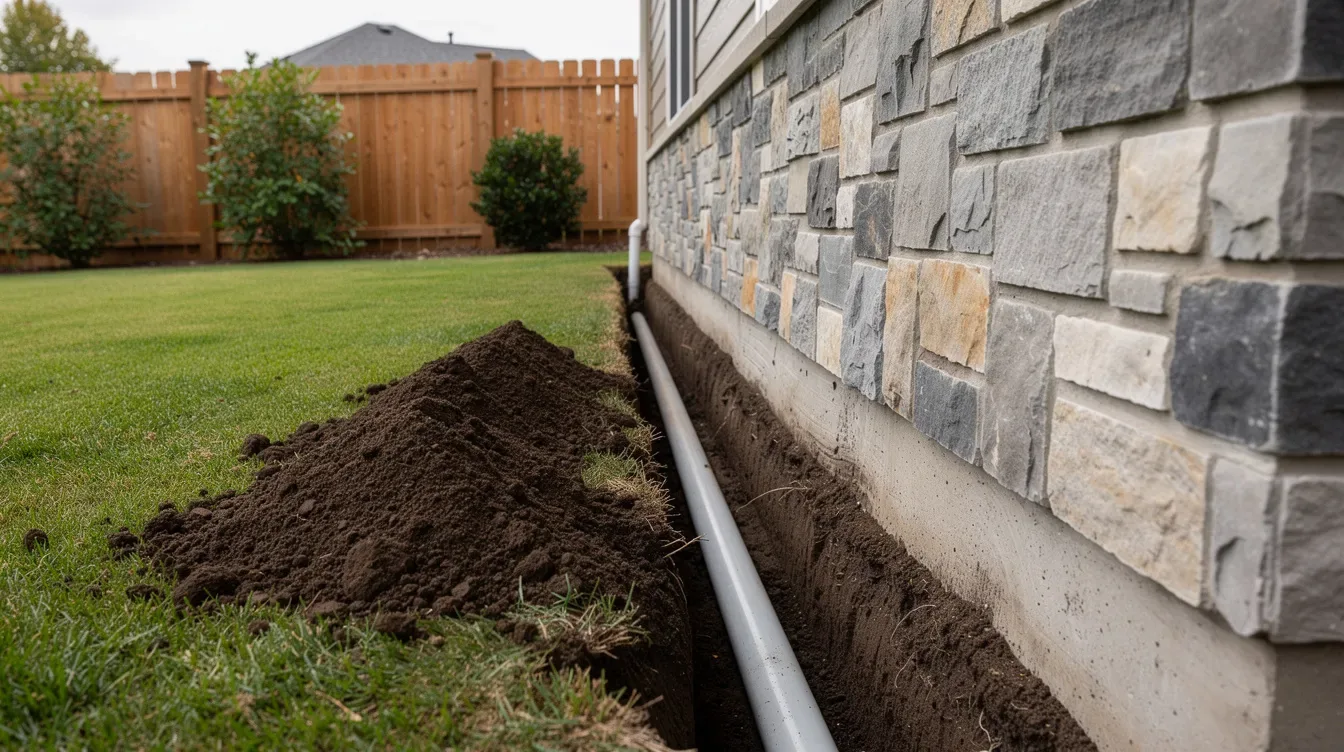
You’ll read that buried pipes belong below the frost line. In Massachusetts the frost line is 48 inches, and that’s the depth for footings. A downspout drain almost never goes that deep. Every inch of depth at the house is an inch of fall you’ve spent before the water moves. Cover of about 8 to 12 inches under lawn is the range commonly given.
What keeps these lines from freezing is that they drain completely. Pitch the whole run to the outlet, skip the low spots, and leave nothing holding water. Call 811 before you dig, and check your town’s rules on where roof water can go, since a run that ends at a lot line can create a problem next door.
Color Options and Materials for a Downspout Extension
Color options vary by product. White and brown are the usual colors, black is common too, and some lines add green or stone. Bob Vila’s table lists five colors for the Amerimax Flex-A-Spout and four for the Gutterlix, and the Dripper Flipper is sold in white and in brown.
Match the extension to the downspout, or to the ground it sits on. Black and brown disappear into mulch. A white tray on a brown downspout shows from the street.
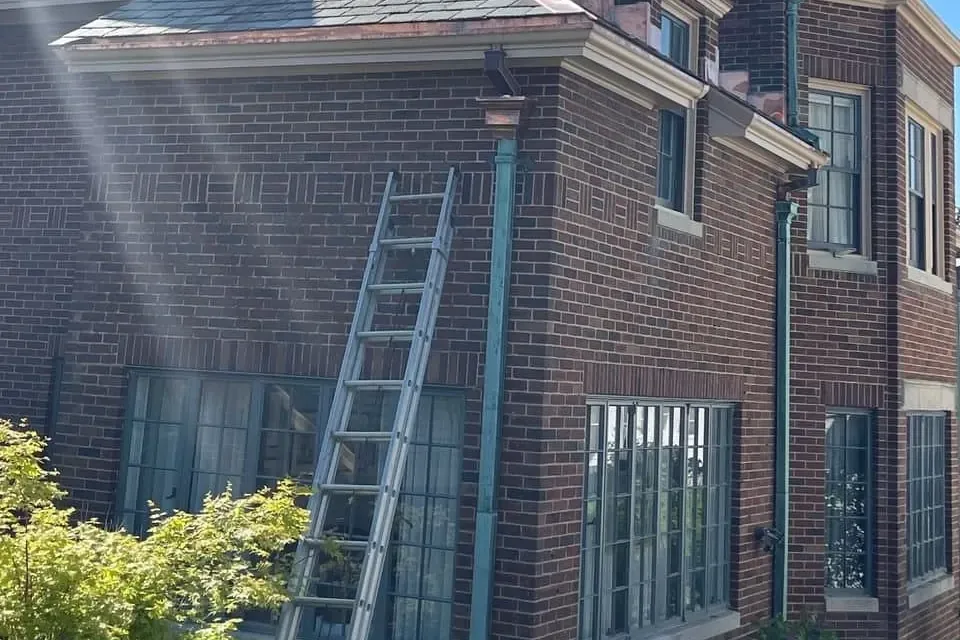
Material matters for the same reason. Vinyl and polyethylene are light and cheap. Aluminum and PVC are more durable and hold their shape better, and corrugated plastic is the easiest to crush. Rigid aluminum is ideal where there’s heavy flow or foot traffic. On a copper downspout, a plastic piece looks wrong in any color. Keep bare aluminum off copper too. Water running off copper can speed up corrosion on the aluminum, which our gutter end cap post goes into.
How to Install a Downspout Extension
Above-ground installation is a plain job for most homeowners, and the assembly is usually just the extension, an adapter and two screws. Buried work and copper tie-ins are a different story.
- Measure the downspout and pick an extension that fits that size, or one with adapters.
- Check where the water should go. Look for the nearest point where the ground slopes away from the house.
- Test-fit the piece at that point, at least 4 feet out.
- Connect the inlet over or into the elbow. Where the elbow gets in the way, cut it back to take the new connector.
- Secure it with two screws through the overlap. Stainless or galvanized screws resist rust.
- Stretch flexible pipe to full length and lay it on a steady slope with no dips. Nothing should point back at the house.
- Run a garden hose into the downspout and watch.
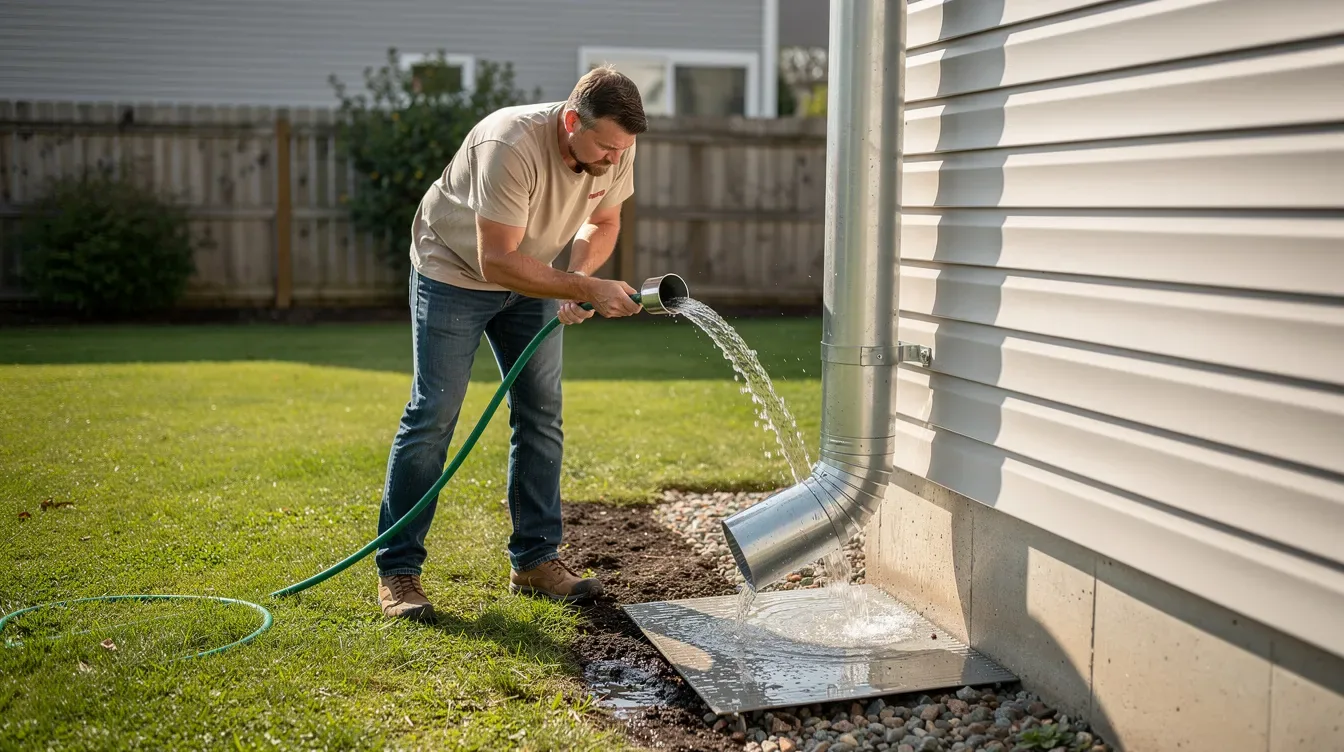
Observing the first test matters. Check the connection for leaks, see that the water drops away from the house and not back toward it, and confirm the piece stays put under flow. Then add a small gravel pad at the outlet if the soil washes out. Those tips hold for rigid and flexible pieces alike.
Downspout Extension Problems and Winter Care
These are the problems that come up most:
- An extension that is too short to clear the wall
- A run pitched toward the house, or one with a dip where water pools
- Clogs from leaves and shingle grit that washed out of the gutters
- A crushed or cracked flexible tube
- An outlet that drains onto a walk and freezes into ice
Inspect each downspout and extension at least twice a year, once after the leaves drop and once after the spring thaw. Pull leaves and debris out of the outlet end, and look for a tube that has sagged. Clean gutters regularly to prevent clogs in extensions, since everything that washes off the roof ends up in them. Our gutter guard installation post covers one way to keep debris out of the system.
In winter, check that the outlet isn’t buried in snow or ice. Heat cable made for gutters and pipes does exist, but it has to be rated for the material and installed the way the maker says, and it’s the wrong answer for most lawn extensions. Ice that keeps showing up on a walk is a sign to change where the water goes.
Call a professional for repeated basement dampness, foundation cracks, a yard that slopes toward the house, or any buried line. There’s no need to worry about a basic above-ground piece. Grading and soil are hard to judge from the surface. If you’re finally ready to buy, hold off adding anything to the cart until the downspout is measured. What’s in stock at the hardware store may not match your downspout, and pricing for the plain pieces is low, so the real cost of a wrong guess is the trip back.
Talk to the Owner
If water is pooling at the foundation, or a downspout is dumping against the wall, it’s often easier to look at it in the yard than to sort it out over the phone.
If you have questions about the gutters or the roof on your house, start at our gutter repair page or contact us. You can also call 617-913-1130.
We’re Art Slate Roofing, LLC, at 22 Clarendon St #2, Malden, MA 02148. Licensed and insured, MHIC #176393, rated 4.8 across 24 Google reviews.
Frequently Asked Questions
How Far Should a Downspout Extension Reach?
Four feet is the usual floor. Bob Vila’s 2026 test roundup gives 4 feet as the standard, with more depending on the soil and the grading around the house. Code doesn’t set a discharge distance for downspouts, only that the ground fall at least 6 inches in the first 10 feet away from the foundation, and some towns add their own minimum, often 5 feet. Six feet is a better target where the yard is flat or the soil stays wet, and buried lines that end at daylight or a dry well are commonly run 10 feet or more. Measure to the nearest point where the ground actually slopes away, not to the nearest patch of lawn, and count any beds or steps along the way.
What Are Flexible Downspout Extenders Good For?
They’re cheap, they stretch to length, and they bend around steps and shrubs. In the same Bob Vila roundup the products ran $5 to $20 and from 21 inches closed to 67 inches stretched out. The trade-off is strength. The longest one tested held about 10 pounds of weight before it caved in, so a flexible tube won’t survive a mower wheel or a boot. It also sags and holds leaves if it isn’t pitched, and it can crack after enough sun and winters.
What Downspout Sizes Are Common?
Rectangular downspouts on houses are mostly 2x3 or 3x4 inches, with 2x3 usually paired with a 5 inch K style gutter. Round ones are usually 3 or 4 inches across, and you see them under half round gutters on older houses. Measure the outside of the downspout at the bottom before you look at any extension, on the narrow side and on the wide side. Some extenders fit one size only, like the Amerimax Dripper Flipper at 2x3, and some ship with adapters for two or three.
Do Downspout Extensions Need to Be Buried Below the Frost Line?
Massachusetts sets the frost line at 48 inches, and that number is for footings. A downspout drain is almost never buried that deep, since every inch of depth at the house is an inch of fall you’ve already spent. Cover of about 8 to 12 inches under lawn is the range commonly given. What keeps a buried line from freezing is that it drains completely, so pitch it all the way to daylight and leave no low spot holding water. Call 811 before you dig.
Can You Use Heat Cable on a Downspout Extension?
Self-regulating heat cable made for gutters and pipes exists, and makers sell it for de-icing downspouts. Instructions matter more than the idea. It has to be rated for the material it touches, fastened the way the maker says, and run on a protected outlet. It uses power all winter too. For a flexible plastic extender on the lawn it’s usually the wrong tool, and it’s easier to keep the run pitched so it empties after every rain. Check the maker’s rating before buying any.
What Color Options Do Downspout Extensions Come In?
White and brown are the usual colors, black is common too, and some lines add green or stone. The color options vary by product. Bob Vila’s table lists five colors for the Amerimax Flex-A-Spout and four for the Gutterlix, and the Dripper Flipper is sold in white and in brown. Pick the color of the downspout or of the ground the piece sits on. Black and brown fade into mulch, and a white tray on a brown downspout shows from the street.