Micro Mesh Gutter Guards: Sorting the Specs From the Sales Pitch
A Boston roofer on micro mesh gutter guards: what fine stainless mesh stops, which specs belong to single brands, and why copper gutters need care.

TL;DR: Micro mesh gutter guards are fine stainless steel screens in a metal frame that cover the gutter. They stop pine needles and shingle grit that coarser guards let through. Debris still collects on top, so they cut gutter cleaning instead of ending it. Figures like 75 microns or 60 gallons a minute belong to single products, not the whole category. Check the fit, the fasteners, the metal touching copper, and what the warranty leaves out.
Gutters · 13 min read
Micro mesh gutter guards get sold as the last word in gutter protection. Some of that is fair. A fine screen keeps out stuff a punched panel can’t, and if you live under white pines you know how much of that stuff there is.
A lot of what gets repeated about them comes off one company’s spec sheet, though. Then it shows up online as if it were true of every product. This post sorts the general facts from the brand claims. When a number belongs to one product, I name the product. When I couldn’t find a source I’d trust, I left the claim out.
Whether you buy micro mesh gutter guards or not, the gutter under them has to be sound first.
What Micro Mesh Gutter Guards Are
A micro mesh guard is a woven screen held in a frame that covers the top of the gutter. The screen is usually stainless steel. The frame is usually aluminum. Rain runs off the roof and drops through the mesh. Leaves and needles stay on the surface.
The word micro has no fixed meaning. A retailer’s listing for LeafBlaster Pro, a Gutterglove product, gives 75+ micron filtration. Leaf Solution, a Virginia maker, lists 440 micron openings on its standard guard and still calls it micro mesh. That’s almost six times wider. Both get sold under the same name, so read the opening size on the product sheet, not the label on the box.
For scale, 75 microns is 0.075 millimeters. That’s the opening of a standard No. 200 test sieve. Asphalt shingle granules are sized more like coarse sand, so a screen that fine blocks shingle grit without much trouble. The bigger openings on other micro products stop most of it too. Pollen gets through almost anything.
How a Micro Mesh Gutter Guard Moves Water
Water clings to metal. When rain sheets off the roof and hits the mesh, it wraps around the wires and gets pulled down through the openings. The debris is left on top. Makers build on that with raised ribs or a V-bend. The idea is to slow the water down and steer it into the trough.
Those shapes matter most in heavy rain. On a steep roof the water picks up speed and can jump a flat guard. Then it lands in the shrubs instead of the gutter. People call it overshoot, and it’s the usual complaint about flat mesh. A raised profile gives the water something to catch on.
Each company says its own bend handles intense downpours. I couldn’t find independent tests that compare one bend against another, so I’d treat those as the maker’s claims.
Flow Rate Claims and Heavy Rain
Leaf Solution says both of its micro mesh lines handle up to 60 gallons per minute. That’s their rating for their products. Online you’ll also see 60 gallons per minute per linear foot passed around as a general fact. I couldn’t find a manufacturer that claims that. A retailer’s page for LeafBlaster Pro rates it a different way, at 28+ inches of rain per hour. You can’t line those two numbers up against each other.
You can check any flow rate against your own house. One inch of rain on one square foot of roof is about 0.62 gallons. Say 800 square feet of roof drains into one gutter run. In a storm dropping 3 inches an hour, about 25 gallons a minute reaches that gutter.
The guard has to pass that water flow with some leaves already sitting on it. Gutter guards must match the volume of water during heavy rainfall, or the overflow goes over the front lip. So do the gutter and the downspouts. A guard can’t give a gutter capacity it doesn’t have, and you still have to maintain the gutter itself.
Micro Mesh vs a Perforated Gutter Cover or Leaf Guard
A perforated panel, sometimes sold as a gutter cover, is a sheet of aluminum with punched holes. A leaf guard with larger openings like that keeps leaves out. Pine needles and shingle granules can still slip in, and they build up at the bottom of the gutter where nobody sees them. Micro mesh has smaller holes. The grit stays on top, where you can at least see it.
Perforated panels usually cost less. Bob Vila’s 2023 cost guide draws on figures from Angi and HomeAdvisor. It puts perforated aluminum at $0.50 to $1.50 a linear foot and micro mesh at $2 to $4. Those numbers are a few years old. The same guide lists LeafFilter at $15 to $39 a linear foot, so the price spread is wide.
No guard is maintenance free, and that has been argued in court. In Zilinsky v. LeafFilter North, a class action filed in federal court in Ohio in 2020, owners said the product let debris collect on top and let rain run over it. LeafFilter denied the allegations. The case settled in 2023 with reimbursements of up to $200 or cleaning vouchers for owners who qualified.
Pine Needles and Other Fine Debris
Boston debris changes with the season. In spring the oak tassels come down, and the maple seeds come later. Pine needles fall through much of the year, with the heaviest drop in autumn. White pine needles are long and thin, and they work into gaps and weave into mats.
Micro mesh is specifically engineered for fine debris like that. It’s where the mesh earns its price over larger openings, especially under pine trees. The screen keeps small debris out of the trough too, seed pods included. On a spec sheet, look at the opening size, not the wire diameter.
The catch is that the needles still land on the surface. A well made guard lets them dry, and then the wind takes most of them. A guard laid dead flat under heavy pines is different. It can hold a wet mat that somebody has to brush off. Pitch makes a real difference here. A slight slope toward the front lip helps debris shed, and how well debris sheds is what decides how often you’re back on a ladder.

Key Features of Mesh Gutter Guards
Start with what the screen is made of. Stainless steel mesh is the norm on good products. Some sellers call theirs surgical grade. That isn’t a standard designation, so ask for the actual grade number. Waterlock Micromesh, sold by Art of Gutter in New Jersey, lists type 304 mesh, for example. Search for waterlock micromesh and you’ll find that spec on the product page.
Next, the frame. Waterlock lists a 0.027 inch aluminum frame. Leaf Solution lists a painted aluminum body with a reinforced back bend. Makers say a stiffer frame resists sagging between hangers when wet snow sits on it. That makes sense, but it’s their claim. Aluminum also holds up in sunlight far better than plastic. Plastic guards get brittle and break over the years. The frame material and its construction matter as much as the screen. Check the coating on the frame if color matters on your house.
Then look at how the mesh is held. Waterlock calls its method Z-Bend Technology, a fold that crimps the mesh into the frame with no adhesive. Leaf Solution hems its mesh into the body. Either way, mechanical crimping means there’s no glue to let go later. Waterlock also sells an Overlap Connection System, where a half inch of mesh overlaps the next section so the run has no gaps. Those are one company’s branded features, so don’t expect them on other brands.
Fit is the last of the key features. How a guard is constructed has to match your gutter. Most guards come in 5 and 6 inch widths for K style gutters, often listed as k style or K-style. Beyond that it varies. Waterlock says its 6 inch guard fits 6 inch K style and box gutters and doesn’t fit half round. A retailer lists LeafBlaster Pro for 5 and 6 inch K style. The same listing adds fascia mount systems and 6 inch half round. When a product says it fits all gutters, it means all the ones that maker lists.

Stainless Steel and Corrosion Near the Coast
Plenty of Greater Boston sits close to salt water, and salt is hard on metal. Type 316 stainless contains molybdenum, and the Nickel Institute and the British Stainless Steel Association both describe it as more resistant to chloride pitting than 304. Neither one says 316 can’t corrode. It still can.
The coast shows up in warranties too. LeafBlaster Pro’s written warranty is 40 years on parts. Within five miles of a shoreline it drops to 10, and it excludes salt spray. A lot of houses in and around Boston fall inside that line. If corrosion resistance matters where you live, check the grade of the steel and the coastal terms both.
Copper Gutters Need a Different Guard
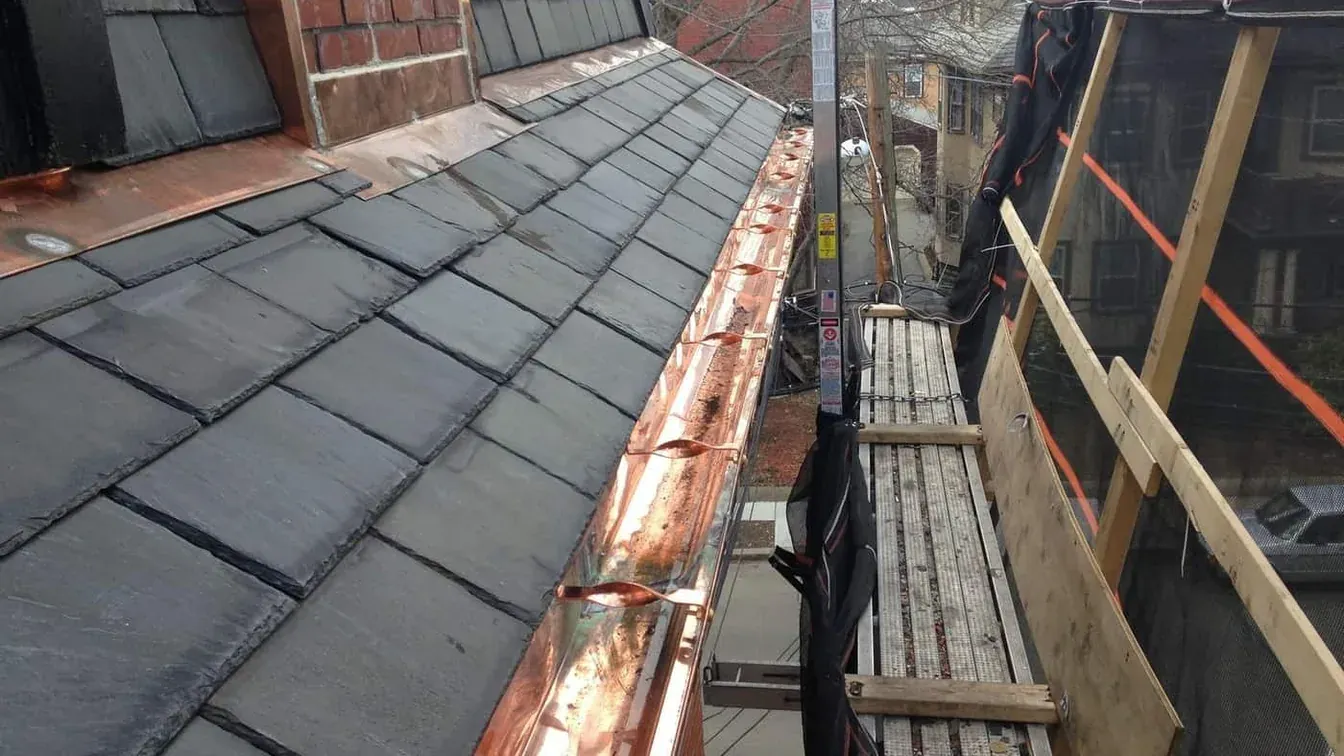
This is where a guard can do real harm. The Copper Development Association warns against wet contact between copper and aluminum, and it says copper runoff can corrode aluminum below it. An aluminum framed guard sitting in a copper gutter is that exact setup. LeafBlaster Pro’s warranty is void if the product is installed in contact with copper.
Some makers sell copper versions. Waterlock lists copper micromesh guards, for one. If you put any guard on copper, everything touching the gutter should be a metal the CDA lists as compatible with copper. Stainless is on that list. So are brass and bronze.
The National Park Service makes a related point in its brief on slate roofs. Once a metal is chosen, it should be used throughout the flashings and gutters, because mixing dissimilar metals can cause rapid galvanic corrosion. You can read it in Preservation Brief 29.
Picking an Installation Method
There are three common ways a guard gets attached, and the installation method can matter more than the brand.
Top mount guards sit on the gutter and screw to the front lip, which some people call the gutter lip. Waterlock’s sheet calls for 3 to 4 screws per section along the front edge, with optional screws at the back for extra hold in snow. A fascia mount guard fastens its back edge to the fascia board above the gutter, so the roof isn’t touched. The third type tucks the back edge under the first course of shingles.
Screws or snap-in is the other choice. Bob Vila’s guide says snap-on guards go in faster and screw-on guards take more work but tend to last longer. In wind it’s simple physics. A guard held by screws is harder to lift off than one held by tension. That counts more on a two-story house, where a guard that pops loose falls a long way.
Position matters too. A guard in the wrong position can make debris accumulate faster. A guard set with a slight forward tilt sheds better than one laid flat. It also shouldn’t push the gutter out of pitch.
Under the Shingles, or Not
You’ll read that putting a guard under the shingles doesn’t void the shingle warranty. That’s too broad. GAF’s technical bulletin on gutter covers says covers installed by professionals using good roofing practices almost never affect its warranty. It also says to avoid covers that call for fasteners through the shingle. Covers that go under the underlayment are on its list to avoid too. And its warranty doesn’t cover damage from installing the cover. Other shingle makers have their own terms, so read yours.
Slate is a separate case. There’s no shingle warranty to protect, but slate breaks when it’s pried up, and it’s hard to match on an old roof. A slate roof can last 75 to 150 years. It’s not worth risking for a gutter guard. On slate I’d want a guard that fastens to the gutter or the fascia and never touches the stone.
DIY or a Pro on a Two-Story House
Big-box stores stock mesh gutter guards in DIY lengths, and on a one-story ranch with a short ladder plenty of homeowners put them in themselves. Waterlock says its product can go in DIY, though it recommends a pro.
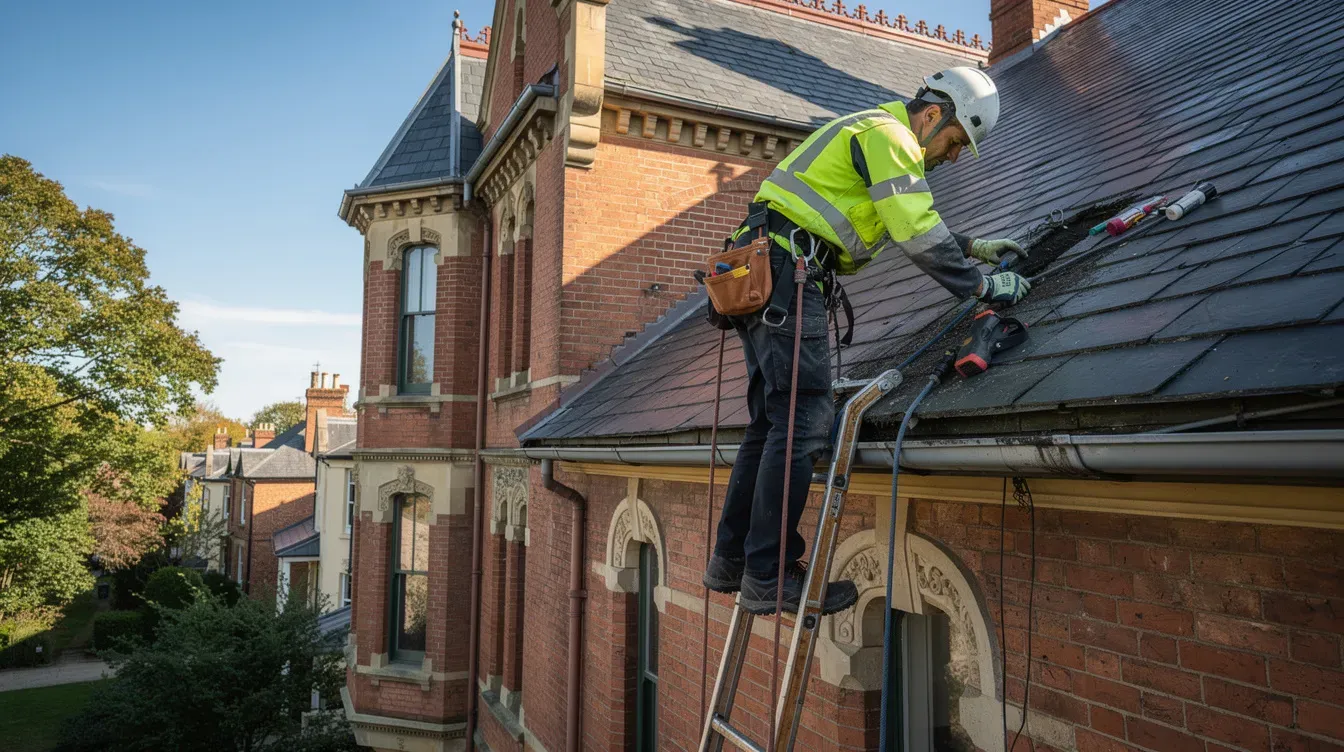
GAF suggests homeowners not install gutter covers unless they have the manufacturer’s instructions, and says a professional who knows good roofing practices may be the better route. On a two-story house I’d agree. You’re on an extension ladder holding 5 foot sections and a drill, working at an angle. Some guards also need tools most people don’t own. Careful contractors set ladders so they don’t bear on the gutter, and they secure them. That’s the part I’d worry about more than the guard itself.
Warranties: Read the Terms
Gutter guard warranties vary a lot by manufacturer and product. I read the written terms for three of them, and they don’t line up.
LeafBlaster Pro has a 40-year limited warranty on parts, and it transfers to the next owner. It doesn’t cover labor, including taking guards off and putting them back. The exclusions list is long. Windstorms are on it. So is excessive snowfall. Moss is excluded, and so is what the company calls improper maintenance.
Waterlock describes its warranty as a lifetime transferable 35-year warranty. Leaf Solution says lifetime limited. Those phrases can mean different things, so ask for the written terms.
Some installers sell their own no-clog warranty on top of the manufacturer’s. So it’s not true that no warranty ever covers debris on top. Most parts warranties don’t, though. Whichever product you’re looking at, read what’s covered before you sign, and ask who pays for labor if a section fails.
Will Gutter Guards End Gutter Cleaning?
They cut it down. They don’t end it. Debris sits on the surface instead of rotting in the trough, and on a micro mesh gutter it’s easy to see. That’s easier to deal with, and it’s still work.
Plan on looking the guards over at least once a year, and again after the leaves drop if you’re under big trees. Most of it can be brushed off. Some of it you can wash off with a hose from a safe spot, or blown off by the next storm once it dries. Once a year or so, pull up one section. Look for fine grit underneath. Micro mesh needs less maintenance than an open gutter, but it still needs some.
If you’d rather not deal with guards at all, the other route is gutter cleaning twice a year on a gutter that’s pitched right. Plenty of homeowners never put guards on at all.
Ice Dams and Snow Load
Gutter guards don’t stop ice dams. University of Minnesota Extension explains that ice dams start with heat leaking into the attic, which melts the snow on the roof. That water refreezes at the cold edge. Air sealing and insulation fix it. A guard can keep a gutter from going into winter packed with leaves, and that’s about the extent of it.
Snow is a mixed story. Waterlock says its guard can take heavy snowfall without buckling. LeafBlaster Pro’s warranty excludes blizzards and excessive snowfall. Neither one tells you much about how a guard handles a winter of ice at the eave on your house.
Several makers say a covered gutter keeps birds and squirrels from nesting in it. A closed top would do that. I couldn’t find an independent test, so I’d treat it as a side benefit and not the reason to buy.
When Gutter Protection Is Worth It
Guards make the most sense for customers whose trees hang over the roof and the gutters are hard to reach. Under pines, micro mesh is the type that stops the needles. On an open lot with a one-story roof, cleaning is often cheaper. Our post on whether gutter guards are worth it runs the numbers, and the gutter guard installation guide covers the steps. For copper gutters specifically, see our post on copper gutter guards.
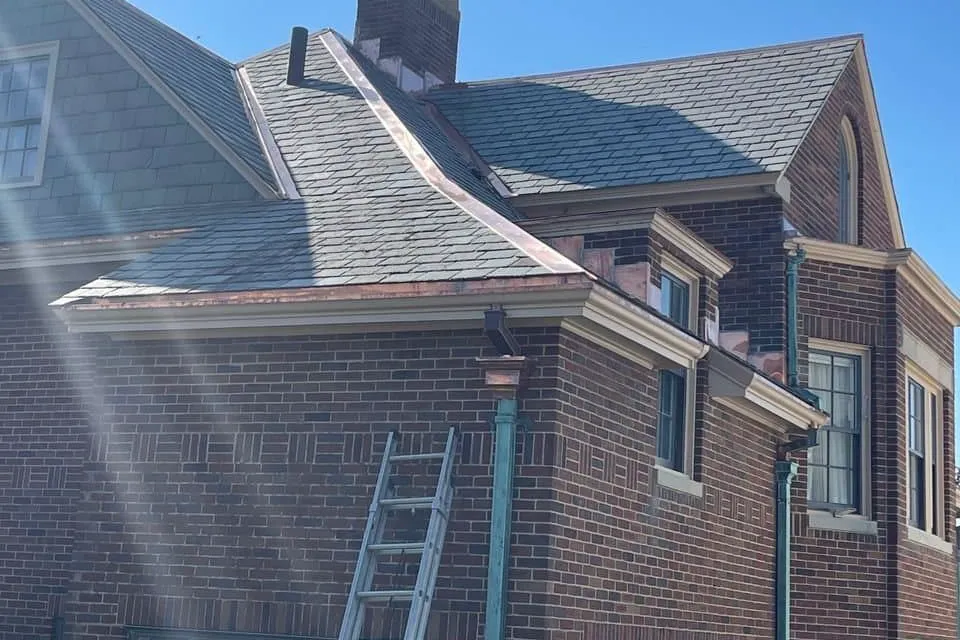
Whatever goes on top, the gutter underneath comes first. A guard on a sagging or leaking gutter just hides the problem until there’s water damage on the fascia or the foundation. Angi puts copper gutters at 50 to 100 years, and a guard shouldn’t shorten that.
Talk to the Owner
Whether micro mesh makes sense depends on the trees over your roof and the gutters under it. That’s easier to judge standing in the yard than reading a spec sheet.
If you have questions about the gutters or roof on your house, see our gutter repair page, contact us, or call 617-913-1130.
We’re Art Slate Roofing, LLC, at 22 Clarendon St #2, Malden, MA 02148. Licensed and insured, MHIC #176393, rated 4.8 across 24 Google reviews.
Frequently Asked Questions
Do Micro Mesh Gutter Guards Keep Out Pine Needles?
Yes. The openings are far smaller than a needle, so the needles stay out of the trough. They still land on top of the screen, and under a big white pine they can mat down on a flat guard and sit there for weeks until wind or a brush clears them off.
Will Micro Mesh Overflow in Heavy Rain?
It can. Fast water off a steep roof sometimes jumps a flat guard. A screen half covered in pollen passes less water too, which is why a guard pitched slightly toward the front tends to do better in a downpour than one laid dead level. Enough downspouts for the roof area matter just as much as the guard.
Can I Put Micro Mesh on Copper Gutters?
Only with parts that are safe next to copper. Wet copper touching aluminum causes corrosion. One maker voids its warranty if the guard touches copper at all.
Does a Gutter Guard Void a Roof Warranty?
It depends on how the guard goes on and whose shingles you have. GAF says most covers installed by a professional using good roofing practices don’t affect its shingle warranty, but it warns against any cover that needs fasteners through the shingles or goes under the underlayment. GAF also won’t pay for damage the install itself causes. Other shingle makers write their own terms.
How Often Should Micro Mesh Be Cleaned?
Look the guards over at least once a year. Under heavy trees, take a second look after the leaves drop in the fall and brush off whatever is sitting on top. Once in a while, lift a section to check for grit underneath.
Which Guards Fit Half Round Gutters?
Fewer than you’d think. One maker says its 6 inch product fits K style and box gutters but not half round, while a retailer lists another brand for 6 inch half round. Match the profile and width of your gutter to the product sheet before you buy anything.